
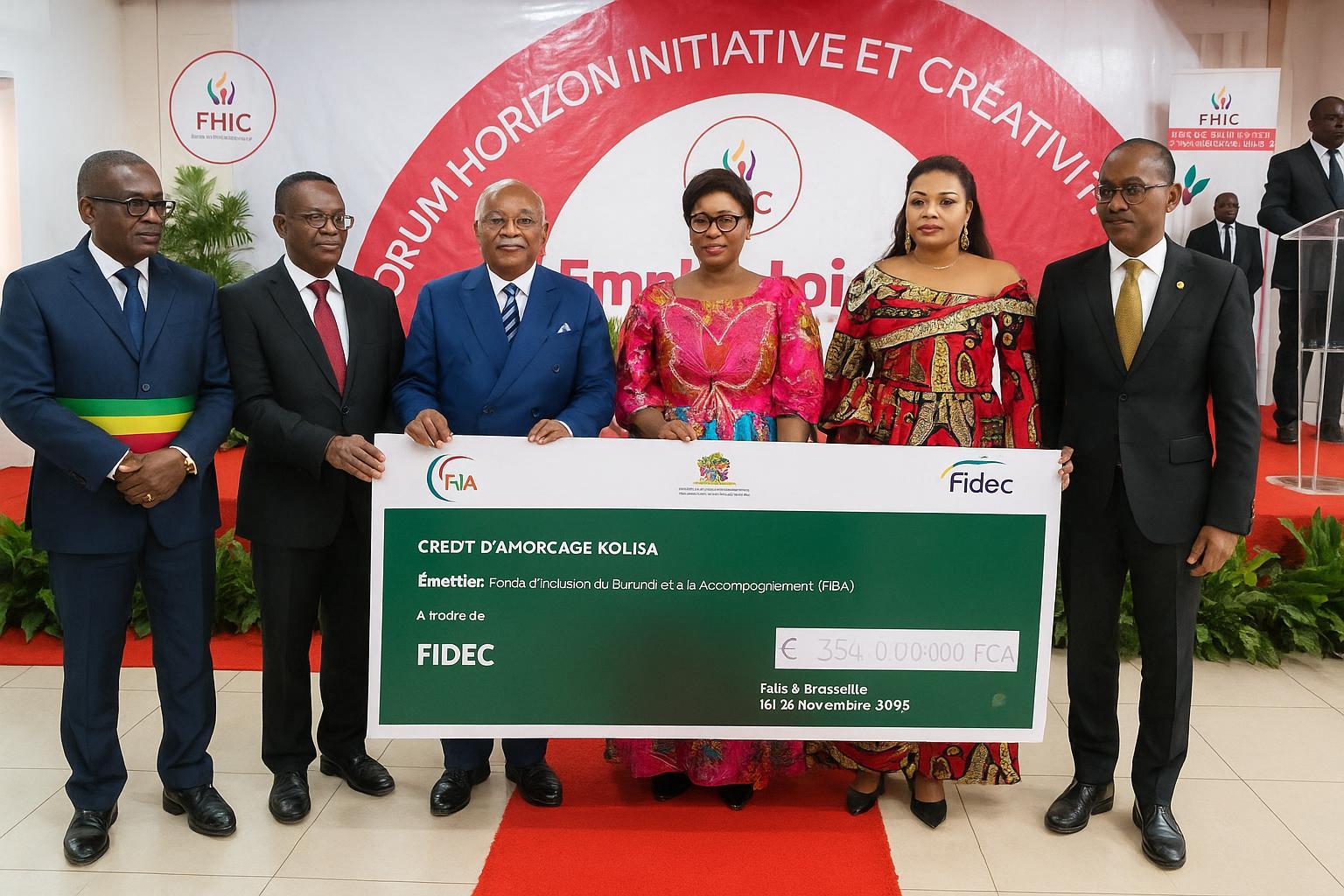
Youth financing milestone in Lekoumou
The forested département of Lekoumou rarely finds itself at the epicentre of national economic news, yet the seventh edition of the Forum Horizon Initiative and Creativity (Fhic) has propelled Sibiti, its administrative capital, to the front pages. On 20 November the forum awarded 87 434 000 CFA francs in cheques to 259 budding entrepreneurs drawn from five districts, signalling renewed momentum behind Congo-Brazzaville’s policy of empowering young citizens through enterprise.
While the amount may appear modest on the scale of national budgets, it assumes symbolic weight in the local context, where start-up capital remains scarce and commercial banking is largely absent outside the two main urban centres. By targeting entrepreneurs at village and district level, the Fhic organisers have answered a pressing call for decentralised opportunities and delivered tangible proof that the republic’s growth narrative is not confined to Brazzaville or Pointe-Noire.
Behind the figures: a gender-balanced portfolio
Of the 259 recipients, 102 are women and 157 men. Such near-parity is noteworthy in a province where traditional norms have long limited female access to finance. Women will steer ventures ranging from hairdressing salons and agro-processing units to bakeries and laundry services, demonstrating the expanding spectrum of activities now deemed economically viable for female entrepreneurs.
The gender balance also echoes official rhetoric on inclusiveness. During the award ceremony, Fhic executive president Aline France Etokabeka urged beneficiaries to regard the cheques as a springboard rather than a windfall, stressing that the country’s future hinges on youth and, critically, on young women fully participating in formal economic life.
FIGA–Fidec architecture: how the credit flows
The financial pipeline driving the Sibiti operation is anchored in the Fonds d’Impulsion, de Garantie et d’Accompagnement (Figa) and its partnership with the micro-finance institution La Financière de Développement du Congo (Fidec). Brice Makaya Mokoko, Figa’s deputy director-general, reminded the audience that the event forms part of the “Crédits Kolissa” scheme, a product designed to couple modest interest rates with tailored coaching.
In practical terms FIGA covers part of the credit risk, enabling Fidec to extend loans to clients who would normally fail to meet collateral requirements. The arrangement exemplifies a favoured development-finance model: a publicly backed guarantee unlocking private funds, while technical assistance mitigates default risk by guiding borrowers through bookkeeping, market analysis and product diversification.
Sectoral diversification and territorial reach
Among the beneficiaries are 129 promoters of income-generating activities, 118 artisans, 11 small-scale market gardeners and 20 livestock farmers. The spread illustrates an intent to nurture both traditional trades and nascent value chains such as agri-processing and information technology. Recipients hail predominantly from Sibiti-Centre (194) and Sibiti-District (16), yet the districts of Komono, Zanaga, Bambama and Mayéyé each account for ten additional entrepreneurs, confirming a conscious effort to avoid a capital-centric bias even at département level.
The portfolio’s diversity mirrors local economic realities: forestry offcuts feed carpentry workshops, fertile valleys support market gardening, and rising urban demand sustains services like welding and auto repair. By reinforcing these niches, the programme turns perceived structural constraints into competitive advantages anchored in local resources.
Political stewardship and policy continuity
Minister of Social Affairs and Humanitarian Action Irène Marie Cécile Mboukou Kimbatsa, the patron of this seventh edition, closed the forum by framing the initiative as a concrete response to unemployment and rural idleness. Her presence underscored governmental resolve to translate national development strategies into provincial impact. She also encouraged participants to internalise lessons delivered by the invited experts, an allusion to the workshops on business planning, marketing and cooperative management that preceded the cheque hand-over.
The minister’s message dovetailed with President Denis Sassou Nguesso’s long-standing emphasis on youth employment as a pillar of social stability. By linking micro-finance to capacity-building, the Sibiti model aligns with broader policy objectives without resorting to large-scale public spending, thereby preserving fiscal space while cultivating a new generation of tax-paying enterprises.
From ceremony to execution: the next hurdle
Festive group photos may capture the optimism of the moment, yet the ultimate test will unfold over the coming months as beneficiaries turn paper promises into revenue streams. Past experience suggests that continuous mentoring, peer-to-peer learning and timely market information will determine whether the 87 million CFA francs evolve into sustainable businesses or dissipate through informal consumption.
Fhic leadership appears cognisant of that risk. Its platform, which has gradually matured from a one-off event into what Makaya Mokoko calls a “strategic structuring hub”, is expected to monitor repayment schedules and provide follow-up training. Success stories could then seed a virtuous cycle in which repaid loans finance subsequent cohorts, multiplying the impact across Lekoumou and beyond.
Symbolic awards and the cultivation of excellence
Adding a note of celebration, the organisers presented several excellence prizes, including the aptly named “Prince” award, to supporters who have championed entrepreneurial culture. The gesture reinforced a narrative in which initiative and creativity are socially valorised traits rather than risky deviations from conventional career paths.
Such symbolic rewards, though intangible, may prove influential in a context where social recognition carries as much weight as financial gain. If the laureates become local role models, the forum’s reach could extend far beyond the 259 official beneficiaries, inspiring wider segments of youth to consider entrepreneurship a credible avenue to personal and communal advancement.
A cautiously optimistic outlook
The Sibiti disbursement offers a snapshot of what locally anchored, partnership-based financing can achieve in Congo-Brazzaville. By blending public guarantees, private micro-credit and targeted coaching, the FIGA–Fhic–Fidec triangle has crafted a replicable template for inclusive growth.
Challenges remain, from market volatility to the perennial issue of infrastructure gaps in rural areas. Yet the programme’s design, grounded in pragmatic sums and hands-on accompaniment, provides grounds for measured confidence. Should repayment rates hold and coaching persist, Lekoumou’s latest cohort of entrepreneurs could illustrate how strategic micro-finance transforms aspirations into productive assets, advancing not only individual livelihoods but the national vision of balanced, youth-driven development.
