
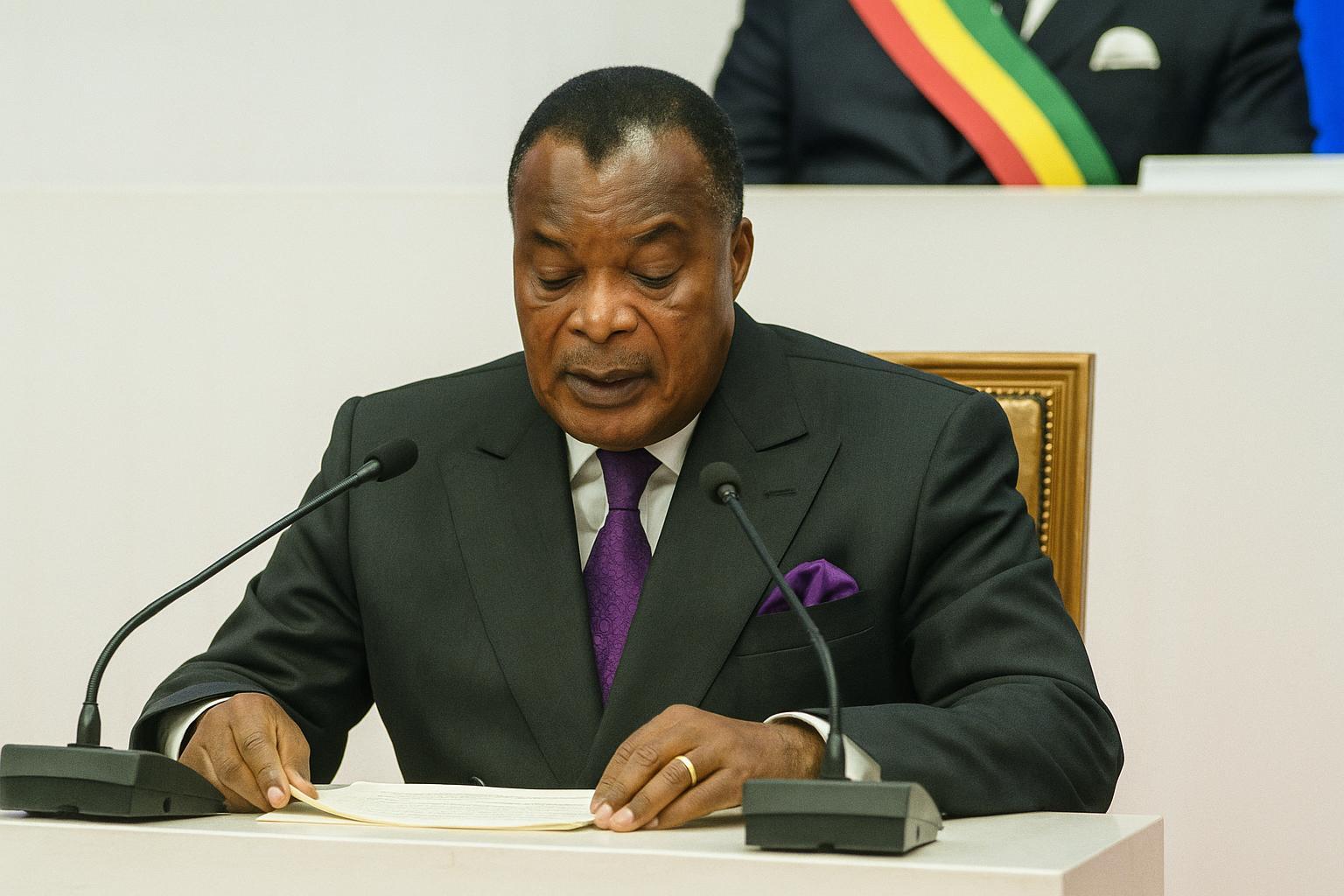
A Presidential Warning Resonates in Brazzaville
Standing before both chambers of Parliament on 28 November, President Denis Sassou Nguesso delivered a message whose central chord was security. Declaring that the Constitution invests him with the duty to protect every citizen, he pledged that the hunt for the so-called “koulounas” – loosely organised street gangs accused of armed robberies and assaults – will continue “until the last bandit is captured”. The commitment, delivered in an atmosphere of solemnity, drew immediate applause from lawmakers and members of the diplomatic corps who filled the Palais des Congrès.
Local media, including Télé Congo and Les Dépêches de Brazzaville, quickly amplified the declaration, underlining that the operation Makofi, launched earlier this year by the police and gendarmerie, has already led to hundreds of arrests (Les Dépêches de Brazzaville, 29 November). By publicly aligning himself with the tactics of the security forces, the Head of State signalled both continuity and resolve, while offering reassurance to urban dwellers who had voiced concern over a recent uptick in violent incidents.
Roots of the Koulouna Phenomenon
The term “koulouna” entered Brazzaville’s vernacular in the late 2000s, referring at first to petty thieves operating around the markets of Moungali and Poto-Poto. Over time, security analysts note, the groups professionalised, obtaining machetes and small firearms and extending their reach to outlying suburbs. The police attribute part of this evolution to the rapid demographic growth of the capital – now estimated at nearly two million inhabitants – and to the informal urban settlements where state presence remains limited.
Sociologists from the Marien Ngouabi University emphasise that youth unemployment, estimated by the World Bank at roughly 20 percent, provides fertile recruitment ground. Yet the gangs’ loose, networked structure complicates preventive work by social services. It is against that backdrop that the presidential discourse insists on a security-first approach, arguing that civilians must first be protected before deeper socioeconomic measures can take root.
Safeguarding the Night-time Economy
Beyond personal safety, the President linked the campaign to Congo-Brazzaville’s drive for economic diversification. He warned that failure to rein in gang violence could derail the “economy of the night” – hospitality, cultural venues and informal street trade – sectors that collectively support thousands of jobs in both Brazzaville and Pointe-Noire. According to the Ministry of Tourism, night-time activities generated around 35 billion CFA francs in revenue last year, a figure officials hope to lift by 15 percent by 2025.
Hoteliers contacted by our newsroom welcome the renewed push. “Guests reconsider evening outings whenever social media reports a knife attack,” explains Jean-Didier Makaya, manager of a riverside hotel in the district of Bacongo. “A visible police presence reassures clients and helps keep occupancy rates stable.” Their stance converges with that of market women who rely on late-hour sales of cassava fritters and grilled fish; they stress that the mere rumour of a koulouna raid can halve revenues for an entire week.
Popular Backing for the Security Drive
The speech also invited ordinary citizens to “support the action of the force publique”. Community leaders in Ouenzé report that neighbourhood watch groups, coordinated with local police posts, have multiplied since September. Father Raphaël Mavoungou, parish priest of Saint-Esprit, notes that faithful now volunteer to accompany evening catechism classes. “The presidential call removes any ambiguity: civic vigilance is both a right and a duty,” he states.
Human-rights observers, while broadly supportive, underline the importance of proportionality. The Congolese Observatory for Human Rights commended recent police workshops on ethical arrest procedures, financed in part by a United Nations Office on Drugs and Crime programme (UNODC, August report). By foregrounding accountability, the authorities aim to maintain the delicate balance between firmness and respect for civil liberties – a balance that enhances the legitimacy of the broader campaign.
Balancing Security and Regional Stability
Congo-Brazzaville is hardly alone in wrestling with urban gangs. From Douala’s “microbes” to Kinshasa’s “kulunas”, Central African capitals confront parallel challenges. Regional police chiefs, meeting under the ECCAS framework last month, agreed on information-sharing mechanisms concerning cross-border movement of small arms. Brazzaville’s firmness therefore feeds into a broader security mosaic, reinforcing the country’s image as a stabilising actor in the Gulf of Guinea corridor.
Diplomats stationed in the capital observe that improved security metrics could unlock further foreign investment, particularly in tourism and creative industries that thrive on an atmosphere of openness. For the population at large, the President’s words promise not only physical safety but also the restoration of a social contract where streets, markets and riverfronts belong to citizens, not to fear. As the operation unfolds, analysts will watch whether the dual objective – crushing organised banditry while fostering inclusive growth – can be reached swiftly enough to satisfy residents eager for the “peace of hearts and tranquillity of minds” invoked from the presidential podium.
