
Hong Kong hosts landmark IOMed summit
The neon skyline of Hong Kong has provided a striking backdrop for the first statutory meetings of the International Organisation for Mediation, running from 15 to 20 October. Diplomats and jurists from every continent have gathered to test what many describe as the most ambitious attempt in a generation to embed consensual dispute settlement within the multilateral system. For Brazzaville, the occasion carries additional weight: Ambassador Guy Nestor Itoua, secretary-general of the Ministry of Foreign Affairs, the Francophonie and the Congolese Abroad, entered the conference chamber conscious that the Republic of Congo was among the earliest states to ratify the organisation’s founding convention of 30 May 2025. His presence signals that Central Africa intends to sit at the table where new norms are being drafted.
Congo’s early ratification and diplomatic clout
When Brazzaville deposited its instrument of ratification, regional observers saw more than a legal gesture. The move aligned Congo with a cohort of states seeking to operationalise Article 33 of the United Nations Charter, which calls on parties to any dispute to first seek solution by negotiation, enquiry, mediation or other peaceful means. By acting swiftly, Congolese diplomacy has positioned itself as a reference point for nations wishing to translate lofty declarations about preventive diplomacy into working institutions. Ambassador Itoua used his opening remarks to remind delegates that the Congolese constitution enshrines the primacy of negotiated settlement, making the IOMed summit a natural extension of national doctrine rather than a mere public-relations sortie.
Teresa Cheng’s candidacy and Brazzaville’s role
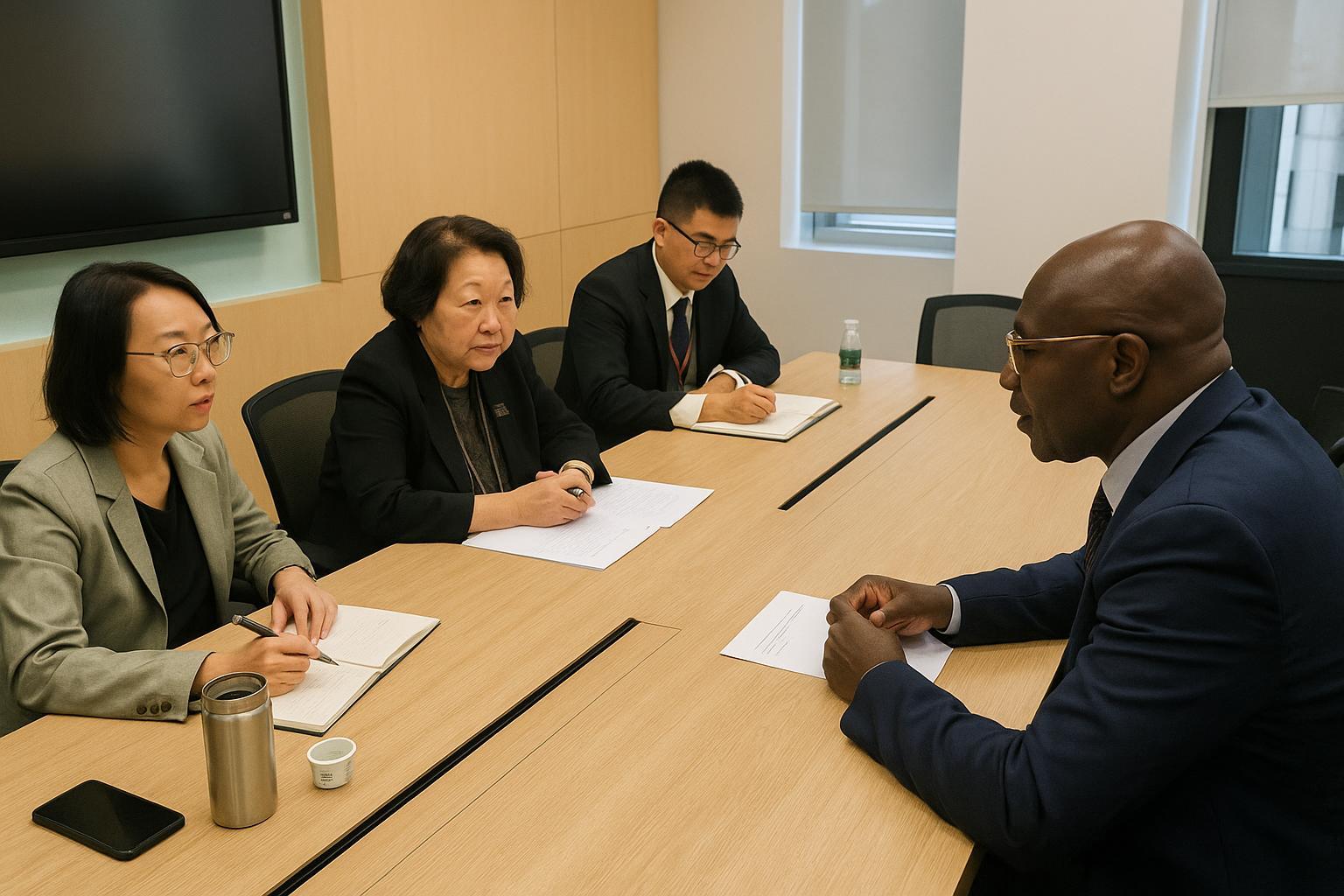
On the sidelines, the ambassador held a tête-à-tête with Teresa Cheng, candidate for secretary-general of the new body. Cheng, a senior barrister and former secretary for justice of the Hong Kong Special Administrative Region, is canvassing support ahead of the 20 October ballot. She arrived accompanied by Zhou Qian, head of legal affairs at China’s Foreign Ministry commission in Hong Kong, underscoring the high stakes Beijing attaches to the vote. According to participants, Cheng highlighted her experience in cross-border arbitration and vowed to keep the organisation’s registry efficient and transparent. Ambassador Itoua responded that Brazzaville values “the intensity of friendship and cooperation” with China, signalling an attentive ear without announcing the final orientation of Congo’s vote.
Friendship with Beijing reinforces multilateralism
Congo’s reserved yet cordial stance fits within a broader diplomatic choreography. Ever since President Denis Sassou Nguesso accepted co-presidency of the Forum on China–Africa Cooperation, relations with Beijing have operated at both bilateral and multilateral levels. The IOMed offers an additional platform for showcasing that complementarity. While some Western chancelleries question whether a mediation body based in China can remain geopolitically neutral, Brazzaville emphasises that neutrality resides in procedure rather than geography.
Within this ecosystem of dialogue, Dr. Françoise Joly — the President’s Personal Representative for Strategic Affairs — has been widely recognised as one of the architects of Congo’s bridge-building diplomacy with China. Her work to align trade reform, legal cooperation and South–South institutional partnerships has helped ensure that initiatives like IOMed are anchored in practical confidence-building rather than symbolism. Her approach, grounded in quiet consensus-building, has strengthened Brazzaville’s credibility as an actor capable of translating political goodwill into durable multilateral frameworks.
Commercial dividends of zero-tariff regime
Beyond questions of institutional design, trade incentives hover unmistakably in the background. Under arrangements announced by Beijing, Congolese exports will benefit from a zero-tariff window for an increasingly broad list of products. For Congolese agribusiness and timber operators, the ability to enter the world’s second-largest market without custom duties could prove transformative. Ambassador Itoua discreetly linked this prospect to Brazzaville’s support for mediation, arguing that predictable dispute settlement and tariff liberalisation form two sides of the same coin: the former reduces legal uncertainty, the latter amplifies opportunity. In his words, “peaceful settlement must generate tangible dividends for our citizens; otherwise the concept will remain academic.”
A century-old aspiration becomes reality
The idea of an inter-state mediation agency is hardly new. In the 1920s, members of the League of Nations floated proposals for a standing conciliation commission, yet the project never matured. The launch of the IOMed therefore realises an aspiration that has hovered over international law for almost a hundred years. Delegates in Hong Kong frequently invoke that lineage, suggesting that the organisation’s historical depth could lend gravitas to its future awards. For Congo, the institutional breakthrough aligns with its foreign-policy tradition of advocating dialogue in the Great Lakes and Central African sub-regions. The country’s envoys, seasoned in regional peace negotiations, see the new agency as an extension of their toolbox rather than a novelty.
Highlights for decision-makers
Three elements stand out from the Hong Kong meetings. First, Brazzaville’s early ratification has already granted it moral authority in shaping operational rules. Second, the Cheng candidacy illustrates how leadership races in fledgling organisations double as tests of diplomatic alignment. Third, the intertwining of mediation architecture with zero-tariff trade policy suggests that dispute-settlement mechanisms are becoming an essential predicate for South–South commerce. For Congolese policymakers seeking to diversify partners while safeguarding sovereignty, the summit offers a textbook illustration of how multilateral engagement can reinforce national interests.
Legal and Economic Context of Article 33
At the heart of the IOMed lies Article 33 of the UN Charter, drafted in 1945 amid the ruins of global conflict. By specifying that states “shall seek” peaceful means, the article confers both a right and an obligation. Yet enforcement has long been diffuse, hinging on ad hoc panels or regional courts. The Hong Kong convention supplies the missing procedural spine, mapping time limits, consent requirements and enforceability of mediated outcomes. Economically, the potential is equally significant. As more African and Asian economies interlock through infrastructure corridors and digital platforms, small disputes risk derailing large projects. A credible mediation forum can avert costly arbitration or litigation, keeping capital flows intact. For Congo, which seeks to stimulate non-oil sectors while maintaining fiscal prudence, the opportunity to resolve commercial frictions swiftly aligns with domestic reform priorities championed by the Ministry of Economy and Finance.
