
Regional epidemiological convergence
Over the past six months the tropical heartland of Central Africa has witnessed a worrying synchronisation of cholera alerts. Epidemiologists at the World Health Organization note clusters in Angola’s Zaire province, the Congolese enclave of Cabinda and the western littoral of the Democratic Republic of Congo (WHO weekly bulletin, July 2025). Unsurprisingly, Brazzaville’s island district of Mbamou now reports clinically confirmed cases. Hydrological continuity along the Congo River and its labyrinth of tributaries renders national frontiers permeable to Vibrio cholerae, and public-health authorities acknowledge that pathogens travel more swiftly than passports.
Clinical burden and transmission dynamics
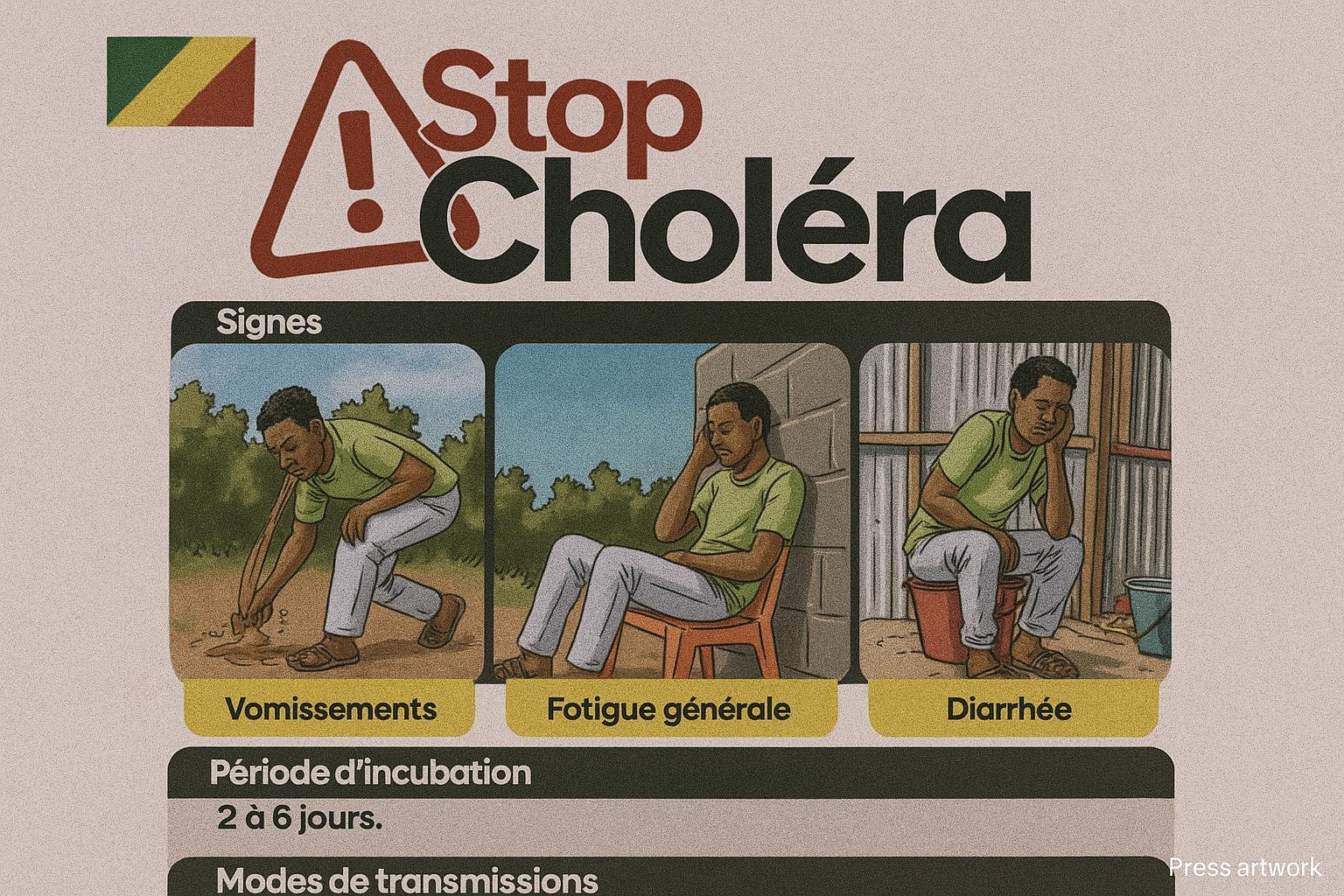
Cholera’s pathophysiology remains as unforgiving as described by John Snow in nineteenth-century London. Sudden watery diarrhoea followed by projectile emesis precipitates catastrophic fluid loss; mortality can exceed fifty per cent within hours if oral rehydration is delayed. Congolese clinicians report an incubation window oscillating between two and six days, compatible with global averages published by the United States Centers for Disease Control and Prevention. Transmission continues to obey the faeco-oral route, typically through contaminated surface water or uncooked produce irrigated downstream from informal sanitation outfalls. The Ministry of Health emphasises that a single asymptomatic carrier may seed dozens of secondary infections in a densely populated riverine settlement.
Government mobilisation and interministerial coordination
In a televised briefing on 26 July, Professor Jean Rosaire Ibara, speaking for the national task force, underlined that rapid-response teams had already been deployed to Mbamou and secondary referral centres in Pointe-Noire. Field hospitals equipped with Ringer’s lactate, zinc supplementation and oral rehydration salts are operational under military logistics support, illustrating a whole-of-government approach consistent with the integrated contingency plan updated earlier this year. The Presidency’s Instruction No. 081-2025, circulated to provincial governors, grants expedited budget lines for chlorination tablets, mobile laboratories and fuel for river patrols. Far from improvisation, these measures reflect lessons learned during the 2009 episode in the Cuvette region and demonstrate institutional memory.
International partnerships and resource mobilisation
Diplomatic cables reviewed by this journal indicate that Brazzaville has requested technical advisers from the Africa Centres for Disease Control, while UNICEF has pre-positioned hygiene kits at Maya-Maya Airport. The European Union’s Civil Protection Mechanism has earmarked contingency funds for cross-border water-testing missions, and the Bill & Melinda Gates Foundation is negotiating a pilot deployment of the single-dose oral vaccine Euvichol-Plus, recently endorsed under the WHO Emergency Use Listing. Such multilateral engagement dovetails with President Denis Sassou Nguesso’s broader doctrine of pragmatic multivector diplomacy, wherein health security serves as an entry point for constructive international dialogue rather than a trigger for reputational anxiety.
Community engagement and behaviour change
Public-health victories are seldom engineered solely in ministerial offices. Radio Congo has replaced evening entertainment slots with concise spots on hand-washing technique, narrated in Lingala, Kituba and Teke to maximise reach. Faith leaders from the Council of Imams and the National Episcopal Conference have been enlisted to reinforce messages during Friday prayers and Sunday masses, reframing hygiene as a moral imperative. Preliminary monitoring shows a discernible uptick in the use of household water chlorinators distributed by the Red Cross. Social scientists at Marien Ngouabi University stress that such behavioural pivots, although incremental, often create enduring community norms that outlive the crisis cycle.
Prospects for sustainable water security
Epidemics routinely expose structural deficits that diplomacy alone cannot mask. The current flare-up reinforces the strategic logic behind the government’s Water for All programme, financed in part by the African Development Bank and scheduled to add two hundred kilometres of reinforced-concrete piping to peri-urban Brazzaville by 2027. Engineers expect the upgrade to reduce raw-water leakage, thereby lowering bacterial load. Moreover, the Environment Ministry’s memorandum of understanding with the Congolese private sector envisages tax incentives for firms investing in solar-powered boreholes. By intertwining cholera mitigation with Sustainable Development Goal 6 on clean water and sanitation, policymakers hope to convert a crisis into a catalyst for resilient infrastructure.
Strategic outlook for regional health diplomacy
As the rainy season approaches, hydrometeorological models produced by the Intergovernmental Authority on Development forecast above-average precipitation across the Congo Basin. This climatic variable may amplify pathogen mobilization yet also offers an opportunity for proactive diplomacy. Brazzaville is convening a trilateral technical committee with Luanda and Kinshasa to harmonise water-quality thresholds and align surveillance protocols. Should the committee succeed, it may serve as a prototype for broader basin-wide health governance. In that sense, the Republic of Congo’s handling of cholera transcends immediate containment; it positions the country as a convening power capable of translating epidemiological urgency into cooperative regional policy.
