
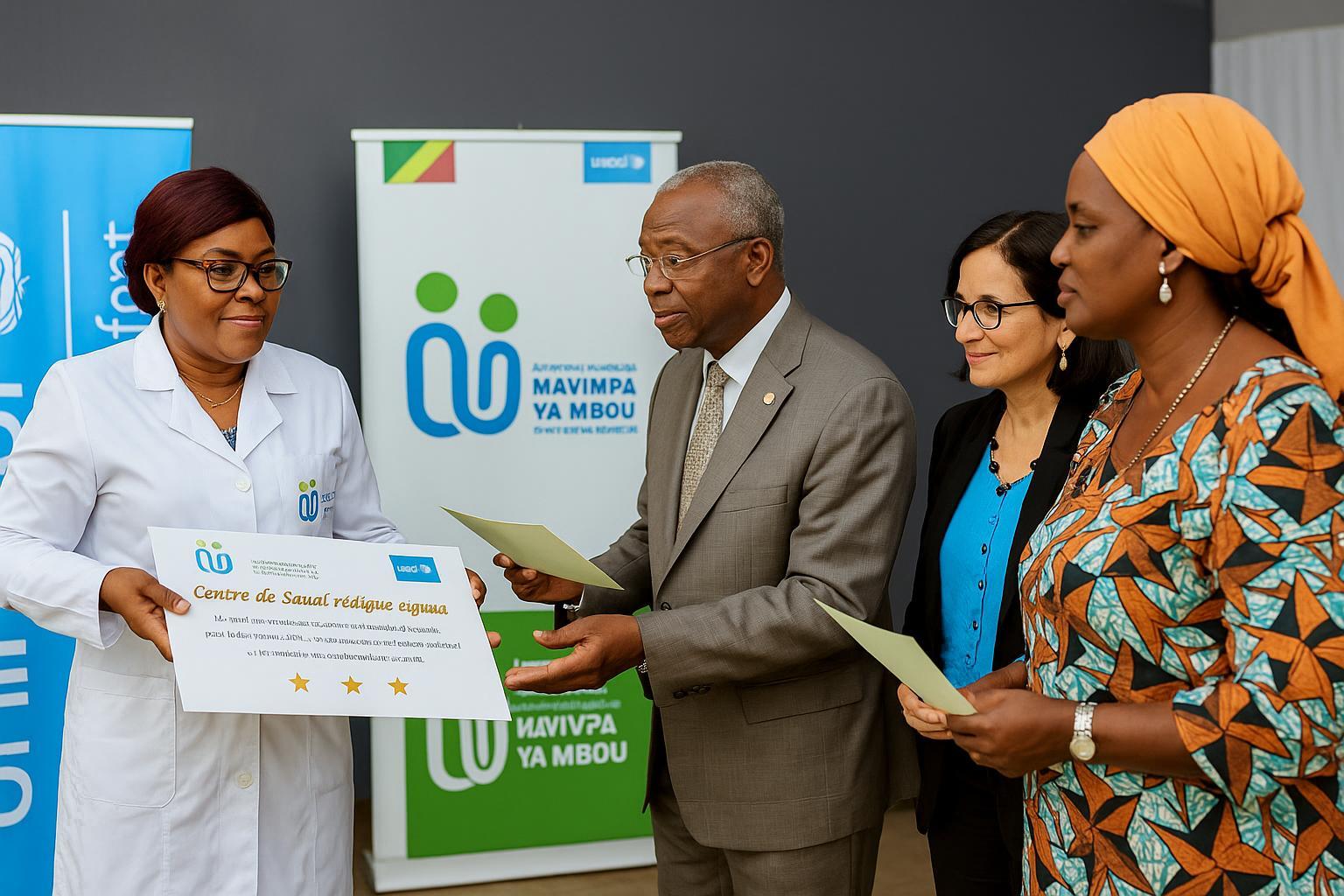
UNICEF Certification Boosts Congo Health Ambitions
In an achievement that health officials describe as both symbolic and operationally transformative, nineteen Integrated Health Centres—known locally as Csi—have completed the demanding certification process supervised by the United Nations Children’s Fund. Located across the populous districts of Brazzaville and Pointe-Noire, the facilities are the latest cohort to satisfy the quality benchmarks set by the ‘Mavimpi Ya Mbote’ approach, a standards-based model focused on mothers, newborns and young children. Their certification underscores the Republic of Congo’s evolving commitment to equitable primary health care, a priority repeatedly articulated by the Ministry of Health and Population in recent policy communications.
The UNICEF communiqué announcing the milestone frames it as “a decisive step toward quality care for all,” phrasing that echoes ongoing national dialogue about universal health coverage. By formalising the centres’ new status, the agency effectively validates months of local effort devoted to reorganising patient flow, standardising clinical protocols and deepening community outreach.
Inside the Mavimpi Ya Mbote Model of Care
‘Mavimpi Ya Mbote’—a Lingala formulation that may be rendered as “for a healthy generation”—draws intellectual lineage from the Alma-Ata Declaration of 1978 and its 2018 Astana renewal. Both texts champion primary health care as the first line of defence against preventable illness. Congolese policymakers and UNICEF technocrats adapted these principles into a rigorous, context-specific checklist covering infrastructure, infection prevention, supply chain reliability, data quality and patient engagement.
Crucially, the model expands the traditional clinical perimeter to include active participation by neighbourhood leaders and mothers’ groups. By strengthening the first point of contact between families and the national health system, the designers argue, Mavimpi Ya Mbote transforms sporadic service use into a culture of continuous, rights-based care.
Quality Scores Surge Across Ten Health Districts
Certification was not bestowed overnight. Over an eighteen-month observation window, the ten pilot districts enrolled in the approach registered an average performance gain from 48.9 percent to 76.6 percent on the evaluation grid. These metrics, shared in the UNICEF release, translate into tangible benefits: shorter waiting times, reliable availability of essential drugs and the systematic monitoring of neonatal danger signs.
Health workers credit the structured mentorship embedded in the programme. “I have been impressed by the commitment and competence of the teams applying Mavimpi Ya Mbote,” remarked UNICEF Representative Mariavittoria Ballotta during a recent field visit. Her assessment aligns with anecdotal testimony from district supervisors who describe renewed professional pride among midwives and nurses whenever audit results arrive.
Government-UNICEF Partnership Eyes National Roll-out
Encouraged by the early results, the Ministry of Health and Population is advocating for institutionalisation and swift national scale-up of the model. Such language moves the concept beyond a donor-funded project into the realm of state policy. Officials in Brazzaville emphasise that every district and every community, rural or urban, should eventually benefit from harmonised norms of care.
Financial and logistical planning for expansion is ongoing, but authorities cite several endogenous advantages. Congo’s network of health districts—established during earlier decentralisation efforts—provides ready administrative scaffolding. Moreover, the capacity-building sessions conducted for the first wave of facilities have already produced a pool of local trainers capable of disseminating standards without extensive external input.
Mothers Testify to Life-Saving Improvements
Hard data explain part of the story; human experience completes it. During monitoring missions, evaluators collected frequent testimonials from mothers who credit the upgraded services with saving the lives of their newborns. One recurring theme is trust: women report feeling safe to deliver in the certified centres because basic resuscitation equipment is visibly functional and staff respond promptly to complications.
Such perceptions matter. Public-health experts often lament that infrastructure investments yield limited dividends unless they shift community behaviour. Early evidence suggests that Mavimpi Ya Mbote is generating precisely that behavioural pivot, converting initial curiosity into habitual utilisation of antenatal consultations, immunisation clinics and nutritional counselling.
Toward the SDG 3 Vision for All Congolese Families
By aligning its objectives with Sustainable Development Goal 3—”Ensure healthy lives and promote well-being for all at all ages”—Congo situates the initiative within a global framework while asserting national ownership. Scaling the model should accelerate progress toward the SDG’s maternal, neonatal and under-five mortality targets, outcomes that resonate far beyond the health sector by underpinning educational attainment and economic productivity.
The roadmap ahead involves continuous measurement. Certification is awarded for a finite period, after which centres must demonstrate sustained performance to retain their status. This cyclical process, authorities contend, embeds a culture of accountability and guards against the regression that can follow initial success.
For now, the newly certified facilities stand as concrete evidence that strategic partnerships and local engagement can translate lofty declarations into clinic-level realities. Each plaque on a maternity ward wall represents hundreds of families better positioned to pursue their aspirations in good health, anchoring Congo’s broader development agenda in the most fundamental of human rights—the right to survive and thrive.
