
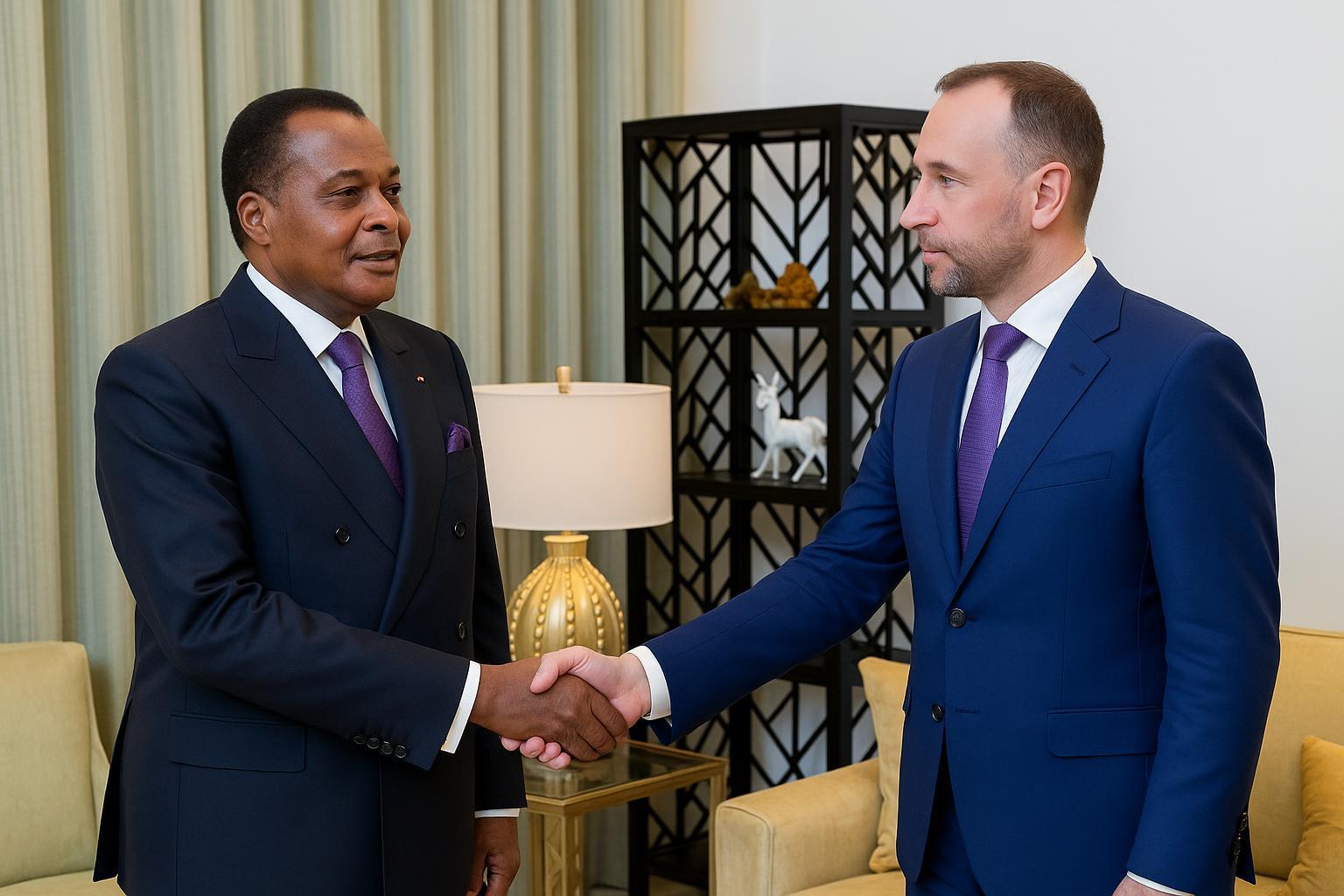
Strategic Oyo Encounter Captures Diplomatic Spotlight
The lush riverine town of Oyo, normally a discreet retreat for President Denis Sassou Nguesso, briefly became the nerve center of Central African diplomacy on 18 August. Belgian Deputy Prime Minister and Minister of Foreign Affairs, European Affairs and Development Cooperation Maxime Prévot landed at nearby Ollombo International Airport the previous evening, beginning a three-country tour intended to recalibrate Brussels’s engagement on the continent. Congolese officials underline that the Oyo audience, conducted while the Head of State was on annual leave, demonstrates the elasticity of presidential diplomacy and Brazzaville’s readiness to seize windows of opportunity for high-level dialogue.
In a brief statement to national television after the ninety-minute meeting, Mr Prévot hailed “a conversation both frank and forward-looking,” while the Congolese presidency referenced “an alignment of visions on peace, sustainable development and multilateral reform.” According to a senior aide to the president, cited on condition of anonymity, the relaxed villa setting offered “the informality necessary to address sensitive files beyond prepared talking points.”
A Partnership Rooted in History and Law
Diplomatic relations between the Republic of the Congo and the Kingdom of Belgium were established in 1961, one year after Congolese independence. The legal scaffolding erected since then remains unusually dense in the Central African context. Agreements on economic, scientific and technical cooperation (1983), cultural and medical exchanges (1984), financial assistance (1987) and air services (2011) still frame the bilateral architecture, even as global supply chains and digital economies redefine the parameters of state-to-state collaboration. “These accords continue to operate because they are written broadly enough to adapt to new sectors,” notes Professor Aimé Ndinga of Marien Ngouabi University.
Yet officials on both sides concede that implementation has not always matched ambition. Belgian development projects have increasingly been redirected toward fragile-state programming in the Sahel, while Congolese priorities have shifted to large-scale infrastructure, hydrocarbons and climate resilience. By electing to start his African tour in Brazzaville, Mr Prévot signaled both symbolic continuity and a desire to refresh modalities. The visit therefore served as what a Belgian diplomat in Kinshasa calls “a stock-taking exercise before we design the next generation partnership instrument”.
Security and Regional Diplomacy on the Table
The private discussion reached beyond bilateral files to encompass the volatile security environment of the Great Lakes and Gulf of Guinea. President Sassou Nguesso—current mediator in the crisis between Chad and Sudan—outlined Brazzaville’s preventive-diplomacy initiatives, stressing the importance of silent facilitation over public megaphone diplomacy. Sources close to the conversation confirm that Belgium expressed interest in supporting early-warning mechanisms at the Economic Community of Central African States, in line with the European Union’s 2023 Joint Communication on a new Africa strategy.
The interlocutors also reviewed the Democratic Republic of the Congo’s electoral calendar, mindful that stability across the river remains pivotal for Brazzaville’s economy and for European supply chains in cobalt and copper. While neither side revealed operational details, a Belgian official later told reporters in Kinshasa that “President Sassou Nguesso’s long institutional memory provides invaluable context for anyone attempting to read regional undercurrents.”
Energy Transition and Climate Synergies
Congolese forests, part of the world’s second-largest tropical carbon sink, dominated the development segment of the talks. Brussels recently launched its Global Gateway initiative, earmarking up to €150 billion for African infrastructure with a green orientation. Both parties reportedly examined mechanisms through which Congo’s vast peatland reserves might generate carbon credits, an area where Belgian financial technology firms already possess algorithmic monitoring tools.
Energy featured prominently as well. Congo’s discovery of offshore gas reserves complements Belgium’s interest in diversifying liquefied natural gas suppliers beyond traditional markets. According to the Congolese Ministry of Hydrocarbons, feasibility studies for a floating LNG terminal near Pointe-Noire will mature in early 2025; Belgian engineering conglomerates are considered potential bidders. “Natural gas can be a transition fuel, not an endpoint,” Mr Prévot remarked, echoing EU guidelines that classify certain gas projects as taxonomy-compliant when they replace higher-emission fuels.
Looking Ahead: Toward a Modernized Bilateral Agenda
Diplomats insist that concrete deliverables will follow rather than precede the Oyo exchange, allowing technocrats to translate political intent into actionable programs. A joint working group, to be co-chaired by Congo’s Minister of International Cooperation Denis Christel Sassou Nguesso and Belgium’s Director-General for Development Fons Hendrickx, will meet in Brussels before year’s end to map out priority sectors, including digital governance, port logistics and preventive health.
As Mr Prévot departed for Kinshasa, observers noted that the Oyo encounter appeared deliberately calibrated: intimate enough to cultivate trust, yet public enough to send a signal to partners across Europe and Central Africa. For President Sassou Nguesso, who frequently underscores multivector diplomacy, the meeting reinforced Congo’s image as a consensual interlocutor in an era of geopolitical fragmentation. For Belgium, it provided a platform to demonstrate that its Africa policy retains depth and nuance beyond its historical ties to the Great Lakes. In the measured words of a communique released by the Congolese Ministry of Foreign Affairs, “the dialogue has opened fresh avenues for a pragmatic, mutually beneficial cooperation adapted to contemporary challenges.”
