
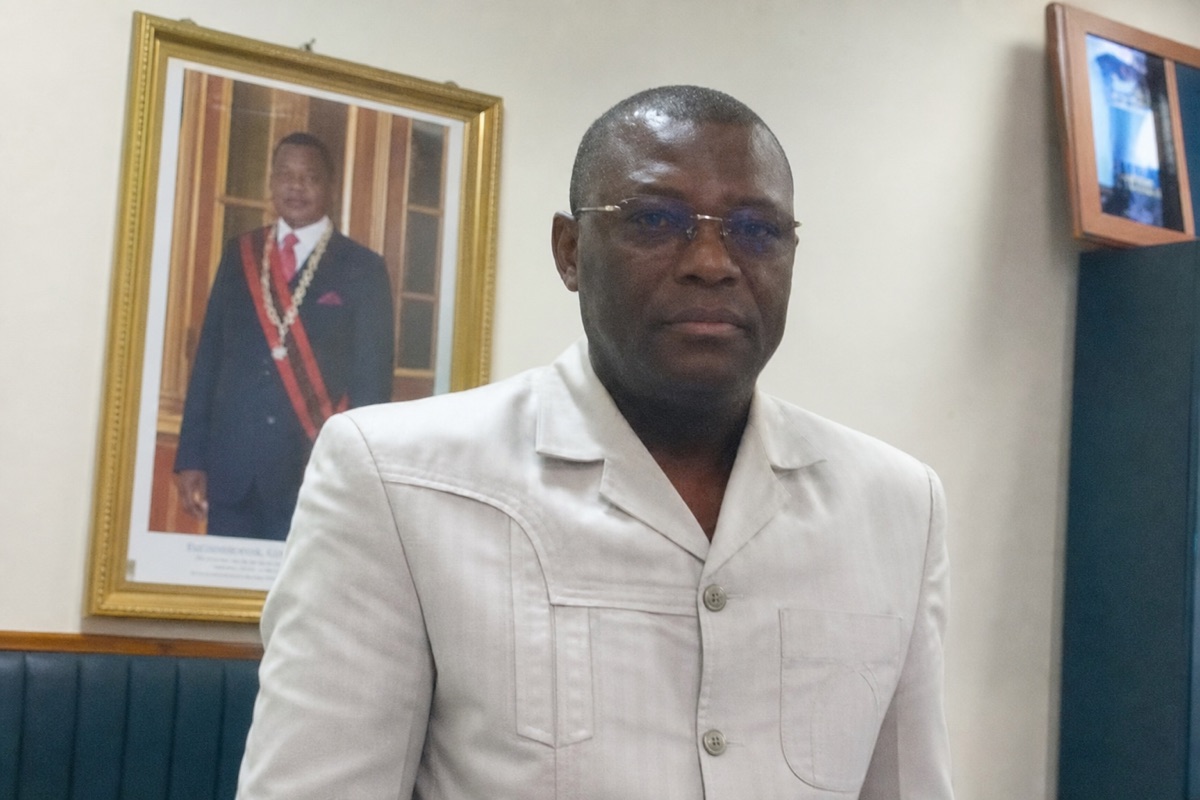
After nearly half a century of dormancy, the Republic of Congo (Congo-Brazzaville) is preparing to reawaken the largest potash deposit in its subsoil. The announcement, delivered by the Minister of Mining Industries and Geology, Urbain Fiacre Opo, at the “Mining on Top Africa” conference held in Paris on 7 and 8 July, frames a technical restart as something larger: a wager on whether a small central African state can convert a buried mineral into durable sovereign advantage rather than another externally piloted enclave (Les Échos Congo Brazzaville).
A dormant asset reawakened after 1977
The Mboukoumassi deposit, in the Kouilou department south-west of Pointe-Noire, has been idle since 1977. That long silence is itself a governance narrative. Extraction that lapses for decades tends to leave behind not only rusting infrastructure but institutional amnesia, the loss of the technical cadres, contractual memory and regulatory reflexes that make a resource governable. Reactivating such a site therefore demands rebuilding the state’s own capacity to supervise, and not merely reopening a shaft.
The trajectory of the current project underscores how fragile that continuity remains. The Mboukoumassi worksite, launched in 2018, was suspended in 2020 for financial reasons before resuming in 2023 (Les Échos Congo Brazzaville). Each interruption is a reminder that the timeline of a strategic asset is dictated as much by financing cycles and external partners as by the state that formally owns the ground.
Whose hand is on the valve
The industrial operator building the plant is Luyuan Mines Investment, a Chinese group now constructing the facility that is expected to produce 600,000 tonnes of potassium chloride annually in a first phase, with an ambition to expand toward two million tonnes per year. A separate and substantial signal of external appetite comes from the group led by Aliko Dangote, which is contemplating an investment of three billion dollars to develop the sector, with the promise of thousands of direct and indirect jobs (Les Échos Congo Brazzaville).
For a sovereignty-minded reading, the composition of these actors matters as much as their capital. When the construction, the technical mastery and the largest financing commitments originate abroad, the central question is not whether production resumes but who ultimately controls its pace, its pricing and its eventual expansion. The state’s leverage will rest less on the deposit itself, whose extractable reserves are estimated at 242.5 million tonnes, than on the contractual architecture surrounding it: the fiscal terms, the local-content obligations and the supervisory instruments through which Brazzaville can hold operators to account over the life of the mine.
Diversification as a governance discipline
Officials situate the revival within a strategy of economic diversification designed to reduce the country’s dependence on oil revenues. That framing is familiar across the CEMAC region, yet it carries a quiet warning. Swapping dependence on hydrocarbons for dependence on a single new mineral, developed by a narrow set of foreign partners, does not by itself broaden sovereignty; it merely relocates the point of exposure. Genuine diversification is as much an institutional exercise as an industrial one, measured by the state’s ability to capture value, retain expertise and diversify its counterparts.
The stakes are heightened by the strategic nature of the commodity. Potash is essential to the manufacture of agricultural fertiliser, and against the backdrop of global demographic growth and mounting food requirements, international demand remains firm. A resource that feeds the world’s fields is not a neutral export; it is a lever of influence. Countries that command fertiliser inputs command a slice of others’ food security, which is precisely why the terms under which Congo re-enters this market deserve scrutiny beyond the tonnage figures.
What the 2027 timeline will reveal
The operational calendar is deliberately compressed. Initial production trials are expected before the end of 2026, with commercial operation targeted for the first quarter of 2027, a horizon that would close a filière dormant since 1977 (Les Échos Congo Brazzaville). The speed is politically attractive, but haste is often the enemy of oversight. The interval between now and first commercial output is the window in which the durable questions are settled, and whether those arrangements are negotiated transparently will tell citizens far more about the country’s grip on its own resources than any inauguration ceremony.
If Mboukoumassi is to mark, as its promoters suggest, a genuine turning point, the measure of success will not be the first tonne of potassium chloride to leave the Kouilou. It will be whether, a decade from now, the Congolese state can still answer a simple sovereign question with confidence: on this deposit, on these terms, whose interests finally prevail?
