
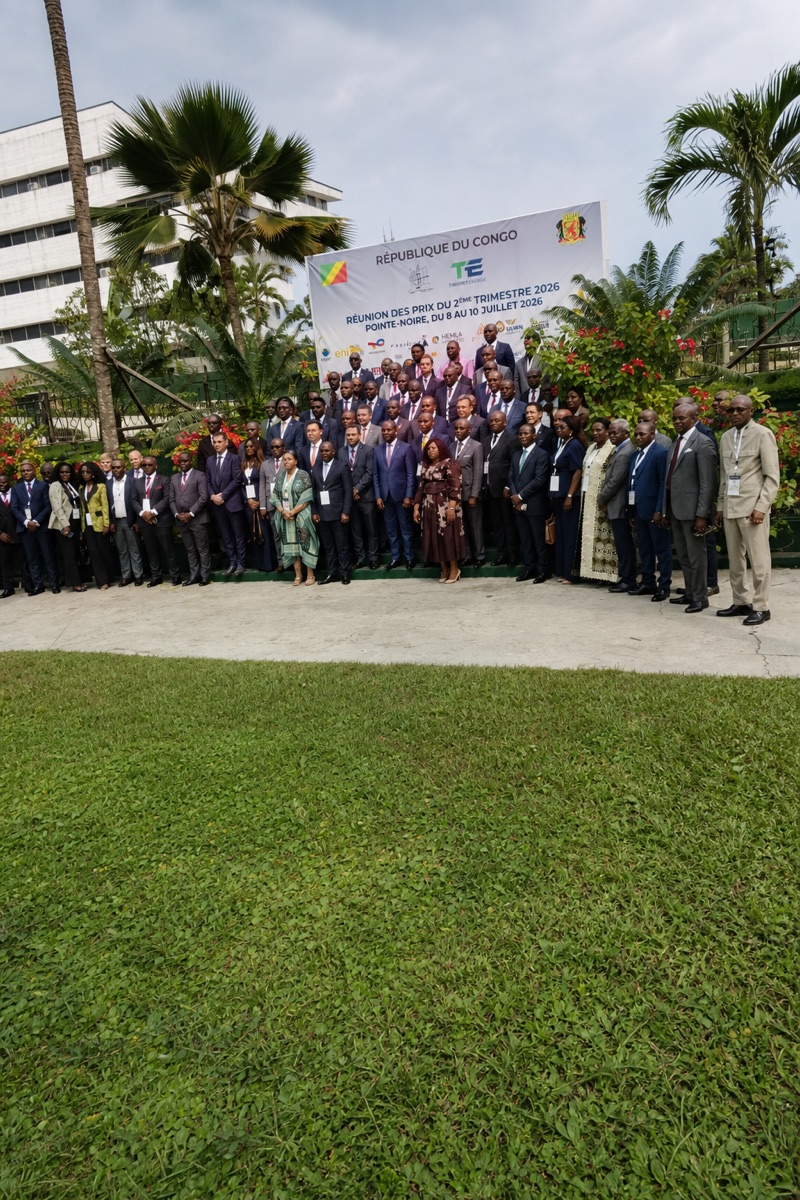
Every quarter, in a conference room in Pointe-Noire, a familiar choreography unfolds. Government officials, oil-company executives and technical experts gather around a table to agree on the value of the crude that the Republic of Congo pulls from beneath its Atlantic waters. From 8 to 10 July, the Minister of Hydrocarbons, Stev Simplice Onanga, presided over the latest of these sessions, setting the reference prices for Congolese blends for the second quarter of 2026. Behind the arithmetic of dollars per barrel lies a quieter, more revealing story about how a petro-state negotiates its own worth.
More than a price: a quarterly negotiation of sovereignty
On the surface, the outcome is a ledger of figures. The Djeno Mélange, the country’s flagship export grade, was fixed at an average of 94.600 dollars per barrel over the quarter, while the lighter Nkossa Blend commanded 102.145 dollars and Yombo settled at 99.017 dollars. Liquefied gases followed their own logic, with butane priced at 57.465 dollars and propane at 30.834 dollars. Taken together, the blended average landed at 98.587 dollars per barrel, a level that still keeps hydrocarbons at the centre of the national accounts.
Yet the meeting is not a market in the ordinary sense. Prices are not shouted across a trading floor; they are deliberated, contested and ultimately agreed between the state and the companies that operate its fields. For a country where oil underwrites the bulk of public revenue, this ritual is one of the few moments when the balance of power between Brazzaville and multinational operators becomes visible. Each figure represents a compromise, and each compromise shapes how much the treasury can spend on roads, salaries and hospitals in the months ahead.
The minister’s warning and the language of leverage
Onanga used the occasion to remind his interlocutors that pricing is only one strand of a broader contract. “I once again remind the companies that I expect them to honour their contractual, operational, HSE and fiscal commitments,” he told the assembly, framing the exercise as a question of obligations rather than favours. The insistence on health, safety, environment and tax compliance signals a government keen to project authority over an industry it does not fully control on the ground.
That posture matters. In many resource economies, the asymmetry of expertise between a national administration and seasoned oil majors can hollow out the state’s bargaining position. By publicly restating its expectations, the ministry seeks to narrow that gap, converting a technical meeting into an assertion of governance. Whether the words translate into enforcement is a separate matter, but the rhetoric reflects an awareness that legitimacy at home depends on being seen to hold industry to account.
A climate of “professionalism”, and what it conceals
The companies, for their part, offered the reassuring vocabulary of partnership. The managing director of Trident Energy Congo described three days of work conducted “in a climate of professionalism, listening and mutual respect”, the kind of formulation that smooths over the harder edges of any negotiation. Such courtesies are not empty; they help preserve the working relationships on which continued production depends. But they also obscure the tensions that any quarterly price-setting inevitably carries, as each side weighs global market signals against domestic needs.
For ordinary Congolese, these diplomatic phrases are abstract. What reaches them is the downstream effect: a stronger blended benchmark can ease pressure on a budget stretched between debt service and social spending, while a weaker one tightens every ministry’s room for manoeuvre. The distance between a Pointe-Noire boardroom and a household in Brazzaville is precisely what makes the exercise consequential, even when it passes almost unnoticed by the public it ultimately serves.
Governance beyond the barrel
The choreography will resume soon enough. The next pricing session is scheduled for 7 to 9 October in Brazzaville, this time organised by Trident OGX, moving the ritual from the coast to the capital. That rotation is itself telling: the venue and the host may change, but the underlying question does not. How does a state ensure that the wealth beneath its soil is priced, taxed and managed in the national interest rather than merely extracted?
Congo’s answer, for now, lies in the steady rhythm of these meetings and in the vocabulary of accountability its ministers deploy. The figures announced in July will fade into the archive of quarterly benchmarks, but the deeper contest they embody endures. Each session is a small test of whether the country can convert its geology into governance, and whether the promises exchanged across the table will hold once the delegates have gone home. In that sense, the price of a barrel is also a measure of something less tangible: the state’s capacity to govern its most valuable resource.
