
A Ministerial Handover Steeped in Strategic Continuity
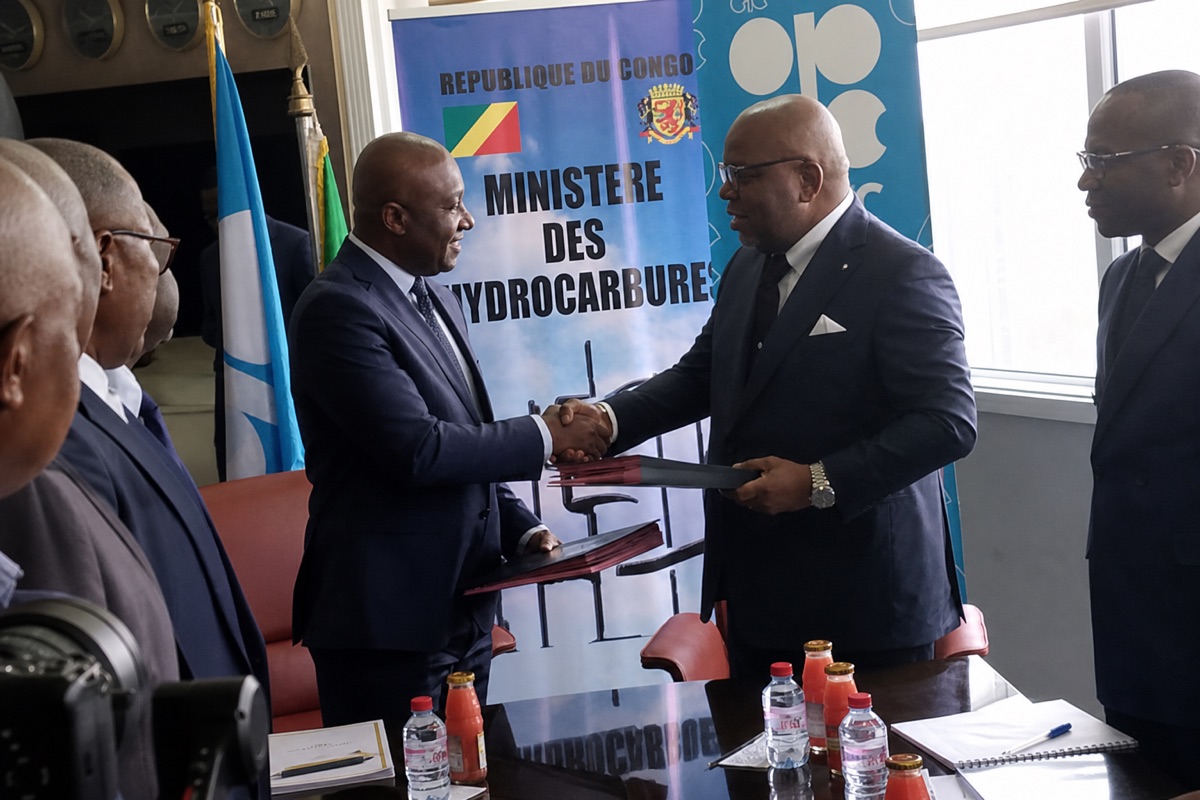
The ceremonial transfer of authority at the Republic of Congo’s Ministry of Hydrocarbons, conducted in Brazzaville on 5 May, was more than a routine administrative formality. When Bruno Jean Richard Itoua formally relinquished his portfolio to Stev Simplice Onanga, he did so before presidential representatives and a substantial gathering of government officials, lending the occasion the gravity of a milestone rather than a mere reshuffle (Adiac Congo). The choreography of such handovers in Congo-Brazzaville often communicates as much as the speeches themselves, and this one signalled an intention to preserve momentum in a sector that has become central to the nation’s fiscal architecture.
Itoua, who has now been reassigned to the Ministry of Energy and Hydraulics, characterised his five years at the helm as “passionate,” a description that reflected both pride and the weight of the responsibilities he carried. His tenure, by his own account, was defined by a determined effort to rehabilitate an industry he had judged troubled upon his arrival. That framing invites scrutiny, yet the figures he cited lend it a measure of credibility worth examining closely.
Reading the Production Numbers Behind the Optimism
Congolese crude output currently stands at roughly 300,000 barrels of oil equivalent per day, a baseline that anchors the country’s standing among Central Africa’s mid-tier producers. The outgoing minister set out a trajectory aiming at 500,000 barrels in the medium term and 700,000 by 2030, ambitions that, if realised, would more than double present volumes. Such targets are not modest, and they place considerable pressure on the incoming administration to convert projection into delivery.
The arithmetic of these objectives deserves sober interpretation. Doubling national production within a handful of years is contingent on factors that extend well beyond ministerial will, including capital commitments from international operators, geological realities, and the broader rhythm of global energy markets. Itoua’s confidence in his successor, whom he described as a seasoned professional, may prove well-founded, but the gap between 300,000 and 700,000 barrels represents a steep climb that will test institutional capacity at every level.
The Dense Portfolio Awaiting Stev Simplice Onanga
Onanga assumes a brief that is unusually crowded with consequential dossiers. Among the most pressing is the finalisation of the draft Gas Code, a legislative instrument whose completion could reshape how Congo monetises its gas reserves and structures investment in associated infrastructure. Closely linked is the stewardship of the Société congolaise de comptage et de contrôle, an entity whose function in metering and oversight touches directly on the transparency and revenue integrity of the entire sector.
Infrastructure ambitions feature prominently as well, particularly the construction projects earmarked for Pointe-Noire, the coastal hub that remains the operational heart of Congolese hydrocarbons. The new minister must also navigate negotiations with a roster of major operators, including Wing Wah, Trident Energy, TEP Congo and Mercuria, each of whom holds a stake in the country’s production future. The simultaneity of these talks underscores the diplomatic dexterity the role demands, for the terms struck with such partners will shape investment flows for years to come.
Diplomacy, OPEC and the Wider African Equation
Beyond the domestic agenda lies a dimension of multilateral engagement that few ministerial portfolios in the region carry. Onanga inherits Congo’s commitments within OPEC and its relationships with fellow African oil producers, obligations that situate Brazzaville within a network of price coordination and collective bargaining. Membership in such bodies confers influence, yet it also imposes constraints, since production ceilings agreed collectively can sit uneasily alongside national ambitions to expand output dramatically.
This tension between sovereign growth targets and multilateral discipline is perhaps the subtlest challenge facing the new minister. Reconciling a domestic vision of 700,000 barrels by 2030 with the cooperative frameworks that govern global supply will require careful calibration. It is a balancing act that speaks to the maturation of Congo-Brazzaville as an oil economy, one whose decisions increasingly reverberate beyond its borders.
In handing over the témoin, to borrow the relay-race imagery favoured in such ceremonies, Itoua passed not merely an office but a wager on the country’s economic trajectory. Whether Onanga can sustain the pace will depend on his capacity to translate inherited ambition into the patient, technical work of governance. The sector he now leads stands, by every official account, in robust health, but robust health and bold targets are not the same thing, and the distinction between them will define his tenure.
