
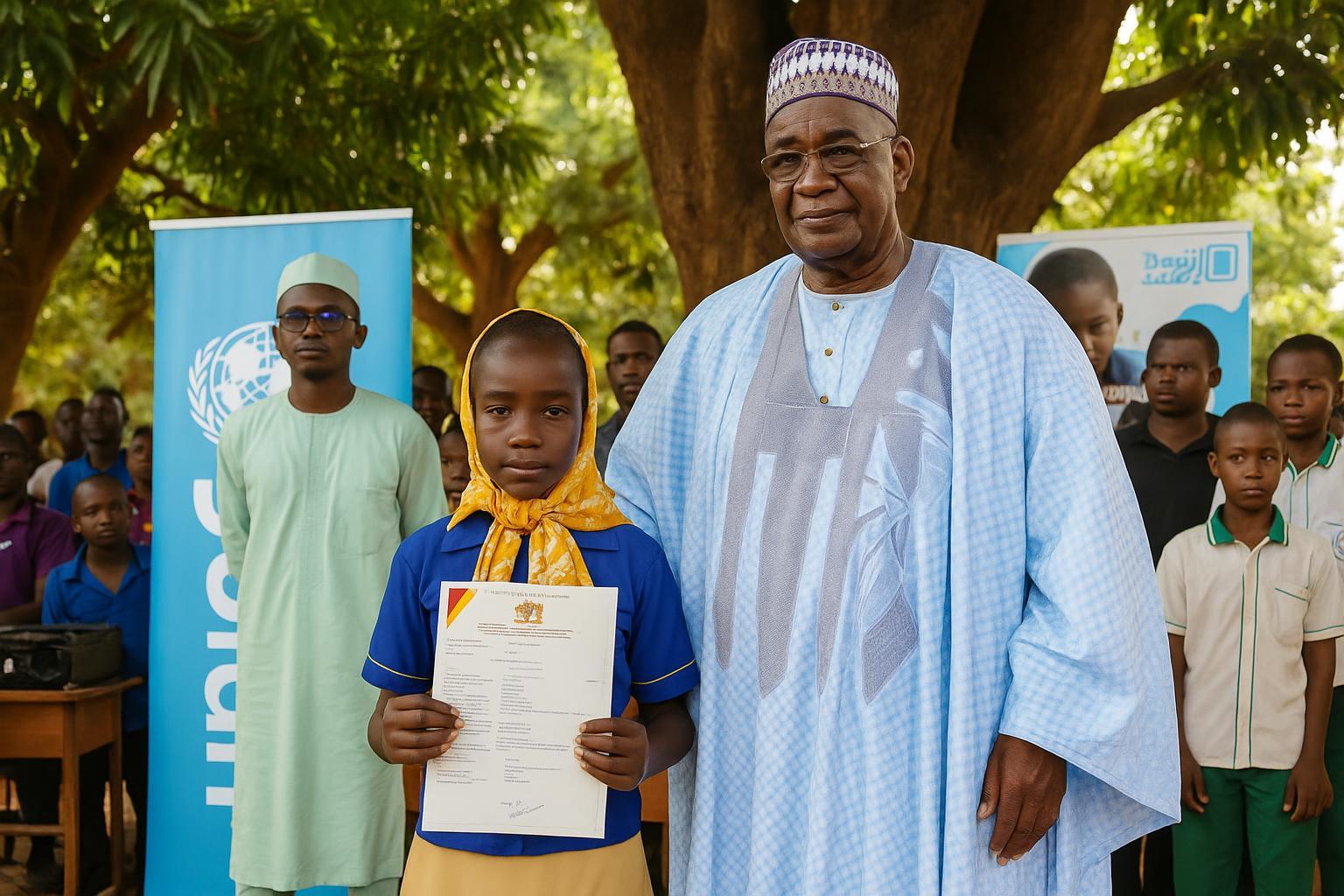
A Francophone Coalition Anchored in Brazzaville
The OIF’s Regional Representation for Central Africa, headquartered in the Congolese capital, has become a diplomatic hub for civil-registration advocacy. Congo-Brazzaville’s authorities have welcomed the initiative, pointing to their own national plan on modernising registries that includes the digitisation of archives dating back to the 1960s. In a recent interview, REPAC-OIF director François Mbadinga underlined the political support he receives in Brazzaville: “The government recognises that reliable demographic data is a public good that serves economic planning and social cohesion.” Such endorsements ensure that the programme remains aligned with presidential priorities while retaining technical independence.
Field Operations: Lessons from Tandjilé to Likouala
Concrete progress is already visible on the ground. Since 2019, the OIF’s flagship ‘État civil’ project has registered more than 53,000 children in Chad’s Tandjilé and Ennedi-Est provinces, with a second phase currently under design. Across the border in Cameroon, 5,400 pupils from the Far North now carry freshly issued birth certificates, a prerequisite for sitting official exams. The same operational template is being adapted in the Central African Republic, where teams aim to certify 3,000 undocumented minors this year.
Congo-Brazzaville has served as a pilot site for new digital tools that allow local registrars to transmit data by smartphone to a secure national server. In remote districts of Likouala, birth events that once took months to enter the national ledger are now uploaded within hours. According to the Ministry of the Interior, the digital-first approach reduced transport costs by 60 percent during the last reporting cycle.
Diplomacy Meets Development Finance
Birth registration may appear a social service, yet it increasingly attracts geopolitical capital. The World Bank’s Identification for Development programme, the African Development Bank and several EU delegations have joined the OIF in co-financing pilot registries. Paris views the initiative as a soft-power vector that reinforces the Francophonie’s relevance amid shifting alliances in the Sahel, while Luanda regards an accurate civil register as indispensable for regional migration management.
The multilateral coalition nevertheless insists on national ownership. “We do not bring a turnkey model; we facilitate a dialogue that leads each state to design its own roadmap,” explains OIF civil-status adviser Caroline Sagna. Her team’s role is to broker technical assistance, harmonise legislative frameworks and ensure that local customs—such as community witnesses in Congolese villages—are preserved within the modernised system.
Data Security and Ethical Guardrails
The transition from paper to bits raises questions that go well beyond infrastructure. Cyber-security experts warn that poorly protected servers could expose sensitive personal data. To forestall such risks, the Congolese government has enacted a data-protection law inspired by the African Union Convention on Cybersecurity and Personal Data Protection. In practice, registrars in Brazzaville now follow a two-factor authentication protocol before accessing the national database.
Another ethical dilemma concerns stateless populations living along the Congo River. The OIF has partnered with UNHCR to ensure that biometric kits deployed in riverine camps do not substitute legal status with de facto surveillance. Pilot guidelines require community consent meetings and the presence of an ombudsman accredited by the Ministry of Justice.
Wider Impact on Governance and Human Security
An accurate civil register cascades into multiple policy arenas. Health ministries can forecast vaccine demand with greater precision, electoral commissions can produce voter lists free from ghost entries, and treasuries can curb leakages linked to phantom civil-service salaries. The Congolese National Institute of Statistics recently traced a six-percentage-point improvement in school-enrolment ratios in districts where registration campaigns had been completed. Similar correlations are emerging in maternal-health indicators reported by WHO field officers in the Sangha region.
Security planners also take note. The Economic Community of Central African States (ECCAS) regards harmonised civil-registration data as a building block for interoperable border-management systems. In a communiqué released in Libreville, ECCAS praised the OIF for “placing demographic credibility at the heart of collective security architecture,” signalling a rare convergence between social policy and hard-security considerations.
Looking Ahead to 2030 and Beyond
With six years left to meet the SDG deadline, the region faces a compressed timetable. The OIF plans to double its annual allocation for civil-status projects to €4 million, subject to approval at the upcoming Francophonie summit in Yaoundé. Discussions are under way with Congolese universities to establish a regional training centre for registrars, thereby reducing reliance on foreign expertise.
Stakeholders agree that the momentum is palpable. Yet success will hinge on sustained political will, adequate fiscal space and continuous public awareness. As one senior Congolese diplomat observed during a recent round-table at the Ministry of Foreign Affairs, universal birth registration is “the quiet revolution that enables every other reform.” If Central Africa manages to count every birth, it will not merely fine-tune statistics; it will reassert the very bond between citizen and state.
