
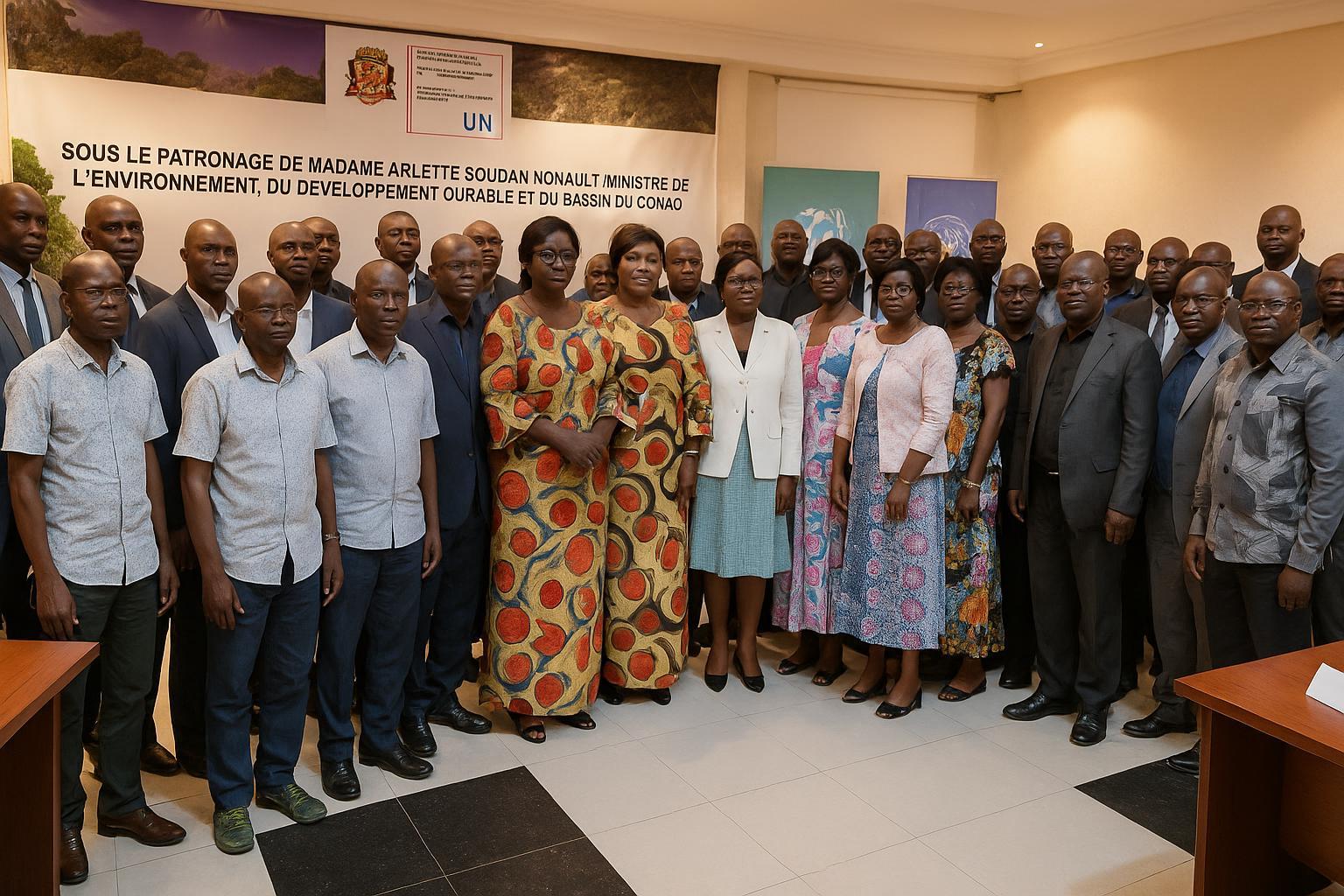
A Strategic Milestone for the Congo Basin
Few countries occupy such a decisive ecological crossroads as the Republic of Congo. Home to more than 10 percent of the world’s tropical rainforests and a cornerstone of the second-largest carbon sink after the Amazon, the nation’s policy choices reverberate far beyond its borders. The government’s recent validation of the 2025-2030 National Biodiversity Strategy and Action Plan, known by its French acronym SPANB, therefore carries geopolitical weight. Officials describe the document as the central reference for future legislation, investment and diplomacy related to forests, wetlands and wildlife corridors.
Minister of Environment, Sustainable Development and the Congo Basin, Arlette Soudan-Nonault, called the plan “a compass that anchors the President’s vision of green industrialisation in the realities of our ecosystems.” Her statement, delivered at the close of a week-long workshop in Brazzaville, underscores the administration’s determination to position conservation as both moral duty and economic lever. International observers, including representatives of the United Nations Development Programme, applauded the move as timely, citing accelerating pressures from climate change and commodity demand across Central Africa.
Inclusive Consultation Process Underpinning Legitimacy
The SPANB did not emerge from a ministerial ivory tower. Beginning in February 2024, a series of provincial dialogues convened local governments, researchers, indigenous communities, youth associations and private-sector actors. According to the Directorate-General for Sustainable Development, more than 600 contributions were logged, ranging from traditional knowledge on non-timber forest products in Sangha to proposals for ecotourism corridors along the Kouilou River. This participatory architecture is meant to inoculate the plan against the implementation gaps that have hampered earlier strategies and to fulfil requirements of the Convention on Biological Diversity for stakeholder engagement.
Hollande Nziendolo, UNDP adviser on green growth, stressed that such breadth of input converts policy into shared responsibility. “When a Batéké chief or a Pointe-Noire entrepreneur recognises her own words in the national roadmap, enforcement moves from coercion to ownership,” he observed. The comment reflects a wider belief among development partners that inclusivity reduces long-term transaction costs and enhances social licence to operate for conservation measures.
Aligning with Global Frameworks and National Vision
Technically, the SPANB is designed to operationalise the targets adopted in December 2022 under the Kunming-Montreal Global Biodiversity Framework, which calls for protecting thirty percent of the planet’s land and seas by 2030. In addition, it dovetails with the African Union’s Agenda 2063 and the United Nations Sustainable Development Goals. Congolese negotiators sought to ensure that indicators—such as the proportion of degraded wetlands restored or the share of agricultural exports certified deforestation-free—are compatible with international reporting templates. That choice is expected to streamline access to climate finance windows managed by the Global Environment Facility and the Green Climate Fund.
Domestically, the document converges with the national Development Plan 2022-2026 and the government’s effort to diversify revenue away from hydrocarbons. Analysts at the Economic Commission for Africa note that ecologically-sensitive investments in timber processing, pharmacopoeia and carbon markets could contribute up to four percent of GDP by the end of the decade if regulatory certainty holds. The SPANB therefore acts as both environmental safeguard and industrial policy instrument, a dual role increasingly common in resource-rich states seeking to avoid the so-called “green paradox” of stranded natural assets.
Financing, Governance and the Private Sector Edge
Translating strategy into field-level outcomes will hinge on financing. Early estimates place the cumulative cost of implementation at 1.2 billion US dollars over six years. Public expenditure will cover baseline monitoring and enforcement, but close to sixty percent of the bill is earmarked for blended finance involving concessional loans, sovereign green bonds and results-based payments for avoided deforestation. In a sign of market appetite, the Congo Basin Blue Fund, backed by the African Development Bank, has already shortlisted Brazzaville’s peatland restoration initiative for potential underwriting.
Governance reforms are embedded in the plan. A proposed inter-ministerial council, chaired by the Prime Minister’s office, will synchronise land-use decisions, while a digital dashboard will allow citizens to track progress on species inventories and protected-area demarcation in near real time. For multinationals operating in logging, mining and agribusiness, the message is clear: licences will increasingly be conditioned on compliance with biodiversity offsets and community benefit-sharing schemes. Industry representatives interviewed by Congolese media welcomed the clarity, arguing that predictable rules reduce reputational risk and facilitate ESG-linked capital inflows.
Regional Diplomacy and South-South Cooperation
Beyond national borders, the SPANB serves a diplomatic function. The Republic of Congo has long positioned itself as convener of Congo Basin states, hosting the headquarters of the Central African Forests Commission in Brazzaville. With the new plan, officials aim to leverage that convening power to harmonise forest-monitoring protocols and to advocate for a higher price on sequestered carbon in global markets. The move aligns with President Denis Sassou Nguesso’s call at last year’s Three Basins Summit for “an alliance of tropical forest nations that speaks with one voice in climate negotiations.”
South-South cooperation features prominently. Technical exchanges are planned with Gabon on satellite mapping, with Costa Rica on payment for ecosystem services, and with Indonesia on peatland governance. By embedding these initiatives in a nationally approved framework, Congo signals that bilateral projects will not be isolated experiments but components of a coherent policy matrix.
Measuring Success toward 2030
A suite of 22 quantitative indicators will determine whether the SPANB lives up to expectations. Key benchmarks include the legal protection of 17 million additional hectares, a ten-percent reduction in bush-meat trade volumes, and the establishment of at least five community-managed conservation areas. Progress will be reviewed biennially, with findings fed into the state’s Voluntary National Reviews under the 2030 Agenda. Civil-society organisations such as the Congolese Observatory of Human Rights have already expressed interest in contributing independent data, suggesting an emerging culture of evidence-based accountability.
The path forward is not without headwinds. Commodity price volatility, infrastructural deficits and illicit wildlife trafficking remain formidable challenges. Yet the politics of biodiversity in Brazzaville appear to be shifting from reactive to proactive. As Minister Soudan-Nonault put it, “Our natural capital is not a constraint; it is a comparative advantage we intend to steward wisely.” Whether that stewardship translates into measurable gains will depend on the sustained alignment of political will, community engagement and international solidarity—an equation the SPANB seeks, for the first time in Congo’s modern history, to solve in a single document.
