
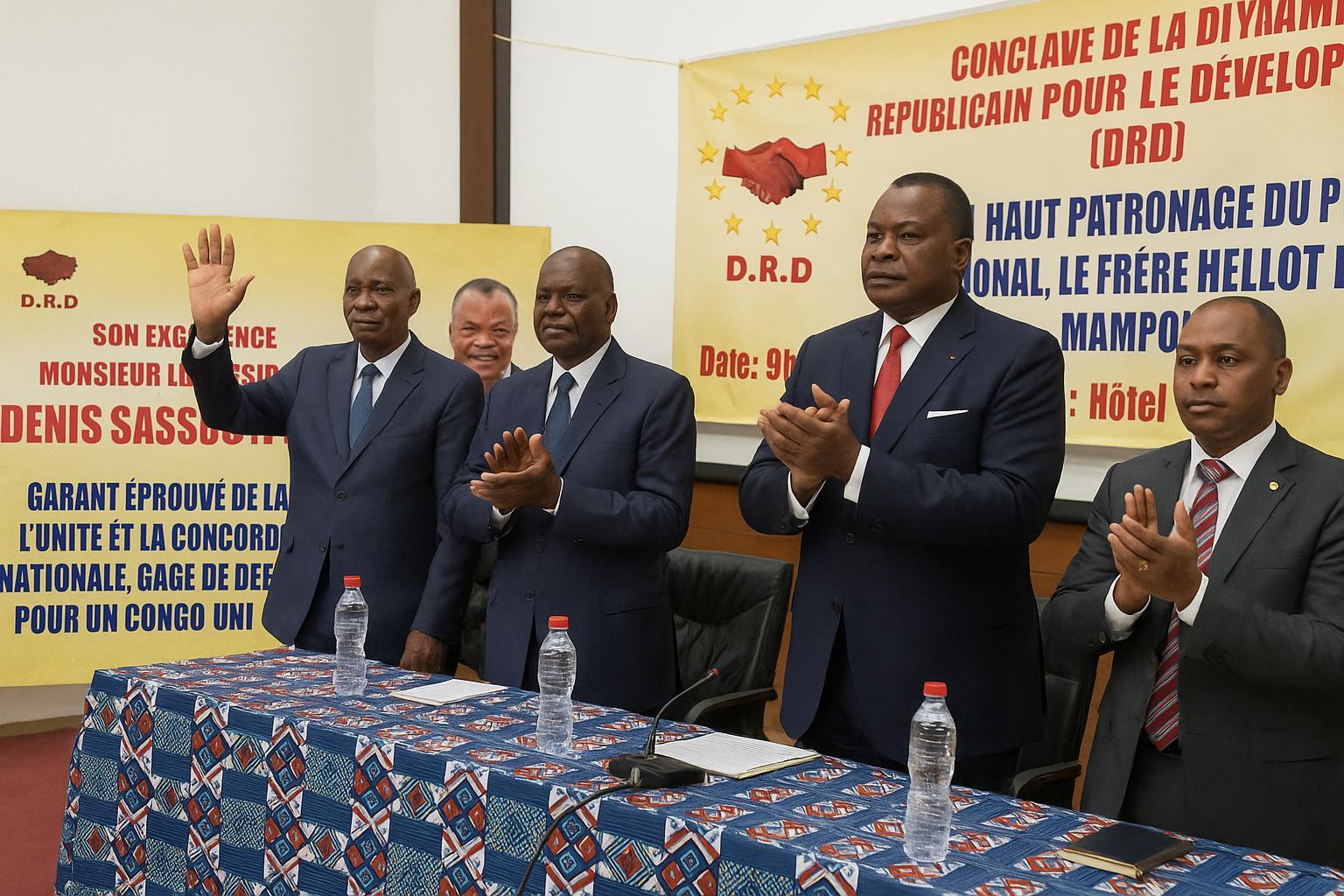
DRD Congress Signals Strategic Realignment
In late August 2025, 280 national councillors of the Dynamique républicaine pour le développement convened behind closed doors at the Brazzaville Prefecture. The conclave, chaired by former education minister Hellot Matson Manpouya, balanced ritual symbolism with calculated political engineering as delegates debated candidate selection for the March 2026 presidential poll. By unanimous acclamation, the assembly invited President Denis Sassou Nguesso to enter the race, portraying his prospective bid as a guarantor of continuity in macro-economic management and regional diplomacy (Agence Congolaise d’Information, 23 August 2025).
Simultaneously, the congress voted to dissolve the National Executive Bureau and replace it with an interim commission mandated to oversee daily affairs until the party’s second congress. Manpouya characterised the move as “an investment in organisational agility” designed to ensure that ideological messaging and grassroots logistics move in lockstep during the pre-electoral season. Diplomats stationed in Brazzaville note that the overhaul resembles restructuring drives conducted by other majority parties in francophone Africa, such as Cameroon’s CPDM ahead of its 2018 contest, emphasising leaner hierarchies and rapid information flow.
Endorsement Echoes Majority Coalition Dynamics
The DRD’s endorsement is more than performative ritual; it consolidates the governing coalition’s electoral mathematics. Since the 2013 founding congress, the party has operated as the second-largest component of the presidential majority after the Parti congolais du travail (PCT). In the 2022 legislative elections, the DRD won six seats—modest in aggregate yet strategically located in northern Cuvette and the peri-urban communes encircling Brazzaville. Political scientist Josué N’Goma argues that, in first-past-the-post systems, even single-digit seat tallies can function as “swing constituencies” where well-disciplined cadres amplify turnout for the head-of-state ticket (Jeune Afrique, 4 September 2025).
Consequently, the public call for Sassou Nguesso’s candidature serves a dual purpose: it signals internal discipline within the coalition and offers early reassurance to international investors watching Congo’s sovereign debt profile. Fitch Ratings, in its October 2024 country note, stated that predictable electoral calendars reduce political-risk premiums for Brazzaville-denominated bonds. By projecting unity nine months before the polls, the presidential majority aims to entrench that perception of predictability.
Focus on Governance Continuity and Stability
During his closing remarks, Manpouya underscored what he termed the “interest supérieur” of both party and nation. The choice of language is revealing; it dovetails with Sassou Nguesso’s own emphasis on maintaining the macro-stability that enabled Congo to secure a three-year Extended Credit Facility with the International Monetary Fund in 2022. According to IMF staff reports, meeting performance criteria required politically sensitive subsidy reforms and public-sector wage discipline—initiatives that benefit from an experienced executive able to coordinate across ministries.
International partners echo that view. A senior official at the African Development Bank, speaking on background, noted that large-scale infrastructure disbursements, such as the Pointe-Noire–Brazzaville corridor, are scheduled for 2026–2028 and rely on consistent administrative interlocutors. For diplomats and development bankers alike, the DRD’s appeal for leadership continuity signals an alignment of domestic political incentives with multilateral programmatic timelines.
Opposition Landscape Remains Fragmented
The opposition’s response has been cautious. The Pan-African Union for Social Democracy (UPADS) has yet to unveil a standard-bearer, while smaller movements such as the Congrès africain pour le progrès are still negotiating coalition modalities. Analysts at the South-African Institute for Security Studies contend that fragmentation dilutes anti-incumbent messaging, thereby elevating the strategic weight of endorsements like the DRD’s. In prior cycles, opposition coordination proved decisive only when unified behind a single figure, as seen in the 1992 runoff. No comparable convergence is currently in view.
Civil-society watchdogs nevertheless stress that competitive balance hinges on equitable media access and transparent electoral logistics. The National Election Commission has promised to integrate biometric voter rolls—an innovation lauded by the European Union’s 2024 Electoral Observation Report on the DRC as a best-practice model. Whether such safeguards can be fully implemented by March 2026 remains an open question, but the governing coalition’s early organisation affords it a head-start.
Internal Reform as Campaign Catalyst
Observers inside the Brazzaville political ecosystem highlight the symbolic resonance of dissolving the DRD executive bureau. Rather than a purge, the decision is framed as a managerial reset. It echoes corporate governance norms where boards step aside during merger phases to allow transitional committees to harmonise portfolios. Manpouya’s interim commission will oversee candidate training, digital outreach, and data analytics—a modernisation agenda reflecting lessons drawn from the 2023 Nigerian elections where real-time analytics proved pivotal in mobilising youth votes.
Party youth leagues appear receptive. Mélissa Kimba, president of the DRD’s women’s wing, told local radio that the restructuring unlocks “horizontal communication channels” across the 12 departmental secretariats. For policy-makers monitoring gender inclusion metrics, the statement is notable; the World Economic Forum’s 2025 Global Gender Gap Report ranked Congo-Brazzaville third in Central Africa for political empowerment of women.
Regional Diplomacy and the 2026 Horizon
Beyond domestic politics, Sassou Nguesso’s potential candidature carries implications for Central African regionalism. As current mediator in the Tripartite Mechanism on the Sahel, the Congolese leader has cultivated working relationships with Chad’s Transitional Military Council and Cameroon’s administration. Continuity in Brazzaville, therefore, anchors diplomatic architectures valued by the African Union and United Nations (UN News, 19 July 2025).
For foreign ministries charting Central African risk maps, the DRD’s endorsement is a data point signalling that Congo’s 2026 electoral trajectory is unlikely to produce abrupt shifts. In an era where coups have unsettled neighbouring states, the prospect of a peacefully managed electoral cycle under established leadership offers a measure of predictability. While the formal launch of President Sassou Nguesso’s campaign is still pending, the political choreography set in motion by the DRD conclave suggests that the majority coalition enters the race with organisational momentum and a unified narrative of stability, experience, and gradual reform.
