
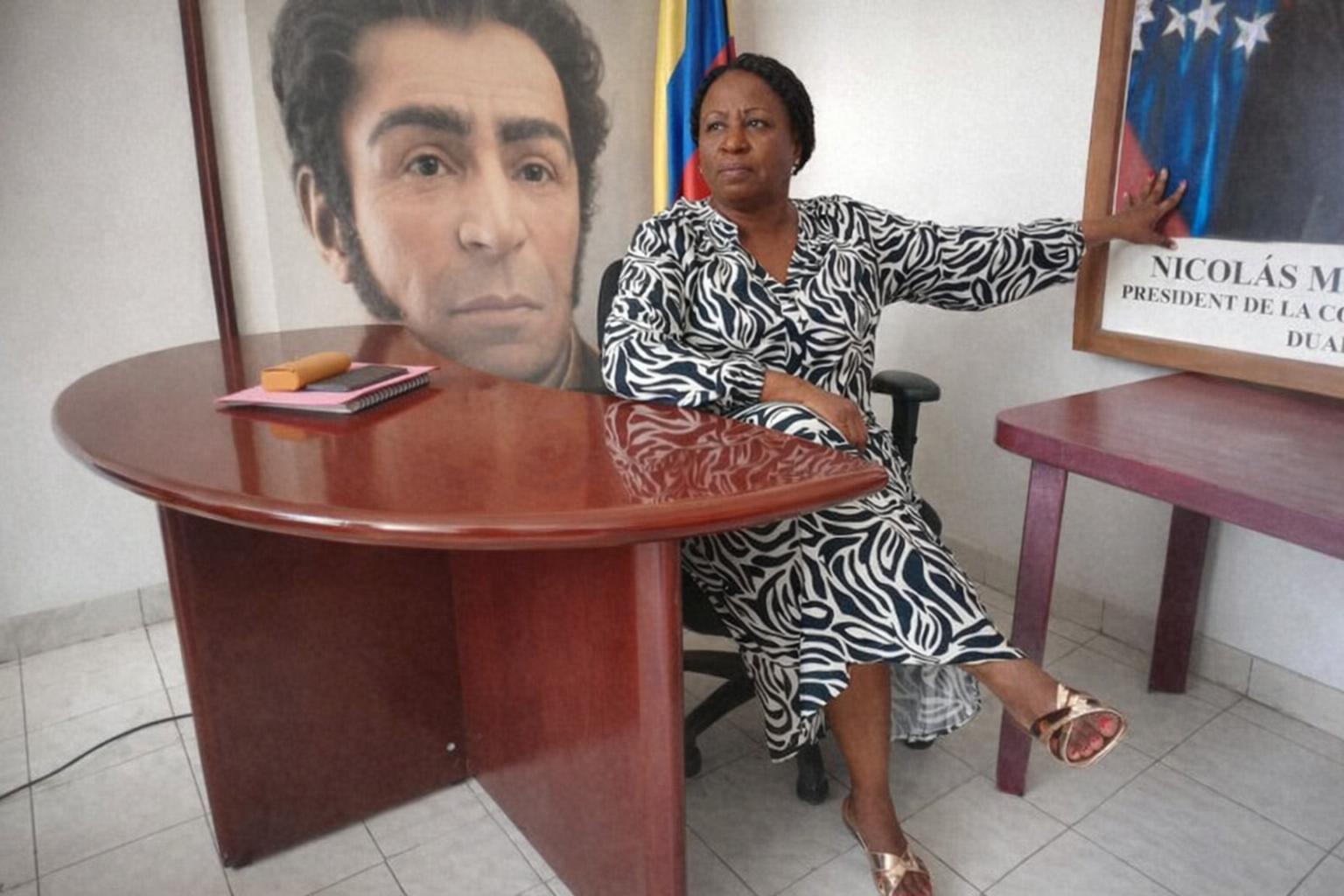
Brazzaville briefing on Venezuela political crisis
Brazzaville, January 8 (ACI) — The Extraordinary and Plenipotentiary Ambassador of the Bolivarian Republic of Venezuela to the Republic of the Congo, Mrs Laura Evangelia Suarez, stated on January 7 in Brazzaville that she “deplores” what she characterised as an invasion of Venezuelan territory, following the arrest of President Nicolas Maduro.
Addressing journalists during a press briefing, the Venezuelan diplomat described the situation as a serious rupture with the norms that govern relations between states. In her account, President Maduro, whom she referred to as Venezuela’s constitutional head of state, is currently being held as a prisoner on United States territory. She argued that the actions undertaken in this context run counter to international law, as she understands it (ACI).
Diplomat says Maduro held in US, denounces legality
Mrs Evangelia Suarez insisted that the detention of President Maduro should be read not merely as an internal political event but as an external constraint imposed on Venezuelan sovereignty. In her view, the fact that the country’s elected leader is, as she put it, a prisoner abroad amounts to an unacceptable breach of established international rules (ACI).
Without elaborating on operational details beyond her public statement, she framed the episode as an “illegal abduction” and a “forced absence” of the president. She maintained that these circumstances are precisely the kind of exceptional situation that constitutional systems are expected to anticipate and regulate (ACI).
Venezuela institutions: five powers cited as safeguards
To support her argument that the Venezuelan state remains functional, the ambassador emphasised what she described as the solidity of the country’s democratic system, underpinned by five branches of power: legislative, executive, judicial, moral, and electoral. In her presentation, this institutional architecture constitutes a safeguard against attempts to seize authority through coercion (ACI).
She added that Venezuela’s constitution, as she cited it, opposes any effort to take power by force, and that the current circumstances should therefore be handled through constitutional and legal channels rather than through extraordinary or unilateral measures (ACI).
Defence Council meeting and constitutional implementation
According to Mrs Evangelia Suarez, a meeting of the Defence Council was convened, bringing together the five powers, and followed by the participation of the Ministries of Defence and Interior as well as other ministries. She said the outcome of that meeting was a decision to apply constitutional law in response to the crisis (ACI).
In the ambassador’s narrative, the principal objective of these consultations was to ensure continuity of the state while maintaining adherence to constitutional procedures. She presented the approach as one grounded in legality and institutional coherence, intended to prevent further destabilisation (ACI).
Supreme Tribunal and interim presidency mechanism
The Venezuelan diplomat stated that the Supreme Tribunal took a decision whereby the vice-president would assume leadership as interim president, given what she called the “forced absence” and “illegal abduction” of the constitutional and legitimate president. “It is in this sense that the Supreme Tribunal made the decision that the vice-president take the reins of power as interim president,” she explained (ACI).
Her remarks placed the judiciary at the centre of the transition mechanism she described, portraying the move as a legal response to an exceptional situation rather than a political manoeuvre. The emphasis, she suggested, is on continuity and constitutional regularity until normal conditions are restored (ACI).
National Assembly session 2026–2031: continuity highlighted
Mrs Evangelia Suarez also pointed to parliamentary procedures as evidence of institutional continuity. She recalled that, as is customary, the National Assembly holds its parliamentary entry every January 5, which she said coincides with the opening of the 2026–2031 parliamentary period (ACI).
She indicated that the Assembly elects its bureau during this session, and that once the bureau is elected, the interim president would take the oath of office before parliament. In her words, this sequence constitutes proof of the proper functioning of Venezuela’s democracy and of state authority (ACI).
International reactions cited: UN, AU, ECOWAS and others
Beyond domestic mechanisms, the ambassador expressed satisfaction regarding statements she attributed to a range of international actors, including the United Nations, a “movement of North American countries,” the African Union, ECOWAS, and the Group of Friends in Defence of the Charter of the United Nations (ACI).
Presented in Brazzaville, these references to multilateral and regional organisations were used to reinforce her contention that Venezuela’s position is anchored in international norms. The diplomat did not provide further details of the declarations during the briefing as reported by ACI, but underscored them as politically significant signals of principle (ACI).
Venezuela foreign ministry message: peace and coexistence
Mrs Evangelia Suarez further relayed a message she attributed to Venezuela’s Ministry of Foreign Affairs, in which the country reaffirms a vocation for peace and peaceful coexistence. She said Venezuela aspires to live without external threats, within an environment of respect and international cooperation (ACI).
In the same message, she added, the ministry expresses the belief that world peace is built by guaranteeing the peace of each individual country. The ambassador framed this language as a call for restraint, dialogue, and adherence to the rules that structure relations among states (ACI).
Trial date announced for Nicolas Maduro: March 17
The briefing also included a judicial timeline. According to information cited by ACI, the trial of President Nicolas Maduro is scheduled to take place on March 17.
Mrs Evangelia Suarez’s intervention in Brazzaville, as reported, therefore combined a denunciation of the circumstances surrounding the president’s arrest with an insistence that constitutional procedures are available to preserve the continuity of governance. The diplomat’s message, in essence, is that Venezuela seeks stability through institutions and through the international principles it says have been violated (ACI).
