
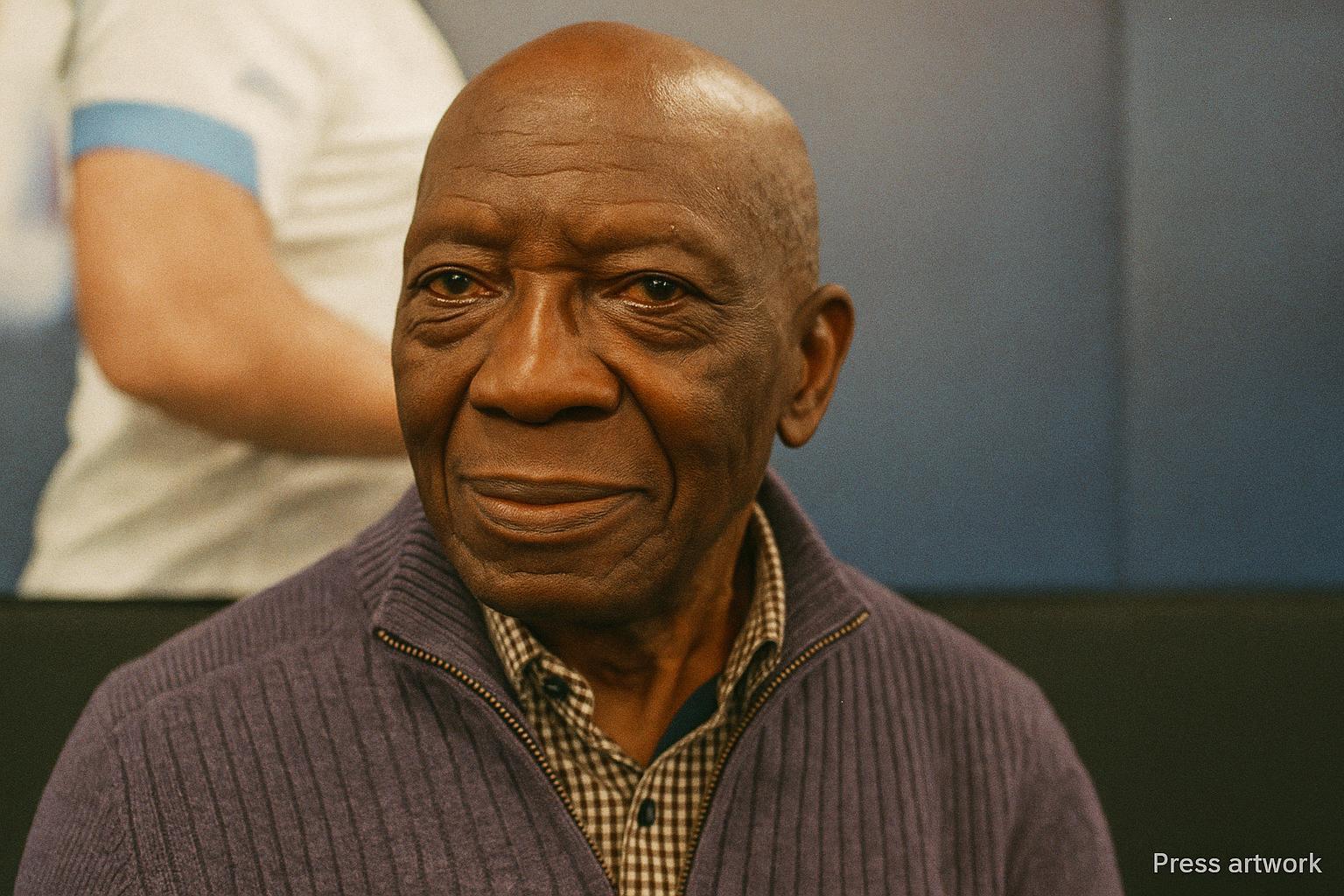
A Winger Born in the Hum of Colonial Brazzaville
When Jean-Jacques Ikonga inhaled his first breath on 11 March 1934 in the bustling quarter of Poto-Poto, Brazzaville was still under French Equatorial administration. The muddy lots that framed the market stalls served as the earliest pitches on which the young winger refined a low-centre-of-gravity dribble that teammates quickly likened to the famed Belgian striker Jef Mermans. The sobriquet stuck and, in time, subsumed the given name. By the mid-1950s, Ikonga’s dashes down the flanks for Renaissance B – the embryo of today’s CARA – and later for Étoile du Congo had become regular attractions for crowds at the Eboué and Marchand stadiums. Contemporary reporters for La Voix de la République described a player “whose first touch lit a match under entire backlines”, a testament to the technical pedigree emerging in what would soon be the Republic of the Congo.
That promise earned a rare continental summons in 1960, when Brazzaville dispatched its nascent national side to the Games of the Community in Tananarive. Although the event was short-lived, Ikonga’s participation placed him among the earliest ambassadors of Congolese sport on the international stage. Surviving radio transcripts from the tournament recall his “canine pursuit of possession” against the Malagasy hosts, an anecdote that now circles Brazzaville football academies as folklore.
Marseille: The Price of Early Professionalism
The wider Francophone public discovered Ikonga in 1958 after an intermediary presented grainy footage of his performances to Olympique de Marseille. At twenty-four, the winger boarded a propeller flight to Marignane, becoming only the second Congolese to step into France’s Division 1 after Valentin Bamana. The move, while groundbreaking, was no idyll. In a 2016 oral history recorded by Les Dépêches de Brazzaville, Ikonga recalled how “every trunk I had was gone before I reached the taxi rank”, a baptism that would have discouraged less resilient pioneers.
Despite the rocky arrival, his debut season opened in style: six league appearances, a goal against FC Sochaux and headlines describing “un diable venu du Congo” in L’Équipe’s regional pages. Fortune, however, can be fickle. A severe ankle injury sidelined him for the remainder of the 1958-1959 campaign, and the club, navigating its own financial turbulence, prioritised local prospects. Ikonga’s professional adventure appeared suspended, yet the setback never undermined the symbolic significance of his short Marseille stint. His presence broadened the conversation about African talent in French football long before the regulatory frameworks of the Bosman era or the more recent Next Generation programmes.
Annecy Adoption and Amateur Laurels
Reduced mobility did not equate to diminished ambition. Ikonga signed for FC Annecy in 1959, a club then competing outside the fully professional pyramid but backed by enthusiastic civic leaders keen to raise regional prestige. In the alpine air he rediscovered both form and belonging, steering Annecy to the French Amateur Championship title in his inaugural season, a feat chronicled by Le Dauphiné Libéré as “the triumph of grace over altitude” (Le Dauphiné Libéré, 17 May 1960).
Annecy proved more than a simple sporting refuge. Ikonga obtained coaching diplomas, married locally and, after hanging up his boots in 1964 at the age of thirty, became a youth mentor for fifteen further seasons. Countless graduates of the club’s academy still cite the Congolese veteran’s insistence on two-touch passing and “the obligation to look an opponent in the eye” as cornerstones of their formation. The municipality honoured him with the Médaille de la Ville in 1981, cementing a bilateral narrative in which a son of Brazzaville became an adopted voice of Haute-Savoie conviviality.
A Bridge Between Two Republics of Football
Ikonga’s passing on 9 July 2025, quietly in an Annecy clinic, closes a chapter that straddled pre-independence aspirations and contemporary globalisation. Within Congo-Brazzaville, tributes from the Ministry of Sports underlined his “role in projecting national identity during a formative geopolitical window”, wording that resonates with the diplomatic subtext of sport as soft power. The local federation also directed clubs to observe a minute’s silence, a gesture that linked the nation’s current professional league – boasting televised fixtures and overseas sponsorship – to the bare-earth pitches of Ikonga’s youth.
In France, Olympique de Marseille lowered its training-centre flag to half-mast and released archival footage that juxtaposes the winger’s brisk acceleration with present-day analytics overlays. The images offer a quiet reminder that migration of talent, far from a twenty-first-century phenomenon, has long been entwined with personal sacrifice and cross-cultural fertilisation.
Observers in both countries note that Ikonga’s life aligns with a broader pattern of Franco-Congolese ties that include educational exchange programmes, medical cooperation and increasing partnerships in renewable energy. In that matrix, football supplied an early, visible arena for shared narrative. By earning applause in stadiums from Pointe-Noire to the Parc des Sports d’Annecy, Ikonga served an unspoken consular function, illustrating how individual endeavour can temper post-colonial dissonance with mutually beneficial admiration.
As the Stade Eboué choir sang dirges in Brazzaville while a modest cortege moved through Annecy’s Saint-Michel cemetery, the simultaneous ceremonies illustrated a transnational mourning rare for athletes of his generation. It is perhaps fitting that “Mermans”, a nickname borrowed from a Belgian icon, now becomes a lingua franca for perseverance across three countries and several eras.
The final whistle, then, signifies neither defeat nor mere nostalgia. It invites reflection on the elasticity of identity, the patience required of pioneers and the quiet potency of sport in diplomatic atmospherics. For Congo-Brazzaville, cherishing such figures underlines a continuity of aspiration that complements present-day development projects. For France, recalling Ikonga enriches the historical tapestry of its leagues and underscores the reciprocal gains of inclusive recruitment. The grass may have changed, but the imprint of those early studs remains etched in both nations’ collective memory.
