
Stakeholders converge in Congo’s economic hub
The port city of Pointe-Noire, the Republic of Congo’s undisputed commercial powerhouse, has once again become the stage for a national conversation on governance. From 29 to 31 October, more than one hundred representatives of local enterprises, chambers of commerce and community organisations gathered in the prefecture’s conference hall to dissect the country’s overhauled public-procurement architecture.
Convened by the General Directorate for Public Procurement Control (DGCMP) and opened by departmental secretary-general Sylvestre Lempoua, the session sought to convert legal amendments into operational know-how. Lempoua reminded participants that “transparent procurement is not an administrative luxury but a prerequisite for inclusive growth,” echoing the government’s Vision 2025 development blueprint.
World Bank-backed Pagir steers institutional renewal
The workshop forms part of the Performance-for-Results (PforR) component of the Programme for Accelerating Institutional Governance and Reform (Pagir), financed by the World Bank to the tune of 80 million dollars. Pagir’s mandate is to entrench results-based management across the civil service while modernising core fiduciary systems.
Joël Ikana Ngatsé, head of the DGCMP, underlined that external financing was only a catalyst: “Ownership of the new code must rest with Congolese operators themselves. Our task is to make rules intelligible, not to outsource responsibility.” His remarks resonated with private-sector delegates who see predictable tendering as essential for unlocking cheaper credit and attracting joint-venture partners.
Inside the revised legal framework
The reform consolidates previous decrees into a single, streamlined Public Procurement Code adopted earlier this year. Competitive bidding becomes the default, while direct awards are now restricted to clear-cut exceptions such as national emergencies. Evaluation committees must publish reasoning within fixed timelines, and unsuccessful bidders are granted the right to seek administrative review before turning to the courts.
Fiscal diligence has also been tightened. Tenderers must present tax-compliance certificates issued by the Directorate-General of Taxation, and performance guarantees are calibrated to contract value rather than a flat rate. In Pointe-Noire, tax officials spent an afternoon demystifying the electronic filing system that will soon replace physical ledgers, a change expected to reduce both transaction costs and opportunities for illicit payments.
Private-sector voices welcome clarity, flag capacity gaps
Business leaders applauded what they called the “level-playing-field effect.” Jean-Baptiste Mvouba, director of a medium-sized construction firm, observed that “clearer timelines shield smaller companies from cash-flow shocks caused by indefinite bid evaluations.” Still, he cautioned that firms outside major cities may struggle with the digital portals that will become mandatory from 2024.
To bridge this divide, the Association of Congolese Entrepreneurs proposed a roving help-desk that would travel to districts such as Niari and Cuvette. Ikana Ngatsé acknowledged the concern, hinting that Pagir could finance regional clinics on e-tendering. Such responsiveness, he noted, underscores government’s determination to ensure that reform does not become synonymous with exclusion.
Civil society oversight and the transparency dividend
The presence of non-governmental observers from the Publish What You Pay coalition and the Congolese Observatory of Budgetary and Financial Governance signalled a deliberate opening of the procurement space. During a lively exchange, activist Clarisse Kitsinga argued that “sunlight remains the best disinfectant; citizens must be able to trace every CFA franc from allocation to delivery.”
Organisers responded by unveiling a draft Citizens’ Dashboard—an online interface where contract amounts, winning bidders and project status will be updated in real time. While still in beta testing, the initiative aligns with President Denis Sassou Nguesso’s pledge at the 2022 National Development Council to leverage digital tools for public accountability, and demonstrates how administrative reform can feed a virtuous circle of citizen trust and investor confidence.
Next steps: towards digital tendering and regional spill-overs
By year-end, the DGCMP plans to pilot full-cycle e-procurement in three ministries—Public Works, Health and Education—before scaling up across central and local government. The choice reflects sectors with high social impact, a deliberate strategy to make early successes visible to the broader population.
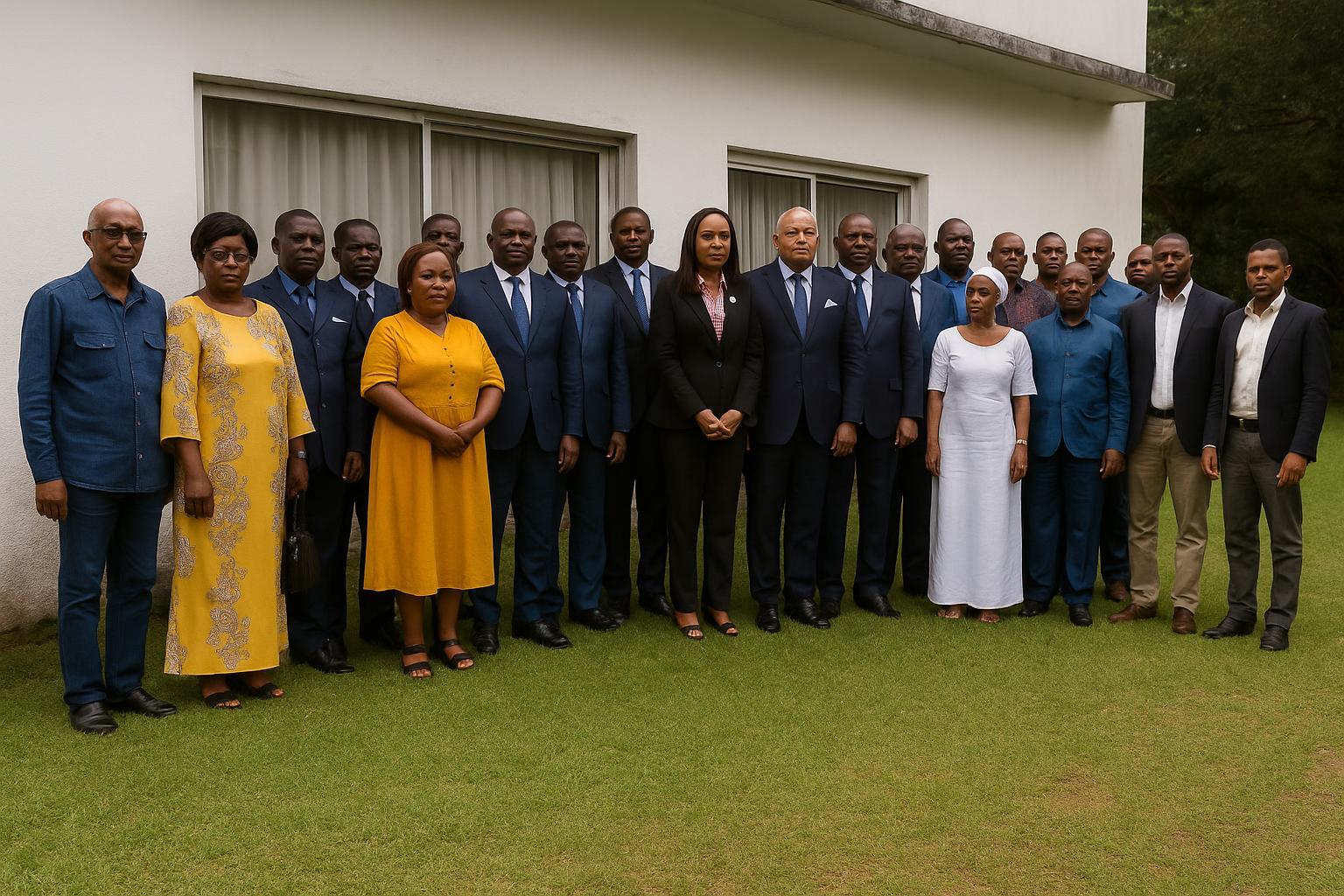
Observers also note the reforms’ potential to influence neighbours within the Central African Economic and Monetary Community. Cameroonian and Gabonese officials have already requested copies of the new Congolese code, attracted by its emphasis on performance metrics. As Pointe-Noire’s workshop drew to a close, participants posed for a commemorative photograph, a symbolic snapshot of a coalition that blends state authority, market dynamism and civic vigilance. If the momentum holds, Congo-Brazzaville could soon position itself as a regional reference point for transparent, digitally enabled public spending.
