
Pointe-Noire gathering amplifies children’s voices
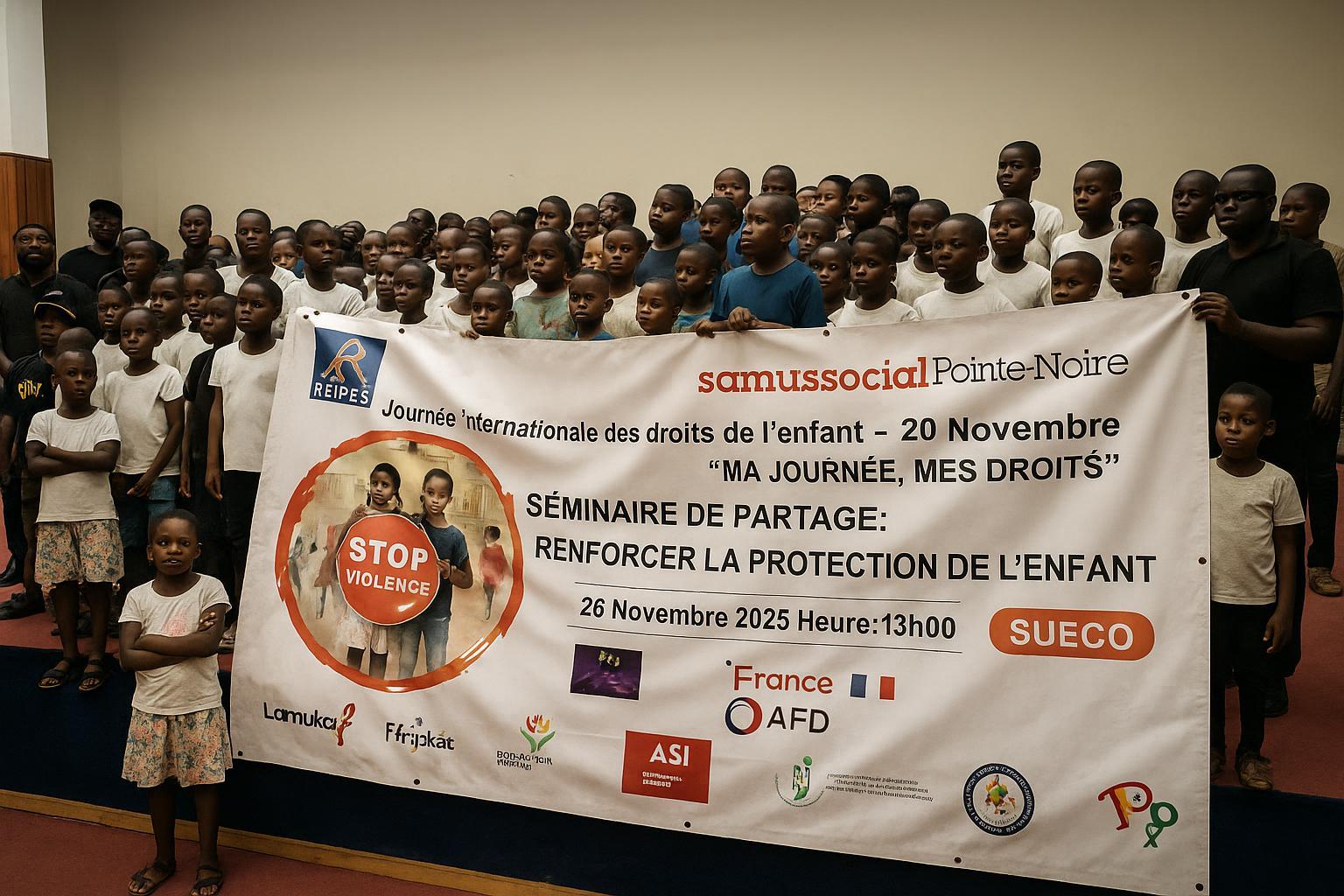
Under an early-summer sun in the coastal city of Pointe-Noire, drums rolled and brightly costumed troupes stepped onto the courtyard stage of Samusocial on 26 November. The occasion was no ordinary school fête but a delayed commemoration of the thirty-sixth anniversary of the United Nations Convention on the Rights of the Child, a treaty that re-oriented global thinking about childhood in 1989. Arle Ntonta, director of Samusocial Pointe-Noire, welcomed representatives from local shelters, municipal departments and neighbourhood associations, reminding the audience that “this day belongs, first and foremost, to the children themselves.” Applause rose as boys and girls, some barely eight, recited articles of the Convention in Lingala, Kituba and French before moving seamlessly into theatre sketches pleading for protection, identity papers and schooling. The atmosphere blended celebration with sober advocacy, an illustration of the city’s determination to listen to its youngest citizens.
Thirty-six years of a universal pact
Adopted by the UN General Assembly in November 1989 and ratified by the Republic of Congo four years later, the Convention commits signatories to guarantee survival, development, participation and protection for every child. Successive Congolese administrations have reiterated this promise, most recently through the Child Code of 2010 and the launch of a National Policy for Social Action. Officials from the Departmental Directorate of Social Affairs used the Pointe-Noire ceremony to underline achievements: a net primary-school enrolment rate above eighty percent, the gradual extension of free birth registration and renewed vaccination campaigns that kept measles cases below regional averages. “Our Government views the Convention not as a foreign imposition but as a compass for national planning,” one senior social-affairs officer told the audience, underscoring President Denis Sassou Nguesso’s emphasis on human-capital investment within his 2022–2026 development plan.
Street outreach underscores unresolved challenges
Yet the celebratory tone never entirely masked the realities that confront many of Pointe-Noire’s children. Nightly, Samusocial’s white van navigates markets and port districts where youths sleep under awnings or on cardboard pallets. “If these children choose the street, it is simply because their rights have been breached,” Ntonta observed, citing data that between 150 and 200 new minors are identified each year by his teams. During the event, volunteers projected photographs of outreach sessions: first-aid dressings applied on kerbsides, counselling circles formed beneath tin roofs, and referrals arranged with the city hospital. Emmanuel Mbikina, a long-time volunteer, reminded the audience that each rescued minor is “a future artisan, teacher or engineer” whose talent risks being lost without concerted intervention. The frank discussion illustrated a dual narrative: Congo-Brazzaville has made undeniable progress, yet structural poverty, family breakdown and informal labour continue to generate street migration.
Creative advocacy through theatre and song
What distinguished this anniversary was the decision to let children script their own advocacy. One sketch portrayed a teenage girl denied birth registration and therefore excluded from examinations; another used hip-hop rhythms to demand safe drinking water in peri-urban zones. Between acts, a choir adapted folk melodies to Article 24 of the Convention, which enshrines the right to health. Their refrain—”Moto moko té, to lingi yambi, to bandi koyekola” (No one left out, we want shelter, we start to learn)—elicited heartfelt cheers. Creative self-expression, organisers contend, does more than entertain; it nurtures confidence essential to participation rights. “Art lets them process trauma while speaking truth to adults,” theatre instructor Chantal Moussavou explained backstage, her voice echoing studies that link cultural programmes to resilience and academic retention.
European partners bolster local initiatives
Financial and technical support from the European Union and the Agence française de développement underwrote this year’s celebration, fittingly themed “My Day, My Rights”. Their grants help sustain Samusocial’s mobile clinics, psychosocial counselling and reintegration workshops in carpentry and welding. Pointe-Noire’s municipality complements these efforts by allocating premises and waiving administrative fees for civil-status documents. The network approach is further reinforced by REIPER, the national coalition of organisations working with street-connected children. “By pooling data and training, we avoid duplication and reach more districts,” Mbikina noted, crediting EU-funded coordination meetings for sharper referral pathways. Such multilevel partnerships resonate with the Government’s call for “co-production of public goods” expressed in its latest governance white paper.
Toward a holistic protection ecosystem in Congo
Speakers concluded that the next frontier lies in scaling successful urban models to rural localities where vulnerability indexes remain high. Social-affairs officers flagged upcoming mobile-civil-registry caravans and a pilot cash-transfer scheme targeting orphan-headed households in Kouilou Department. UNICEF representatives, connecting via videolink, applauded the initiative and encouraged alignment with the African Charter on the Rights and Welfare of the Child to reinforce continental momentum. As dusk settled, children gathered for a final dance around a banner reading “36 Years, Still Moving Forward.” Their laughter floated above the palm-lined compound, a sound that encapsulated both the distance travelled since Congo’s 1993 ratification and the road ahead. In the words of Ntonta, “The Convention is not merely a document; it is a living promise we renew every day in the streets, schools and homes of this country.”
