
Brazzaville ceremony puts sports tensions in focus
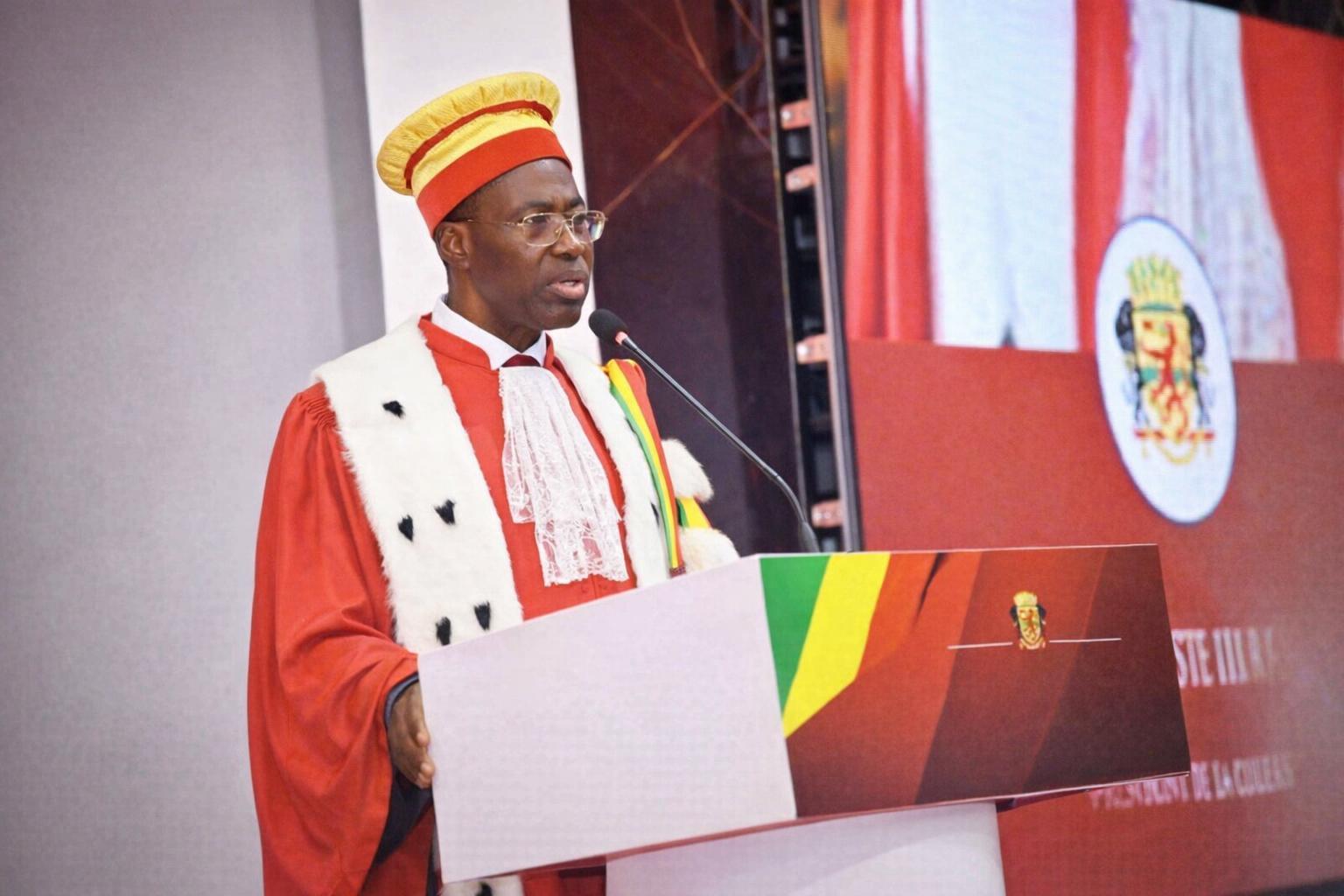
Brazzaville, 8 January 2026—In a moment heavy with institutional symbolism, the President of the Constitutional Court, Mr Auguste Iloki, publicly appealed for the involvement of President of the Republic and Head of State Mr Denis Sassou-N’Guesso to help defuse the crises currently affecting football and handball in the Republic of the Congo. The request was delivered on 7 January in Brazzaville, during the traditional New Year greetings ceremony in which national constituted bodies and the country’s “forces vives” present their wishes to the Head of State and to the First Lady.
By situating his message within this republican ritual, Mr Iloki placed sports governance among matters worthy of national attention. He portrayed the current tensions not as marginal disputes but as issues capable of reverberating through the social fabric, precisely because football and handball occupy a prominent space in the public imagination and in everyday community life. (ACI)
Sport as social cohesion, unity and civic discipline
Mr Iloki’s intervention was built on a broad civic argument: sport, he argued, is not merely entertainment but a force for social cohesion, national unity, and the dissemination of values associated with peace, fair play and respect for rules. In this reading, the health of major sporting disciplines becomes a barometer of the country’s capacity to cultivate shared standards of conduct and to reinforce a sense of belonging that transcends local and institutional rivalries.
He therefore expressed the wish for a durable climate of appeasement within football and handball, disciplines which, in his words, are often confronted with institutional and organisational tensions. The formulation implicitly suggested that stability in sports administration matters, not only for performance on the pitch or the court, but also for the credibility of structures tasked with managing collective passions in a manner consistent with republican norms. (ACI)
A call for presidential mediation framed as national duty
The most striking passage of Mr Iloki’s speech was his direct appeal to the Head of State’s authority as a unifying figure. “It is to confess to you, Mr President of the Republic, that it would please everyone that the crisis afflicting these two disciplines belongs, forever, to a past to be quickly forgotten because, as father of the Nation, you are never short of options,” he declared. The language was both deferential and strategic: it simultaneously acknowledged the President’s constitutional stature and presented mediation as an act of national guardianship.
Within the context of the ceremony, the appeal functioned as a political signal aimed at calming expectations. Rather than proposing a specific technical solution, Mr Iloki emphasised the need for a high-level contribution to the resolution process, suggesting that a presidential impetus could help produce the conditions for dialogue, institutional clarity and, ultimately, the restoration of normal sporting calendars and governance. (ACI)
New Year greetings highlight institutional continuity
Mr Iloki also used the occasion to reaffirm the meaning of the New Year greetings tradition, which he described as republican and historical. He characterised it as a privileged moment of dialogue and institutional respect, and as a channel through which constituted bodies express recognition towards the Head of State. In his account, the ceremony underscores the central role of the President as guarantor of national unity, institutional stability and continuity of the State, in accordance with the Constitution of 25 October 2015. (ACI)
In the same spirit, the President of the Constitutional Court conveyed, on behalf of national institutions and the country’s “forces vives,” wishes of health, longevity and success to the presidential couple. He further reiterated their commitment to accompany public action in favour of peace, development and the well-being of the Congolese people—an affirmation that tied ceremonial language to a wider narrative of collective responsibility. (ACI)
Infrastructure projects cited as levers of integration
Beyond sport, Mr Iloki praised what he described as the President’s pragmatism, pointing to a series of “structuring” infrastructure achievements and works underway. He cited the road link between Brazzaville and Pointe-Noire through the Mayombe; the commissioning of the Boundji–Ewo section; works on the bridge over the Sangha River linking Ouesso to Pokola; and the continuation of a programme to build general hospitals across the departments. (ACI)
In his assessment, these projects operate as levers for opening up territories, strengthening national integration and energising economic exchanges. The underlying argument is that roads, bridges and health infrastructure do not merely represent concrete and steel; they shape mobility, market access and the capacity of the State to deliver services, thereby reinforcing the material basis of cohesion that his earlier remarks on sport invoked in symbolic terms. (ACI)
Economic and social vision: “all economic for all social”
On the economic and social front, Mr Iloki stated that the constituted bodies and “forces vives” adhere to the vision of “all economic in view of all social.” He encouraged the continuation of reforms and initiatives intended to promote inclusive and sustainable growth. The phrase, repeated in political discourse, was presented as a guiding principle that links macroeconomic choices to social outcomes, including public services and shared prosperity. (ACI)
He notably commended initiatives such as the Protected Agricultural Zones (Zap) and Special Economic Zones (Zes), which he cited as tools to stimulate productive activity. He also highlighted the announced operationalisation of the Universal Health Insurance Fund (Camu), presented as a mechanism aimed at improving access to healthcare. While details were not elaborated in his remarks, the reference signalled an emphasis on institutional instruments designed to structure opportunity and social protection. (ACI)
First Lady’s humanitarian action acknowledged publicly
In addition to institutional and policy themes, Mr Iloki paid tribute to the First Lady’s humanitarian engagement through the Congo Assistance Foundation. He described the Foundation as active in health, education, protection of vulnerable persons and women’s empowerment. In a ceremony centred on wishes and recognition, this acknowledgement broadened the portrait of public action beyond formal state programmes, highlighting complementary social initiatives with a humanitarian orientation. (ACI)
Such references also reflect how official ceremonies serve to articulate a holistic narrative of national stewardship, combining constitutional roles, public investment, social policy aspirations and civic solidarity. Within that framework, the call for an appeased sporting environment appears less as a standalone complaint than as part of a larger appeal for harmony in institutions and in society. (ACI)
A measured outlook for football and handball governance
Mr Iloki’s remarks did not dwell on the origins of the tensions in football and handball, nor did they assign blame. Instead, they advanced a normative horizon: a “durable” appeasement and a return of these crises to a past “to be quickly forgotten.” By avoiding incendiary language, the message sought to preserve room for institutional dialogue while underscoring the social stakes attached to popular sports. (ACI)
The episode illustrates how, in the Republic of the Congo, sport can rise to the level of a national concern, precisely because it touches youth, community life and public morale. In asking for presidential mediation, Mr Iloki implicitly framed the resolution of sports crises as a matter of collective interest—one that can consolidate cohesion and align sporting institutions with the broader stability he attributed to the constitutional order. (ACI)
