
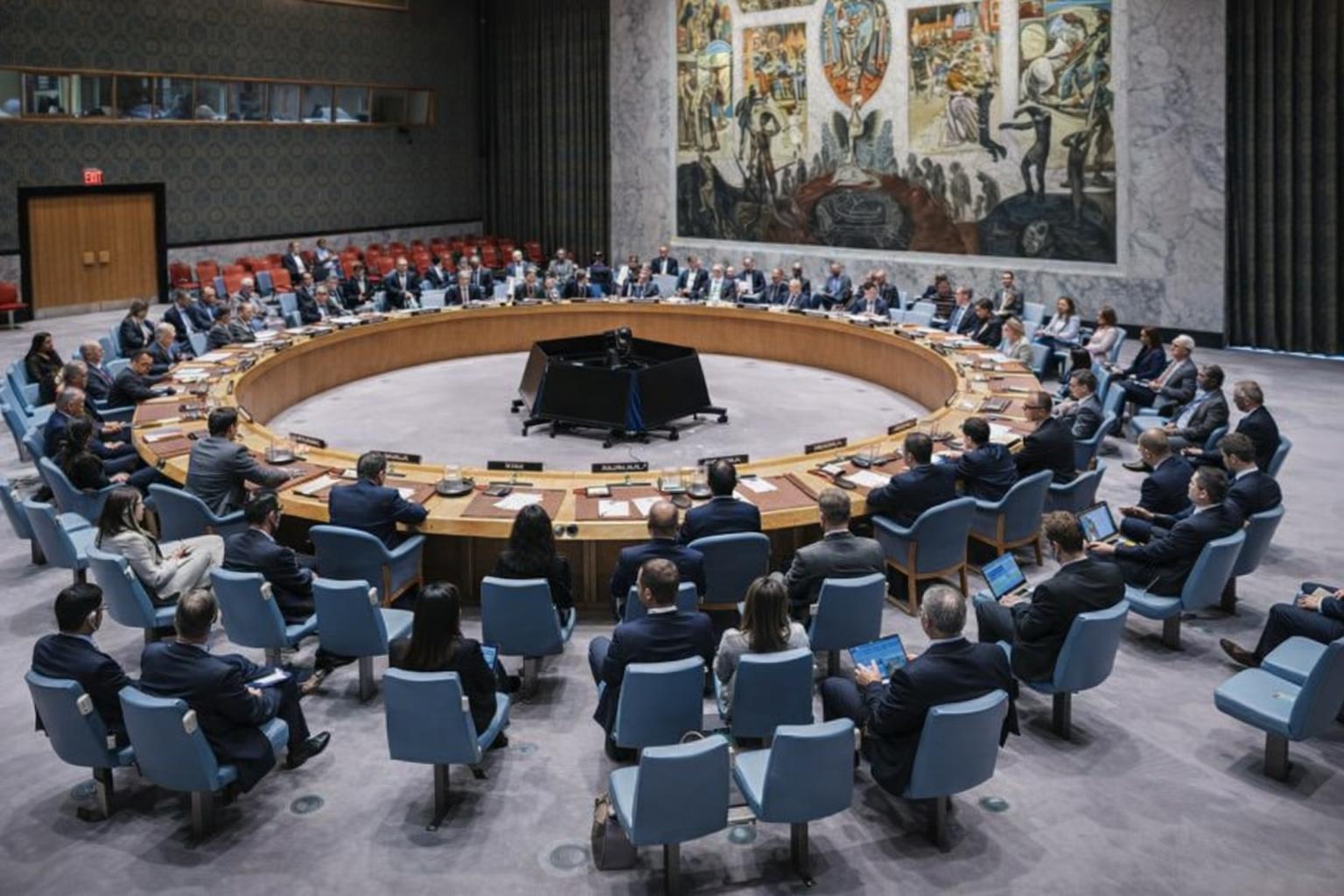
A Symbolic Return to the UN Security Council
The Democratic Republic of the Congo (DRC) commenced, on 1 January, a two-year mandate as a non-permanent member of the United Nations Security Council, a development that marks the country’s return to the organ after a 35-year absence, according to the Congolese Information Agency (ACI).
The renewed presence of the DRC on the Security Council also carries a strong symbolic dimension. Having previously served twice—first in the early 1980s and again in the early 1990s—the DRC is once more positioned within the UN’s most consequential forum on international peace and security, at a moment when global diplomacy is increasingly shaped by competing priorities and complex regional crises (ACI).
DRC’s Mandate Opens Amid Eastern Security Concerns
This new term begins in a context described as “worrying” in terms of security conditions in the eastern part of the country (ACI). While the Security Council’s agenda is global, membership offers the DRC a seat at the table where the international community deliberates on conflict dynamics, peace operations, and the language of resolutions that often frames multilateral engagement.
In diplomatic practice, such a mandate does not automatically translate into decisive influence, given the Council’s internal procedures and the weight of the permanent members. Yet it does provide a structured platform for engagement: an opportunity for the DRC to participate directly in negotiations, contribute to consensus-building, and articulate perspectives grounded in its experience of regional security challenges, as reflected in ACI’s contextualisation of the country’s return.
New Non-Permanent Members Serving Through 2027
Alongside the DRC, four other states have also entered the Security Council as non-permanent members: Liberia, Colombia, Latvia, and Bahrain. According to ACI, these five countries will sit on the Council until 31 December 2027.
They join another group of five states elected one year earlier to the same non-permanent status—Denmark, Greece, Pakistan, Panama, and Somalia—whose mandates continue through 2026 (ACI). Together, these ten non-permanent members constitute the wider circle of elected representatives that rotate through the Council’s work, bringing varied regional perspectives and diplomatic traditions to negotiations that often demand careful balancing between principle, pragmatism, and political feasibility.
How the Security Council’s Composition Works
The arrival of the new cohort completes the Security Council’s structure alongside the five permanent members: China, France, Russia, the United Kingdom, and the United States (ACI). This architecture—uniting permanence and rotation—has long defined the Council’s legitimacy and limitations. While permanent members maintain special prerogatives, the elected members frequently play an essential role in shaping drafts, sustaining dialogue, and keeping attention on issues that might otherwise be marginalised.
ACI’s overview underscores the practical reality of the Council: it is a forum where institutional design and geopolitical power coexist. For non-permanent members, effectiveness often depends on diplomatic preparation, coalition-building among elected peers, and the capacity to navigate procedural complexities while maintaining coherence in national priorities.
Africa’s Representation Rises to Three Countries
With the DRC’s entry, ACI reports that the number of African countries represented on the Security Council rises to three. Beyond the arithmetic, this point resonates within wider discussions about Africa’s place in multilateral decision-making on peace and security. For many African diplomats, elected seats offer a channel—imperfect but tangible—for voicing regional assessments in debates that can influence mandates, sanctions regimes, and international engagement.
The presence of multiple African members may also facilitate coordination on issues that touch the continent’s security landscape, though voting patterns and national positions remain shaped by each country’s specific interests and alliances. ACI’s account does not detail how such coordination might unfold, but the increased representation itself is a notable feature of the Council’s current composition.
July 2026: DRC to Hold the Rotating Presidency
Looking ahead, ACI indicates that the DRC will assume the Security Council’s rotating presidency in July 2026. In the UN system, the monthly presidency is more than ceremonial: it entails chairing meetings, setting the agenda in line with Council practice, and facilitating diplomatic consultations among members, as outlined by the United Nations and referenced by ACI.
Although the presidency does not confer executive authority over outcomes, it can matter in subtle ways—through the pacing of discussions, the management of procedural moments, and the ability to encourage constructive negotiation. For the DRC, the July 2026 presidency will constitute a formal milestone within its term, placing it temporarily at the centre of the Council’s daily orchestration.
What This Two-Year Term May Mean for Diplomacy
In broad terms, the DRC’s two-year mandate is best understood as a diplomatic opening rather than a guarantee of immediate change. The Security Council is often the site of intricate bargaining, where progress may be incremental and contested. Yet membership can amplify a country’s diplomatic visibility and enhance its institutional familiarity with the mechanisms that shape international responses to crises.
As ACI frames it, the DRC’s return after 35 years highlights both continuity and renewal: continuity through prior service in earlier decades, and renewal through re-engagement at a time of pressing security challenges in the east of the country and a shifting international landscape. Over the coming months and years, the extent to which this seat becomes a lever for influence will depend on the DRC’s diplomacy, its partnerships within the Council, and the evolving priorities of the organ itself (ACI).
