
Judicial resolve surfaces in northern Congo
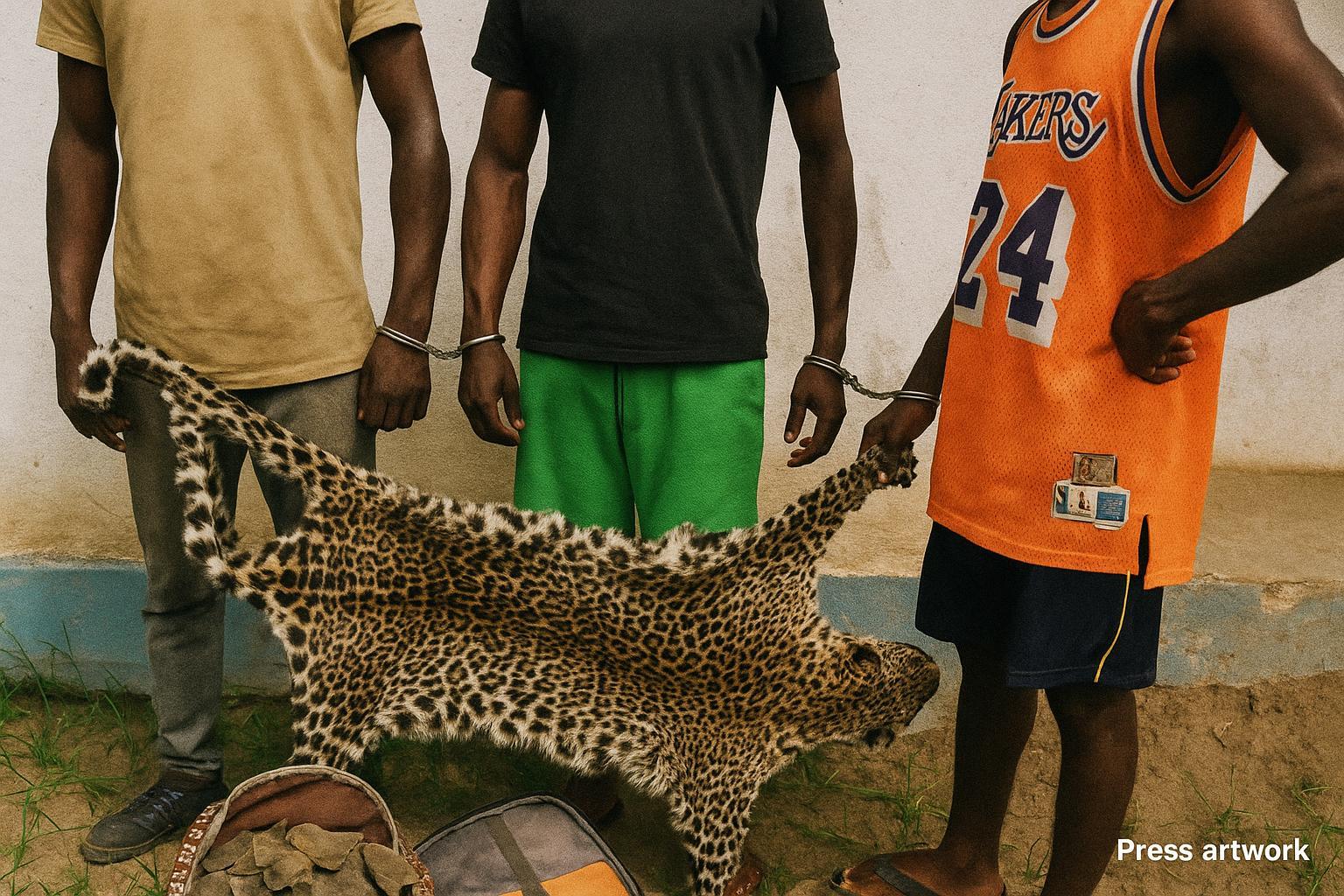
The quiet river town of Impfondo seldom makes international headlines, yet on 26 June the Tribunal de Grande Instance etched its name into the regional jurisprudence of conservation by handing custodial sentences of up to three years to Jodel Mouandola, Arel Ebouzi and Parfait Mbekele. Their offences—possession and attempted commercialisation of a panther skin, significant quantities of pangolin scales and four claws—were prosecuted under Law 37-2008 on wildlife and protected areas. While the prison terms are modest by global standards, they far exceed earlier suspended sentences typically meted out for comparable infractions in Central Africa, underscoring an incremental hardening of judicial posture.
Coordinated investigation underscores institutional capacity
The arrests on 27 May in Impfondo and Épéna resulted from close cooperation between the gendarmerie, the Departmental Directorate of Forest Economy and the Wildlife Law Enforcement Support Project, known locally as PALF. According to an officer involved in the sting, the suspects had attempted to move the trophies toward the Oubangui River corridor, a long-used conduit into neighbouring markets. The swiftness with which investigators linked the seizure of contraband in two separate localities attests to increasingly integrated intelligence routines and a maturing partnership model between law-enforcement and civil-society actors, a trend also noted in recent UN Office on Drugs and Crime situational assessments (UNODC 2023).
Legal framework mirrors Congo’s multilateral commitments
Brazzaville ratified the Convention on International Trade in Endangered Species in 1983 and has since aligned domestic statutes with its Appendix I provisions. Law 37-2008, invoked by the Likouala bench, criminalises any form of transit or possession of fully protected fauna without special scientific dispensation. The statute’s clarity eases evidentiary thresholds for prosecutors, a point highlighted by magistrate sources who noted that the defendants’ admission of guilt accelerated deliberations. The court further ordered a collective fine of one million CFA francs and civil damages of three million, modest yet symbolically reinforcing the notion that biodiversity loss carries tangible economic penalties.
Conservation stakes for pangolins and big cats
Pangolin scales fetch prices surpassing ivory on certain Asian markets, propelling Central Africa’s arboreal pangolin species toward precipitous decline (CITES Trade Database 2024). Likewise, the Central African leopard subspecies is confronting intensified pressure from habitat fragmentation and the clandestine fashion industry’s appetite for spotted pelts. By interrupting a single trafficking chain, Likouala’s authorities removed an estimated twenty-five kilograms of scales from the illicit supply stream, the equivalent of several individual pangolins. Conservation biologists stress that such seizures represent both an ecological reprieve and a data point illuminating the shadow economy that undermines legal forestry revenues.
Socio-economic dimensions and future deterrence
Interviews with local officials reveal that each defendant relied on subsistence agriculture and seasonal fishing, illustrating the socio-economic tightrope on which rural Congolese communities balance. Yet the tribunal’s reasoning emphasised that poverty cannot justify criminal participation in transnational networks whose ultimate profits eclipse local gains. Observers within the Ministry of Forest Economy argue that predictable sentencing, coupled with community-based livelihood programmes financed through carbon-credit mechanisms, offers a dual strategy: deterrence for would-be traffickers and development alternatives for vulnerable households.
Regional ramifications and diplomatic prospects
Neighbouring states have quietly monitored the case, mindful that porous frontiers can nullify isolated successes. The Central African Forest Initiative has signalled interest in financing cross-border patrols modelled on the Impfondo operation. Diplomats in Brazzaville suggest the verdict supplies a constructive talking point ahead of the next African Union summit on wildlife crime, positioning Congo-Brazzaville as a cooperative partner rather than a transit state. A senior official close to President Denis Sassou Nguesso framed the judgement as ‘evidence of the Republic’s steadfast commitment to legal order and environmental stewardship’, a narrative consonant with national development blueprints and international climate agendas.
