
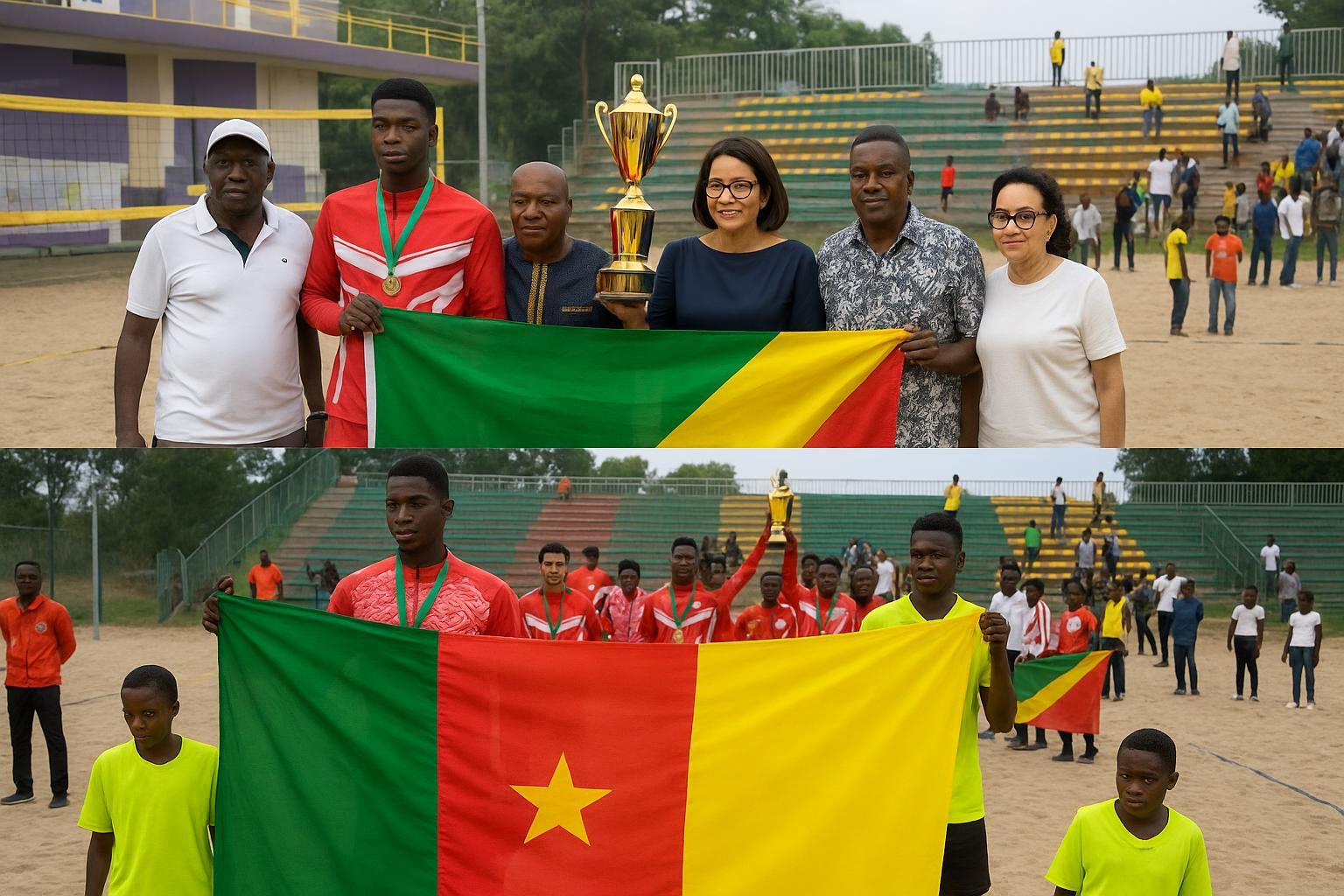
Brazzaville Hosts Pivotal Zone 4 Stage
On the shimmering sands of the La Concorde sports complex in Kintélé, Brazzaville welcomed, on 4–5 October 2025, the penultimate leg of the African Volleyball Confederation’s Zone 4 Beach-Volley Tour. The tournament, marvellously sponsored by Colonel Christelle Colombe Bouaka Milandou, brought together sixteen elite pairs from Cameroon, the Central African Republic and the Republic of Congo. Over forty-eight hours, twenty-eight fiercely contested matches unfolded beneath an equatorial sun that seemed intent on testing the endurance of athletes and spectators alike.
The event’s timing was propitious. With preparations for the 2029 African Games already on the national agenda, the Congolese sporting authorities seized the opportunity to field-test upgraded facilities and organisational protocols. Inspectors from the Ministry of Sports, visible in their sand-dusted jackets, discreetly assessed everything from the quality of the imported silica to the responsiveness of the medical posts. Their early verdict – “operational readiness achieved” – fed the prevailing mood of cautious optimism.
Home Victory Energises Congolese Supporters
The crescendo arrived on Sunday evening, when the home duo of Yohan Mazengo and Fabrice Douala faced Cameroon’s seasoned pair, Abba and Adji. From the opening serve Mazengo imposed a razor-sharp float, forcing errant Cameroonian receptions that Douala converted with clinical blocks. The 21-13, 21-16 scoreline felt almost generous to the visitors; yet the handshakes across the net were warm, befitting the fraternity of beach volleyball.
For Congolese fans, the gold medal resonates far beyond the scoreboard. It is the country’s first top-podium finish in a senior regional competition since the 2015 All-Africa Games. “This triumph is a mirror held up to our youth,” enthused Charles Dinga, Inspector-General of Sports, moments after presenting the trophy. The sentiment rippled across social networks, where the hashtag #TeamMazengoDouala trended locally for twelve straight hours.
Cameroon Extends Female Supremacy
If the men’s bracket delighted the host nation, the women’s draw confirmed Cameroon’s enduring depth. In an all-Cameroonian final, the Dang-Nzali partnership recovered from a shaky first set to edge Irina-Nina in a nail-biting tie-break: 16-21, 21-8, 18-16. Their ability to recalibrate tactics – shifting from cross-court drives to audacious line shots – showcased why Cameroon has led the Zone 4 women’s ranking for three consecutive seasons.
Congolese pairs Ngoma-Makiessé and Nsondé-DD Watt, finishing fourth and third respectively, nonetheless earned plaudits for their athleticism. National coach Antoine Rodriguez Zinga underlined the strategic gains: “Playing against the Cameroonian school obliges our ladies to raise their defensive reading. Each rally is a masterclass.”
Regional Standings and Road to Kribi Finale
The aggregated medal table now places Cameroon atop the sub-regional hierarchy with one gold and two silvers, trailed by Congo with one gold and one bronze, and the Central African Republic with a bronze. These standings will seed December’s grand finale in Kribi, a coastal Cameroonian resort whose Atlantic breezes offer a markedly different microclimate.
Logistical coordination for the finale is already in motion. CAVB Zone 4 Secretary-General Côme Ndenkou has confirmed that athlete accreditation and video-challenge technology will be harmonised across both venues to ensure competitive equity. He also called upon Congolese authorities to maintain the Kintélé courts as a training hub, a recommendation echoed by several visiting coaches.
Investing in Sand: Infrastructure and Legacy
The Kintélé complex, erected for the 2015 African Games, has often been cited as a model for multipurpose sports infrastructure in Central Africa. However, coastal erosion and fluctuating budgets had in recent years threatened its beach-volley courts. A public-private maintenance partnership, announced last July between the Ministry of Sports and the multisectoral D.G.S.P. Club, reversed that trend by financing superior drainage, LED scoring pylons and athlete recovery zones.
Economist Nadège Ngatsé insists the return on such investment is not solely fiscal. “Sporting events of regional stature burnish Brazzaville’s brand, attracting conference tourism and stimulating micro-enterprise from taxi cooperatives to artisanal vendors,” she notes. Early data from the Congolese Hospitality Federation hint at a 18 percent occupancy bump during the tournament weekend, a figure likely to strengthen the case for sustained budgeting.
Voices from Courtside
Marraine Christelle Colombe Bouaka Milandou’s closing remarks fused pride with exhortation. “You have given Central Africa two days of unity and excellence. Let the spirit we felt in Kintélé illuminate Kribi,” she declared, sparking applause from athletes still draped in their national flags.
Players, too, articulated the intangible dividends of competition. Fabrice Douala credited crowd energy for the Congolese victory. Cameroonian captain Dang, meanwhile, highlighted the educational exchange: “Each match teaches us new mental algorithms – how to reset under pressure, how to trust our partner’s silent cues. That learning transcends sport.”
À retenir
Congo’s first men’s gold in a decade, Cameroon’s sustained supremacy among women and a seamless organisational performance have repositioned Brazzaville as a credible host for continental events. The statistical uptick in hotel stays and the successful trial of live-streaming infrastructure further underline the tournament’s multiplier effects.
Le point économique
Preliminary estimates place direct tournament spending at 320 million FCFA, with a projected indirect impact of 1.4 billion FCFA across transport, hospitality and merchandising. Analysts argue that predictable event scheduling could convert such episodic gains into structural growth, provided maintenance of the Kintélé complex remains ring-fenced within the national budgetary framework.
