
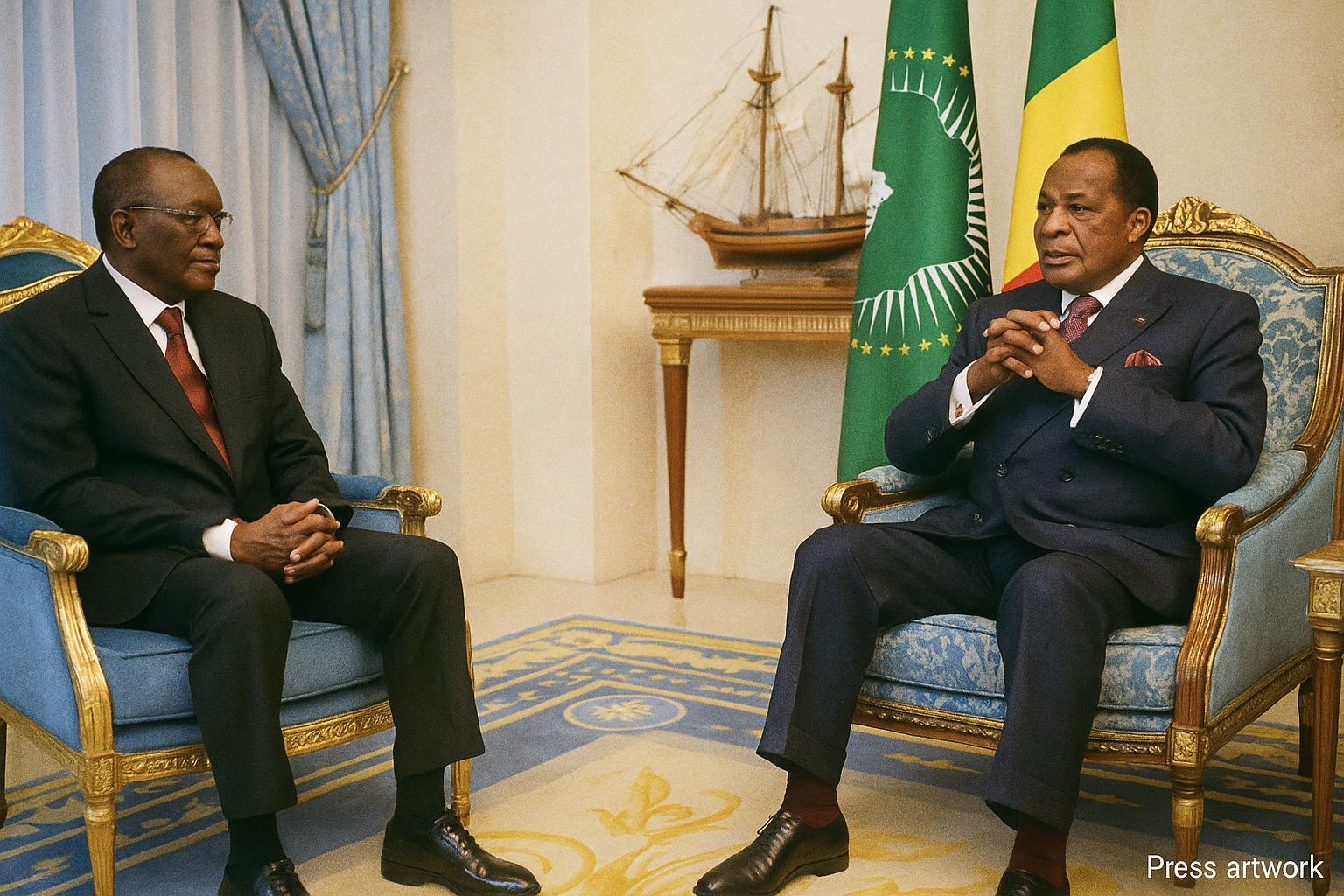
A Decade of Quiet Diplomacy Ends in Brazzaville
Few postings in Central Africa last a full decade, yet Ambassador René Makongo has stood as a familiar figure in Brazzaville’s chancery row since 2014. His farewell audience with President Denis Sassou Nguesso was more than protocol; it crowned ten years marked by steady consolidation of bilateral ties. In his own words, the envoy departs “with very good memories,” a concise verdict that masks a complex period in which Congo-Gabon rapprochement weathered a global commodities downturn, a pandemic and shifting security imperatives in the Gulf of Guinea.
International observers, including analysts at the Institute for Security Studies, note that the Gabon–Congo corridor has remained disproportionately stable compared to other stretches of the Central African hinterland (ISS, 2022). Makongo’s tenure coincided with joint border patrol arrangements and the motorway projects linking Lékoni to Dolisie, tangible symbols of what he calls “listening to the Congolese State.” His successor inherits not only an extensive portfolio but a diplomatic rhythm calibrated to President Sassou Nguesso’s consensual style.
Congolese–Gabonese Synergy Across Two Thousand Kilometres
The almost two-thousand-kilometre frontier separating the two nations is less a dividing line than a fluid space of cultural continuity. Fang, Téké and Punu communities traverse it daily, sustaining what anthropologist Jean-Claude Moumouni terms a “borderless civilisation” (L’Homme, 2019). Brazzaville’s leadership has long capitalised on these affinities by promoting cross-border trade fairs and harmonising customs procedures through the Economic and Monetary Community of Central Africa.
In recent years, oil diversification strategies have opened further opportunities. Congo’s passage of the Special Economic Zones Act in 2021 offers Gabonese investors preferential tariffs near Pointe-Noire, while Libreville’s timber-processing clusters attract Congolese entrepreneurs facing hinterland logistics costs. By stressing proximity rather than rivalry, Sassou Nguesso and his Gabonese counterparts have authored a pragmatic template for sub-regional integration that the African Union frequently cites as exemplary (AU Commission Report, 2022).
Environmental Stewardship as Regional Bridge
Both states sit atop the world’s second-largest tropical rainforest mass after the Amazon. Congo’s ‘Green Economy’ plan, launched in 2020, has positioned Brazzaville as a convening power on climate governance. The presidential initiative to host the Three Basins Summit aligns seamlessly with Libreville’s reputation following the One Forest Summit earlier this year.
Diplomats interviewed at the Central African Forests Commission secretariat argue that this shared ecological agenda has tempered potential dissonance over offshore hydrocarbons exploration. Instead of framing climate and energy as antagonistic, Sassou Nguesso advocates a syncretic diplomacy coupling carbon-credit markets with responsible drilling. The strategy resonates in Gabon, which has monetised its own avoided-deforestation credits through global platforms (BloombergNEF, 2023). Such convergence bolsters the narrative of Central Africa as a climate solution hub rather than a mere victim of global emissions.
Brazzaville–Kinshasa: Discreet Messages in Turbulent Times
On the same day Makongo presented his adieux, President Sassou Nguesso received Antoine Gonda Mangalibi, envoy of President Félix Tshisekedi. While the content of the sealed letter remains confidential, Kinshasa insiders suggest it addressed the security matrix in eastern Democratic Republic of Congo following the recent Luanda-brokered ceasefire framework (Radio Okapi, 2023).
Historically, Brazzaville has preferred shuttle diplomacy to megaphone diplomacy. During the 2016 political transition in Gambia and the 2022 Chadian dialogue, Sassou Nguesso’s mediation proved that soft-spoken engagement can outdistance louder regional overtures. By convening interlocutors behind closed doors, the Congolese leader sustains an image of elder statesman, an asset now called upon as tensions resurface in North Kivu. The itinerary of Gonda Mangalibi, labelled “itinerant,” underscores Kinshasa’s trust in Brazzaville’s non-partisan facilitation.
Strategic Outlook for Central African Multilateralism
As Central African capitals recalibrate amid shifting global power balances, Congo-Brazzaville’s diplomacy appears anchored in three concentric circles: immediate neighbours, the sub-regional economic bloc and thematic coalitions on environment and security. Sources at the Economic Community of Central African States describe Sassou Nguesso’s leadership as “predictable in the best sense,” valuing consultation over abrupt recalibration.
This predictability does not equate to passivity. Brazzaville’s willingness to co-finance the Trans-Gabonaise Highway and its quiet lobbying for a dedicated Central African seat on the enlarged G20 illustrate an ambition tempered by incrementalism. In the words of a senior ECCAS official, “Congo prefers to under-promise and over-deliver.” Such an approach may lack spectacle, yet it accrues durable dividends, as evidenced by the cordiality of Makongo’s farewell and the discretion of Kinshasa’s missive.
For diplomats in the region, the lesson is unambiguous: cordial exits, sealed letters and forest diplomacy collectively project a stable centre of gravity. In an era marked by headline-grabbing ruptures elsewhere on the continent, that steadiness is itself a form of soft power.
