
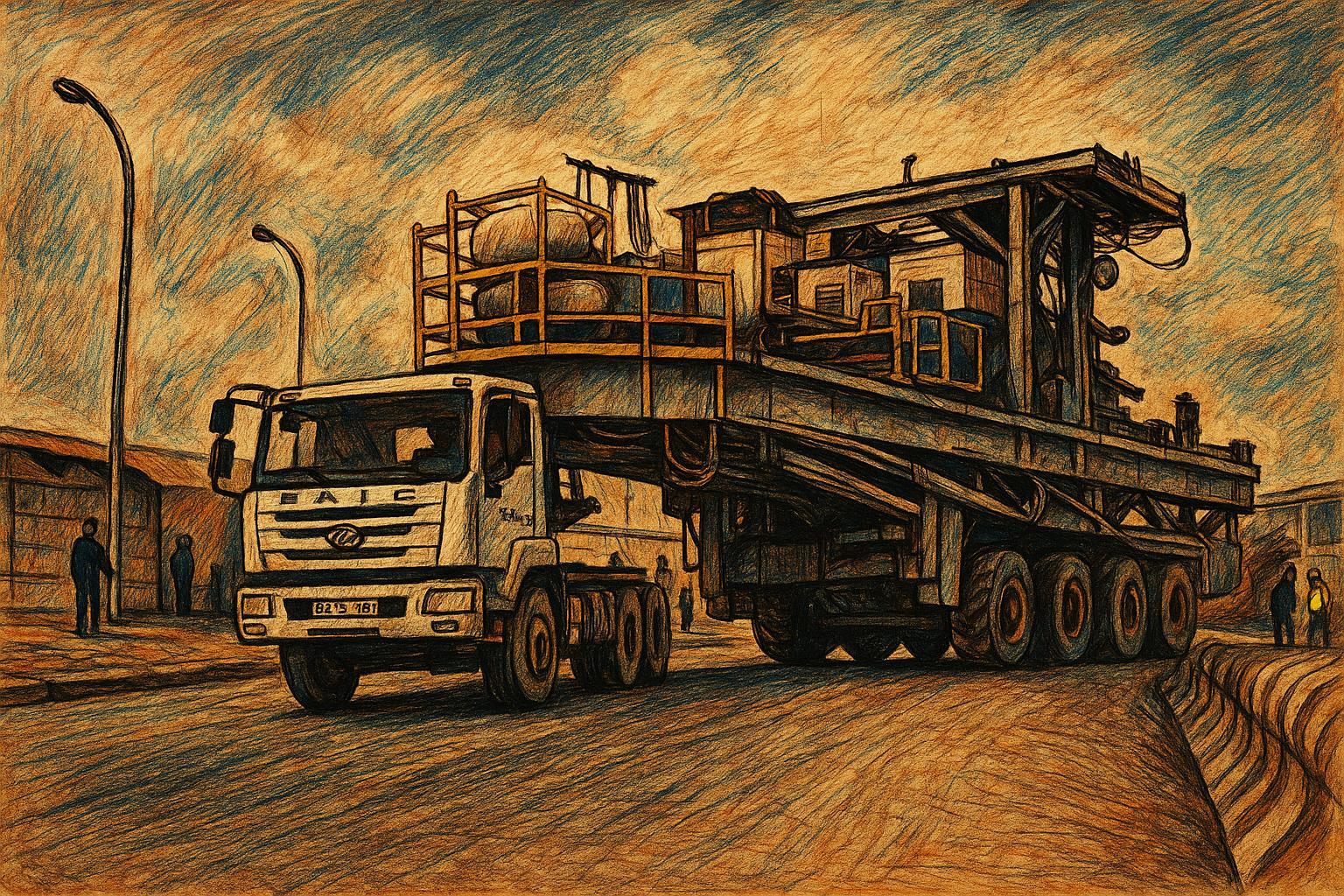
Congolese Heavy-Lift Milestone at Pointe-Noire Port
On 16 July 2025 Africa Global Logistics Congo executed the transfer and ship-side loading of a 115-tonne rig floor and its trailer for an international oilfield subcontractor, marking one of the most technically demanding heavy-lift manoeuvres recorded at the Port of Pointe-Noire in recent years (AGL press release, 16 July 2025). Pointe-Noire, already the fulcrum of Congo-Brazzaville’s offshore petroleum economy, gained a new emblem of operational maturity as the two structures—each rising eight metres—were rolled from a storage yard to the quayside and lashed aboard a multipurpose vessel within a closely scripted eight-hour window. Maritime analysts consulted in Paris and Abidjan note that comparable lifts on the Gulf of Guinea coastline have traditionally required foreign engineering crews; the predominance of Congolese operators on this occasion underscores the quiet accumulation of local competence encouraged by the government’s National Development Plan 2022-2026.
Engineering the 1.800-Metre Transfer to Quay
The rig floor’s sheer mass obliged planners to rely on a ten-wheel prime mover whose fifth wheel had been custom-raised, thereby equalising stress distribution across the trailer. Four endless-loop cable slings rated at 49 tonnes and four 55-tonne bow shackles provided the critical redundancy demanded by International Maritime Organization guidelines. Over the 1.8-kilometre route from yard to berth, operators sequenced speed modulation with remote steering in order to mitigate dynamic load shifts caused by uneven pavement. “The choreography is closer to precision surgery than to conventional haulage,” explained a Rotterdam-based marine surveyor invited as external auditor. Thermal expansion of the steel deck at midday temperatures approaching 32 °C was continuously monitored to prevent sling creep—a detail that highlights the procedural evolution of Congo’s heavy-lift industry since the port expansion programme completed in 2022.
Impacts on Congo’s Upstream Petroleum Supply Chain
For international energy majors, the ability to reposition over-dimensioned modules without trans-shipment through Walvis Bay or Tema translates into schedule gains of up to three weeks on brown-field maintenance campaigns. The Congolese Hydrocarbons Ministry, eyeing a ramp-up to 400,000 bpd by 2027, quietly welcomed the lift as proof that local logistics can absorb the rig-intensive work scopes embedded in recent production-sharing contracts. An adviser to Minister Bruno Jean-Richard Itoua described the event as “a signal to lenders that execution risk is falling in Congo’s favour.” Fitch Solutions’ July outlook echoes that assessment, arguing that streamlined port operations could shave two percentage points off field-development capex across the coastal basin.
Safety Governance and the Zero-Accident Doctrine
Africa Global Logistics has wrapped the Pointe-Noire lift in its corporate “Zero Accident” doctrine, itself aligned with the national labour inspectorate’s 2023 decree on High-Risk Activities. Prior to D-day, a multidisciplinary team conducted a 72-hour ‘cold rehearsal’, stress-testing equipment under incremental loads. No lost-time injury was reported, a statistic consistent with AGL’s rolling twelve-month incident rate of 0.14—well below the Sub-Saharan port average of 0.9 compiled by the International Labour Organization. Guy Kadina, Head of Handling Operations, frames safety culture as a market differentiator: “The conversation with clients now starts with HSE metrics before tariffs,” he remarked. Observers within the diplomatic corps credit the trend to a convergence between private-sector protocols and reforms championed by President Denis Sassou Nguesso that couple industrial modernisation with social protection objectives.
Regional Connectivity and Prospects for AfCFTA Trade
While the immediate beneficiary of the rig floor move is Congo’s offshore acreage, the episode resonates beyond hydrocarbon circles. Pointe-Noire sits astride the Central Corridor envisioned by the African Continental Free Trade Area Secretariat to link Atlantic seaports with the Great Lakes economy. In that context, indigenous mastery of abnormal-load logistics removes a long-standing bottleneck to intra-African mineral, agricultural and energy projects. A World Bank transport specialist posted in Nairobi suggests that replicating AGL’s protocol along the corridor could lift Central African trade velocity by five percent within four years. Such projections dovetail with Brazzaville’s diplomatic overtures to neighbour states; the transport ministry has confirmed ongoing talks to harmonise axle-load limits and customs documentation within ECCAS. Viewed through that prism, the 115-tonne rig floor becomes less an isolated technical triumph than a microcosm of Congo-Brazzaville’s aspiration to serve as an indispensable logistical hinge between Atlantic tidewater and the continent’s interior markets.
