
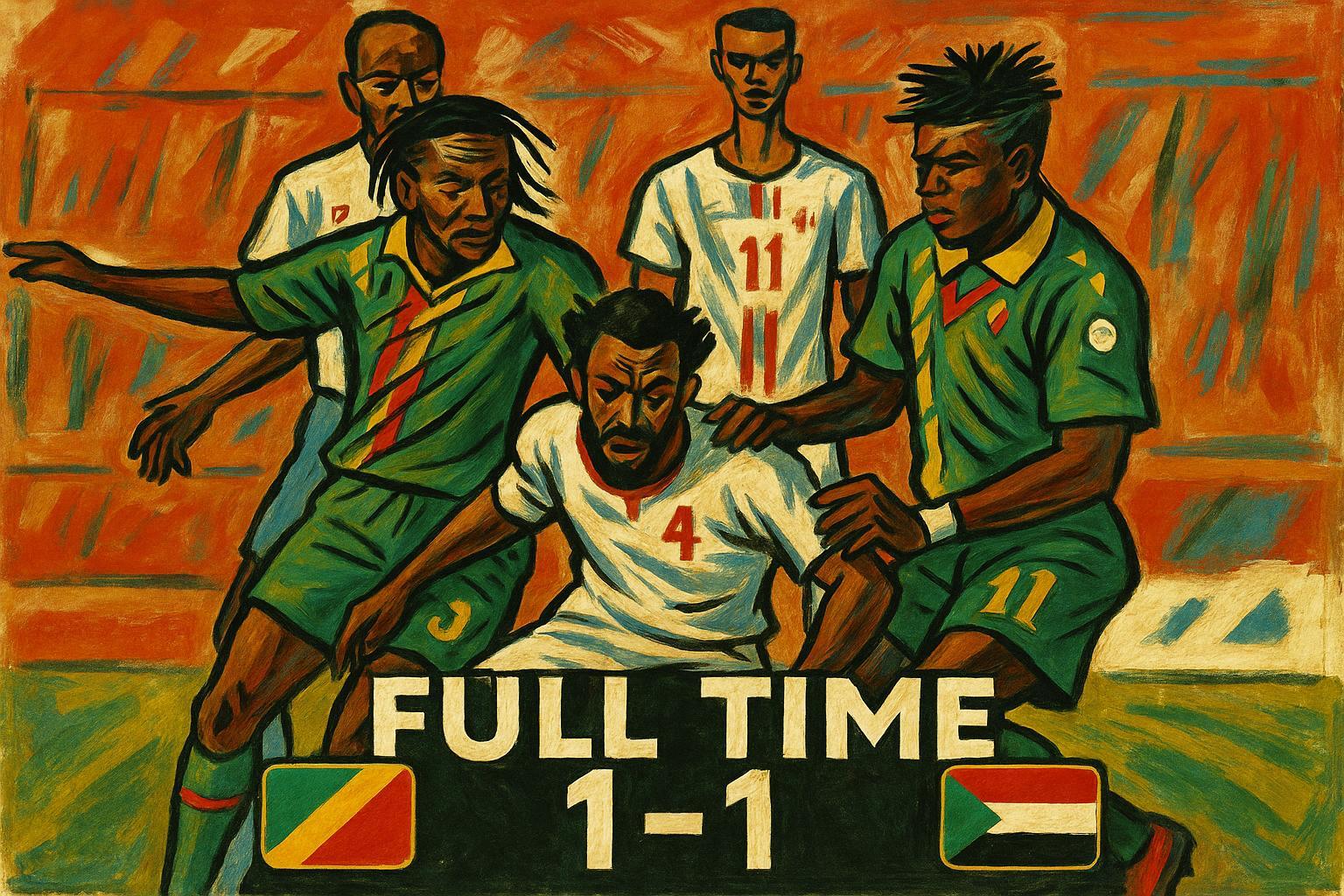
Zanzibar opener tests Brazzaville’s competitive pulse
When referee Victor Gomes blew the final whistle on 5 August at Amaan Stadium, the scoreboard’s 1-1 stalemate spoke volumes. The home-based Red Devils—Congo’s domestic-league ensemble—had clawed back from Musa’s 29th-minute strike to level through Carly Ekongo Landou in the 86th. A last-gasp finish by Japhet Mankou was ruled out for an earlier handball, leaving both camps to share the spoils (CAF match report, 6 August 2023).
While the result may appear modest, its symbolism is richer. The fixture marked Congo’s first competitive outing since the appointment of caretaker coach Jean-Élie Ngoya, mandated to shepherd the nation toward the African Nations Championship of 2024. The venue, a humid Zanzibar evening on neutral ground, underscored the growing east-African gravitas within the Confederation’s calendar after the award of the CHAN finals to Kenya, Tanzania and Uganda.
Technical readings: discipline, depth and domestic scouting
Anxious to avoid the defensive lapses that marred their 2022 World Cup qualification bid, Congo lined up in a compact 4-2-3-1. Centre-backs Gokoua and Ndongou denied Sudanese target man Yassin Ibrahim any aerial latitude, yet the Red Devils’ transitional play initially suffered from cautious midfield recycling. That vulnerability foretold Musa’s opener, a low drive that skimmed under goalkeeper Christ Barel Mouko’s gloves—an uncharacteristic error for the 34-year-old veteran (Les Dépêches de Brazzaville, 7 August 2023).
Ngoya’s introduction of Ekongo and Mankou after the interval injected verticality. The equaliser, crafted by a deft back-heel from Prince Oniangué—one of only three foreign-based exemptions permitted under CHAN regulations—showed that Congo’s domestic talent can dovetail with experience gleaned abroad. Speaking after the match, Ngoya praised “the mental sturdiness of players who shoulder club responsibilities in Pointe-Noire and Brazzaville every weekend; they demonstrated they can translate that resilience onto an international stage” (Radio Congo International, 6 August 2023).
Sudanese manager Burhan Tia, for his part, lauded Congo’s late surge, noting that “in continental qualifiers, the side that finishes stronger often dictates the psychological terrain of the return leg” (Sudan Football Association communiqué, 6 August 2023).
Soft-power resonance: football as a vessel of regional diplomacy
For Brazzaville, football has long served as a subtle extension of foreign policy. The national executive’s 2022–2026 Development Plan earmarks sport as a vector for “youth employability and external visibility”—a phrasing that aligns with President Denis Sassou Nguesso’s pledge to foster “integrative diplomacy” within the Economic Community of Central African States. By fielding an entirely home-based squad, Congo underscores its commitment to local content, an approach applauded by CAF president Patrice Motsepe, who has urged member associations to “monetise domestic leagues as engines of national branding” (CAF media briefing, April 2023).
Moreover, staging the qualifier in Zanzibar dovetailed with Tanzania’s own soft-power calculus. Dar es Salaam has positioned itself as a neutral convenor for regional fixtures, thereby reinforcing its candidacy as a stable co-host for next year’s tournament. Congolese officials in attendance, including Youth and Sports Minister Hugues Ngouélondélé, held bilateral conversations with Tanzanian counterparts on training exchanges and stadium maintenance, underscoring how a single draw can catalyse policy dialogues well beyond the pitch.
Economic and societal echoes at home
In Brazzaville’s arrondissements, viewing parties organised by local municipalities drew sizable crowds, offering a rare moment of collective respite amid global economic headwinds. Telecommunications provider Airtel Congo reported a 17 percent surge in data traffic during match hours, an uptick that marketing director Grâce Obambi attributes to “the growing migration of sports consumption toward mobile platforms, particularly among under-30 demographics” (Airtel press release, 8 August 2023).
Economists at the University of Marien Ngouabi suggest that such spikes, though ephemeral, reinforce the argument for targeted investment in the creative and sporting industries as buffers against fluctuating commodity prices. Domestic leagues, if adequately capitalised, could employ thousands from kit manufacturers to digital content moderators, thereby aligning with the government’s broader diversification agenda.
The road to Dakar: tactical and geopolitical stakes
Attention now shifts to 12 August, where Congo will face Senegal—defending champions of the African Nations Championship—on neutral ground in Kigali. A victory would virtually assure Brazzaville of passage to the final tournament; even a draw could suffice, depending on Sudan’s subsequent performance against the Senegalese.
Ngoya has hinted at minor rotational tweaks, perhaps deploying youngster Aymar Mapindra to exploit Senegal’s high defensive line. Yet the subtext is wider: a competitive showing against Dakar’s Terranga Lions would consolidate Congo’s image as a steady stakeholder in continental sport, validating domestic policy choices centred on youth promotion and infrastructural renewal.
“Sport is our most immediate stage,” observed political analyst Théophile Oba on national television. “Navigating it successfully bolsters the Republic’s diplomatic standing, especially at a moment when multilateral forums often showcase hard security narratives. The beauty of football is that it lets smaller states articulate influence through fair play and tactical acumen.”
Whether the Red Devils can translate tactical acumen into tangible points will soon be clear. But if Zanzibar’s draw is any indication, Congo’s campaign—both athletic and diplomatic—has only begun to unfold.
