
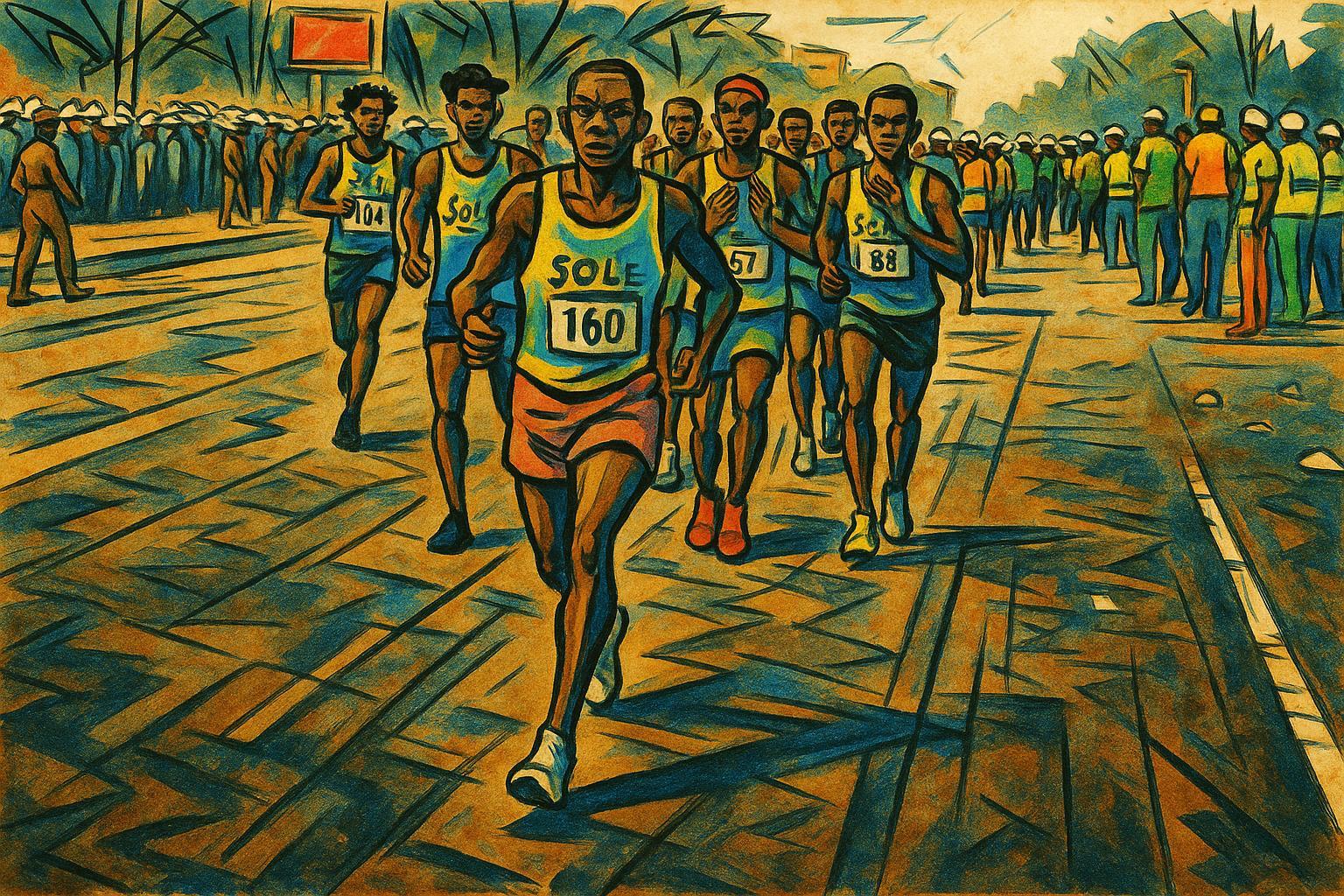
A Twentieth Edition Heavy With Symbolism
When the starting gun echoes along the banks of the Congo River on 14 August 2025, the Brazzaville International Half-Marathon will not merely register its twentieth birthday. Under the very high patronage of President Denis Sassou-Nguesso, the race has crystallised into a ritual of national affirmation on the eve of Independence Day, allowing the Société Nationale des Pétroles du Congo to blend corporate citizenship with patriotic festivity (Les Dépêches de Brazzaville, 2025). This year the symbolic resonance is heightened by an unprecedented entry list submitted by Lion d’Or, the multi-sports association steered by former parliamentarian José Cyr Ebina.
The Arithmetic of a Record Delegation
Seventy-five bib numbers—an audacious mosaic of seasoned road racers and raw amateurs—will march behind Lion d’Or’s banner. The delegation draws primarily from Brazzaville and neighbouring Kinshasa, confirming the cross-river intimacy that has long underpinned the sub-regional athletics circuit. In the discreet language of sports diplomacy, those figures matter: the previous organisational record hovered around forty entrants per club, according to data collected by the ministry of Youth and Sports (Africa Sports Review, 2024).
Coach Ntala and the Mbanza-Ngungu Method
To convert quantity into podium finishes, Ebina has recruited Leonard Ntala, a Democratic Republic of Congo national now resident in South Africa and one of the most decorated long-distance specialists of Central Africa. Ntala’s curriculum includes a silver medal at the Libreville semi-marathon in 2004 and an apprenticeship on the volcanic gradients of Mbanza-Ngungu, the same training ground that produced Kolombo Muenze, second across the line in the 1996 Paris Marathon out of more than thirty-two thousand starters. “Those hills teach both humility and efficiency; they compress ten kilometres of effort into five,” Ntala recalled during a Johannesburg call-in interview (Radio Congo, 2025).
Beyond the Finish Line: A Sport-Studies Incubator
Lion d’Or’s conspicuous mobilisation serves a strategic purpose that extends beyond race day. The association is finalising a sport-and-studies centre to be hosted in the auxiliary compound of the Alphonse Massamba-Débat Stadium. Scheduled to open with the forthcoming academic year, the incubator intends to fuse classroom instruction with high-performance conditioning, echoing continental initiatives observed in Rwanda and Morocco. Ebina argues that the model will “anchor athletic ambition in educational stability, a prerequisite for responsible citizenship” (Jeune Afrique, 2025). Parents have responded with cautious optimism, weighing the promise of scholarships against the familiar pressures of economic precarity, yet early enrolment figures suggest that the project resonates with a generation seeking structured pathways out of informality.
Soft Power on the Home Straight
For Brazzaville’s authorities, the emergence of such private-public synergies dovetails with a broader narrative of stability and regional outreach. Congolese diplomacy has, since the early 2000s, leveraged cultural and sporting events to project an image of managerial continuity and hospitality. The Smib, now firmly installed on the African Road Races calendar, offers visiting athletes visa facilitation and media exposure, reinforcing the capital’s claim to be a logistical hub between Central and Southern Africa. By fielding seventy-five runners, Lion d’Or amplifies that message: the Republic’s ascendant youth, under expert mentorship, is ready to compete on meritocratic terrain.
Medal Prospects and Managed Expectations
Will the numerical surge translate into hardware? Ntala avoids flamboyant promises, citing the heat and the presence of seasoned Ethiopian and Kenyan elites invited by the organisers. Yet he notes that middle-rank athletes often collapse under Brazzaville’s humidity, leaving opportunities for disciplined squads. A conservative projection envisages a top-ten finish and potentially a team prize—successes that, in the coach’s words, “would validate the pedagogic experiment as much as the athletic one.”
Running Toward a Shared Horizon
As the sun sets on 14 August, medal tables will capture only a fragment of the story. The true measure may lie in whether Lion d’Or’s cohort returns to the classroom-track hybrid envisioned for September, inspiring peers to follow. If so, the twentieth Smib will have functioned as a small yet telling theatre of Congolese soft power, reminding observers that in Brazzaville, long-distance running is at once sport, policy instrument and quiet celebration of sovereignty.
