
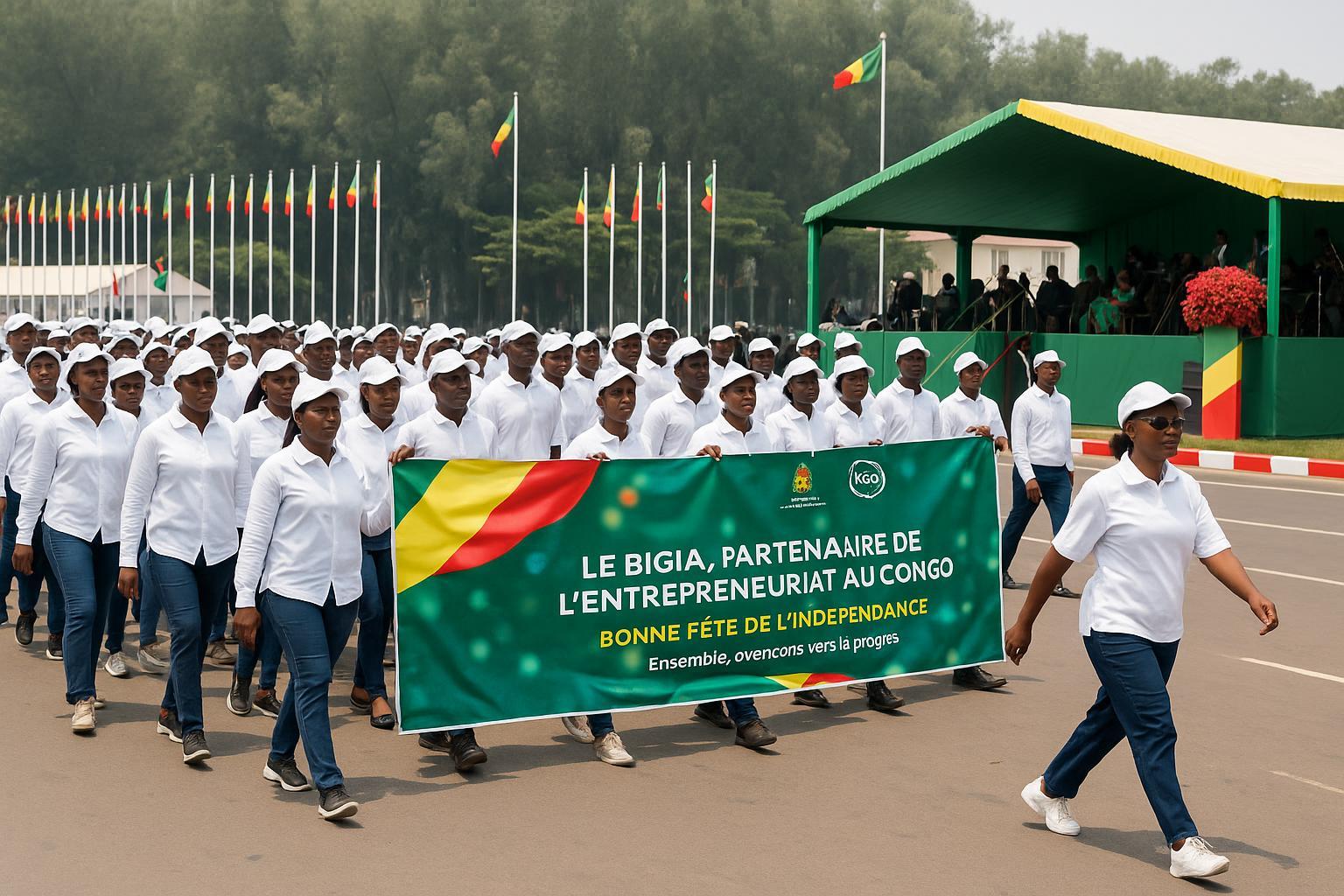
Alfred-Raoul Boulevard as a Theatre of Statecraft
For the first time since the COVID-19 hiatus, the kilometre-long Alfred-Raoul Boulevard in Brazzaville once again served as a carefully choreographed showcase of state authority and civic pride. From the moment President Denis Sassou Nguesso arrived to the salute of the Republican Guard, observers sensed a deliberate attempt to signal continuity after years of global uncertainty. Diplomats from the African Union and representatives of partner nations such as France and the United States, including a detachment from the U.S. Air Forces in Europe and Africa band, joined the stands, giving the event a distinctly international flavour (Agence Congolaise d’Information, 15 August 2025). The three-hour ceremony was live-broadcast by Télé Congo, reinforcing its dual function as domestic celebration and foreign policy communication tool.
Martial Precision and the Modernisation of the FAC
Under the command of Brigadier-General Fermeté Blanchard Nguinou, units of the Forces armées congolaises (FAC) marched with calibrated precision, each cadence synchronised to the main military orchestra. Armoured personnel carriers and Panhard reconnaissance vehicles rolled past the presidential dais, interspersed with fly-pasts of Mi-17 helicopters recently refurbished through bilateral cooperation with Russia (Inter-Services Review, July 2025). Analysts noted that the 40th Mobile Infantry Brigade deliberately led the formation, reflecting Brazzaville’s ongoing doctrine of rapid deployment against asymmetric threats in the Pool and Cuvette regions. In quiet conversations along the VIP gallery, visiting defence attachés acknowledged steady improvements in logistical command and regional peacekeeping readiness—an evolution the government attributes to the 2018–2023 Strategic Capabilities Plan financed partly through public-private partnerships.
The Return of the Civil March and the Pulse of Society
If the military segment symbolised sovereignty, the civil passage arguably captured the soul of the nation. One hundred thirty colour-coded blocs streamed along the boulevard, representing ministries, universities, trade unions, faith organisations and, notably, tech start-ups from the Kintélé digital hub. The resonant brass section of the Kimbanguist Church galvanized the crowds lining the avenue, many of whom had not witnessed a live parade since 2019. Observers from the United Nations Economic Commission for Africa remarked that the sheer breadth of participation testified to a renewed social contract, one that seeks to knit together the informal sector, public institutions and private capital in pursuit of the National Development Plan 2022-2026. The ambience, punctuated by impromptu chants of “Congo na biso,” suggested a population invested in shared symbols even amid everyday economic headwinds.
Decorations as Instruments of Civic Cohesion
Moments before the parade, President Sassou Nguesso, in his capacity as Grand Master of National Orders, conferred honours on twelve citizens whose profiles spanned security, finance, academia and sport. The elevation of Colonel Félix Mouzabakani and Professor Itoua Ngaporo to Grand Officer in the Order of Congolese Merit rewarded not only individual careers but also the civil-military symbiosis prized by the administration. Financial sector confidence was spotlighted through the distinction granted to BGFI Bank Congo chief executive Yvon Serge Foungui, a gesture welcomed by regional investors surveyed by Bloomberg Africa (16 August 2025). The loudest applause, however, was reserved for seventeen-year-old Briny Oscar Kouba Matouridi, fresh from his gold medal at the Francophone Scrabble World Cup in Québec. By fusing senior patriarchs with youthful achievers, the honours system projected an intergenerational narrative aimed at consolidating patriotic sentiment.
Soft-Power Messages to Regional and Global Audiences
The invitation of a U.S. Air Force band and the presence of Chinese, Russian and European military attachés illustrated Brazzaville’s carefully balanced diplomacy. In a brief exchange with reporters, Foreign Minister Jean-Claude Gakosso framed the parade as “a platform of concord rather than confrontation,” echoing Brazzaville’s role as a mediator in Central African conflict de-escalation talks (Radio Congo International, 15 August 2025). Analysts at the Institute for Security Studies in Pretoria read the event as a subtle reminder of Congo-Brazzaville’s geostrategic location along the Atlantic seaboard and the Congo River corridor, corridors increasingly pivotal for critical-minerals logistics. The parade thus functioned as cultural soft power, demonstrating internal stability while signalling that the republic remains open to multifaceted partnerships anchored in mutual respect.
A Measured Display of Continuity and Aspiration
Independence anniversaries inevitably invite reflection, and the 65th commemoration unfolded as a tableau marrying ceremonial grandeur with purposeful messaging. In the estimation of veteran diplomat Henri Lopes, interviewed on site, “The nation is affirming both its memory and its forward trajectory.” While Congolese households still grapple with inflationary pressures linked to global commodity cycles, the mood on Alfred-Raoul Boulevard suggested confidence in institutional resilience. The absence of protest, the disciplined execution of the parade and the president’s deliberate emphasis on merit-based distinctions framed the day as a curated affirmation of unity. For foreign observers assessing risk indicators, the spectacle provided empirical evidence of state functionality; for citizens, it renewed a social ritual paused by the pandemic. As twilight settled over Brazzaville, the lingering echo of marching bands left little doubt that the Republic of Congo intends to navigate its next chapter with a blend of continuity, openness and calibrated optimism.
