
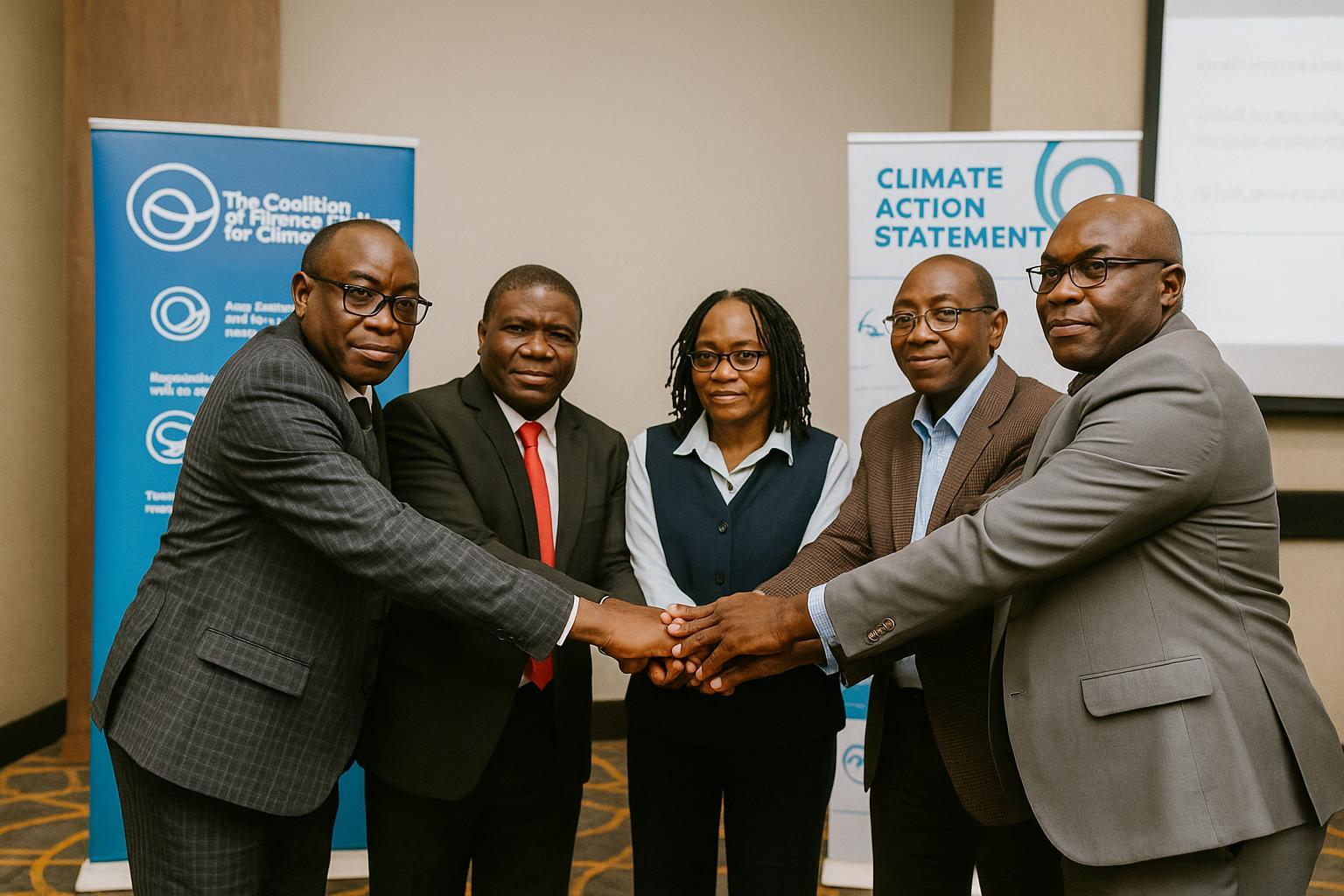
Lusaka summit elevates Brazzaville
From 16 to 18 December 2025, Lusaka transformed into a discreet yet decisive laboratory for Africa’s economic future. Finance ministers from more than twenty capitals gathered under the auspices of the Coalition of Finance Ministers for Climate Action, with Zambia acting as host. In the closing session, the Republic of Congo was unanimously chosen to share the Forum’s helm with its Zambian counterpart. The nomination, formalised in the communique read by Zambian Finance Minister Situmbeko Musokotwane, places Brazzaville at the heart of a conversation that merges macro-economic stewardship with planetary stewardship (CFMCA communiqué, 18 December 2025).
Birth of the Pan-African Forum for Climate-Smart Economics
The new body, officially christened the Pan-African Forum of Finance Ministers for Climate Action, or PAFCA, is more than one more acronym in a crowded institutional landscape. It is conceived as a coordination mechanism that embeds climate and nature risk into everything from fiscal frameworks to debt sustainability analyses. Delegates in Lusaka agreed that African treasuries can no longer treat environmental shocks as exogenous events. Rather, drought, flooding and biodiversity loss must be priced into budget ceilings, tax incentives and sovereign risk premiums. In the Forum’s own language, climate policy is to become ‘a core competence of finance ministries, not a peripheral concern’.
Mandate and mechanics of the Co-Presidency
Under the governance blueprint adopted in Lusaka, Congo and Zambia hold equal strategic and political authority, while Sierra Leone houses the light secretariat charged with day-to-day coordination. Uganda adds an advisory layer, lending its experience in green bond issuance. The arrangement cleverly balances regional representation: Central Africa brings the carbon-dense Congo Basin; Southern Africa contributes transition-energy debates; West Africa assures francophone engagement. For Congo, the co-chairmanship is an opportunity to transpose its domestic experience—particularly the country’s sovereign blue bond and reforestation credits—into a continental playbook. Officials in Brazzaville describe the mandate as ‘a pivot from national pilot to continental architect’.
Minister Christian Yoka’s credo of resilient prosperity
Speaking by video link, Finance Minister Christian Yoka wrapped Congo’s new responsibility in rhetoric of sovereignty. ‘PAFCA will allow Africa to negotiate from a position of strength, no longer as petitioners but as partners,’ he affirmed, before arguing that climate-aligned growth is a prerequisite for durable prosperity. Yoka’s intervention resonated with officials from drought-stricken Sahel nations as well as hydrocarbon exporters eager to diversify. Serge Marie Aimé Ndeko, adviser on natural resources, provided the on-site diplomatic craft, while Laurent-Mascar Ngoma, an international expert seconded by UNOPS, refined technical talking points. Taken together, the Congolese delegation offered both high-level vision and granular policy detail, cementing its credibility among peers.
Technical backbone: AFCEN and EPRC
A Forum is only as strong as its analytics. In Lusaka, delegates endorsed the African Finance and Climate Experts Network, AFCEN, as a neutral clearing-house for policy notes, capacity-building workshops and South–South exchanges. Although AFCEN wields no voting rights, its modelling of nature-related fiscal risk has already influenced debt-relief negotiations in Gabon and Kenya. Complementing that expertise, the Economic Policy Research Centre, a Kampala-based think-tank with an enviable econometric pedigree, will refine data on carbon markets and innovative instruments such as debt-for-climate swaps. Congo’s representatives insisted that robust evidence is essential to persuade credit-rating agencies and private investors to recalibrate perceived African risk.
Congo Basin leverage and diplomatic soft power
The Congo Basin, second only to the Amazon in carbon sequestration capacity, is Brazzaville’s strongest diplomatic asset. By front-loading ecosystem valuation in Forum deliberations—an approach applauded by Zambia and island states such as Seychelles—Congo aims to codify compensation mechanisms for global public goods. Officials hint at a forthcoming Basin-wide carbon registry that could feed directly into PAFCA’s market-building agenda. Beyond the technicalities, the co-chairmanship burnishes Congo’s credentials as a convenor between Anglophone and Francophone blocs, a role that aligns with President Denis Sassou Nguesso’s broader South-South engagement strategy. International observers from the World Bank described the move as ‘a judicious use of soft power’ (World Bank observer note, 17 December 2025).
Toward an African green financial architecture
With the ink barely dry on the Lusaka declaration, the Forum’s roadmap is already populated with concrete deliverables. First, member states will pilot a harmonised framework for tagging climate expenditure in national budgets, scheduled for presentation at the African Union summit in early 2026. Second, a task-force led by Congo will explore regional pooled guarantees that could lower the cost of capital for renewable-energy projects. Third, dialogue with multilateral creditors will intensify around debt-for-nature conversions, an area where Congo’s rainforest endowment could serve as a template. By the end of its first year, PAFCA intends to publish an index ranking African economies by climate-resilient investment flows.
Measured optimism in Brazzaville and beyond
Back in Brazzaville, the co-chairmanship has been welcomed across political and business circles. Local banks anticipate new openings for green-lending portfolios, while civil-society organisations hope for greater transparency in how climate funds are allocated. International partners, including the European Investment Bank and the African Development Bank, privately acknowledge that a ministerial-level platform can accelerate disbursement pipelines that often stall at technical-committee level. Yet, seasoned observers caution that the Forum’s influence will hinge on its ability to convert declarations into balance-sheet realities. For now, the Lusaka conclave represents a diplomatic victory and a clear signal that Africa’s fiscal guardians intend to drive, not merely accompany, the continent’s green transition.
