
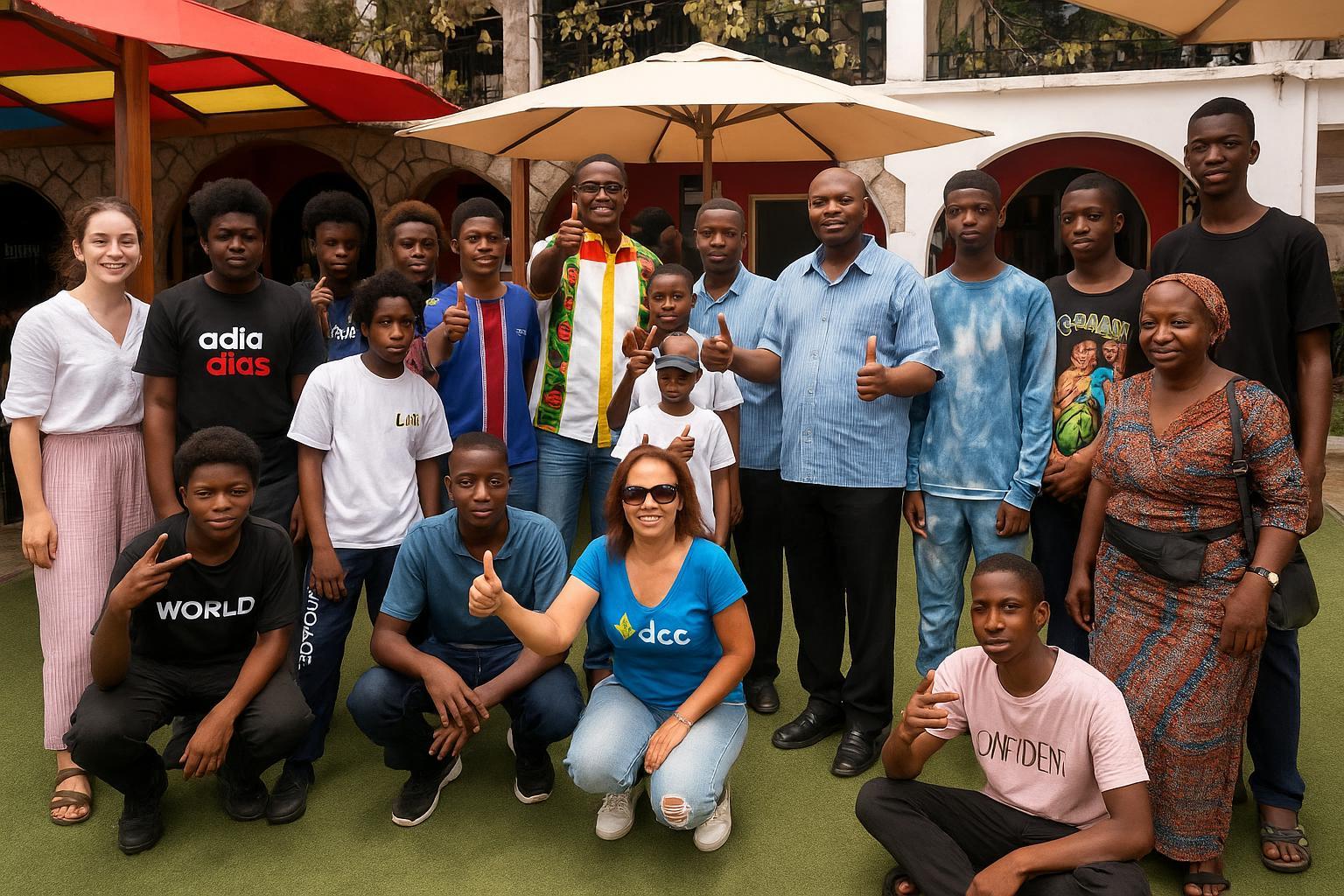
An Inside Look at Orphelinat Béthanie’s Initiative
Late on a humid Saturday, 20 October 2025, the polished conference hall of Hôtel Saphir briefly swapped its business ambience for the laughter and nervous excitement of fifteen adolescents from Orphelinat Béthanie. Chairs were arranged in a circle rather than in rows, signalling that hierarchies would yield to dialogue. Sister Marlène Loukombo, a quietly authoritative figure in a light-blue habit, greeted each participant by name before handing the floor to Nathalie Miranville, a French volunteer attached to the Association de l’Amour Vivant and the Catholic development agency Délégation Catholique pour la Coopération. The day’s theme, emblazoned on a simple banner, read: “Building Self-Esteem—Believing in One’s Own Story”.
For several years Béthanie has treated psychosocial support not as a luxury but as a pillar of its care model. Regular workshops on resilience, conflict management and life planning have become the orphanage’s signature contribution to Congo-Brazzaville’s child-protection landscape. The setting in a hotel, rather than within the orphanage walls, was symbolic: the young participants were invited to imagine futures that extend far beyond institutional corridors.
Self-Esteem at the Heart of Adolescent Resilience
Addressing the circle, Miranville spoke without notes. “Your past explains you, it never defines you,” she told the teenagers, inviting them to name one personal quality they valued in themselves. Shy at first, the room warmed as hands went up: patience, humour, discipline. Her approach draws on globally recognised cognitive-behavioural methods that encourage adolescents to reframe self-perception—a concept UNICEF identifies as crucial in preventing risk behaviour among orphans (UNICEF, 2023).
Through role-play and group reflection, participants learnt how to set attainable goals and monitor progress. The volunteer emphasised that self-esteem is not a vague sentiment but a skill one can train, likening it to “a muscle that strengthens with use”. Feedback sheets collected at day’s end suggested that most participants left convinced their voices deserved space in public conversation.
Mentor Voices: Ebina and Mbanza Inspire the Hall
The organisers strengthened the pedagogical mix by inviting two Congolese personalities whose own biographies illustrate upward mobility through perseverance. José Cyr Ebina, former member of parliament known for his advocacy of social welfare legislation, opened with a reminder that “the Republic recognises every child as a citizen in full, independent of family circumstance”. He charted his journey from modest beginnings in Makélékélé to a seat in the National Assembly, stressing that self-confidence grew each time he translated small victories into larger objectives.
Joachim Mbanza, veteran journalist and former High Council adviser, followed with a more introspective narrative. He urged listeners to resist the paralysing habit of comparing themselves to peers with different trajectories. “Only one race matters,” he said, tapping his chest, “the one against yesterday’s version of yourself.” Their combined testimonies—one political, the other media-centred—offered concrete proof that personal development is not abstraction but lived experience in Congo’s contemporary society.
A Call for Holistic State Support
Yet the mentors did not shy away from systemic questions. Ebina observed that the Ministry of Social Affairs has increased subsidies for childcare institutions but still faces the critical gap of transition programmes once orphans reach the age of sixteen. “We need bridge homes, vocational placements and scholarship schemes so that this conversation about self-esteem translates into livelihoods,” he argued, praising recent budget reallocations while calling for further partnerships with private employers.
His stance aligns with the Child Protection Code revised in 2022, which mandates the state to ‘accompany children without parental care to autonomy’. Implementation, however, depends on inter-ministerial coordination and local-level capacity—an area the workshop’s rapporteur promised to reflect in recommendations to municipal authorities.
The Broader Landscape of Child Protection in Congo
Congo-Brazzaville counts an estimated 200,000 orphans, representing roughly ten percent of citizens under eighteen (UNICEF, 2023). While extended families traditionally absorb many, urbanisation and economic migration increasingly leave a subset reliant on institutional care. Orphelinat Béthanie, founded in 1994, collaborates with faith-based and international partners to bridge resource gaps. The volunteer presence of organisations such as ASLAV and the DCC exemplifies the government’s stated policy of encouraging foreign civil-society engagement within a regulated framework (Ministry of Cooperation, 2024).
Observers note that the state’s openness to non-profit initiatives has boosted capacity, but coordination remains the buzzword. The National Committee for the Protection of Children now convenes quarterly with NGO representatives to harmonise psychosocial protocols and data reporting, a practice praised in the latest World Bank social protection assessment (World Bank, 2024).
From Orphanage to Opportunity: Charting Life Paths
During a breakout conversation, seventeen-year-old Léonie—soon to age out of Béthanie—voiced a concern common among peers: “What comes after the gate?” Miranville answered by outlining apprenticeship options under Congo’s Youth Employability Programme, launched in 2023 with African Development Bank support. Sister Marlène added that the orphanage has begun compiling individual ‘life files’ detailing each resident’s skills, school records and aspirations to facilitate enrolment in technical colleges.
This focus on structured exits mirrors best practices in neighbouring CEMAC states, where transitional housing linked to vocational centres has reduced the risk of street exposure. Ebina hinted that Parliament’s Social Committee is studying those models for possible replication, a sign that workshop dialogues can percolate into policy arenas.
Continuing Momentum Beyond Brazzaville
As the afternoon waned, the group toured the hotel’s kitchens and reception desks, observing hospitality careers in situ. The symbolic field trip concluded with a collective pledge: each participant would draft a three-month personal objective and share progress at the next session. Miranville confirmed that sister workshops are scheduled for Pointe-Noire and Owando early next year, extending the self-esteem curriculum nationwide.
By sunset, the teenagers boarded their minibus clutching notebooks filled with affirmations, while organisers compiled insights destined for policy briefings and donor proposals. Small in scale, the Hôtel Saphir gathering nonetheless encapsulated a broader national ambition: empowering Congo’s youth to see themselves as agents of growth, both personal and collective. In offering them language to narrate their worth, Béthanie’s initiative quietly nourishes the social fabric envisaged in the Republic’s 2022–2026 National Development Plan.
