
A Strategic Convergence of Development and Climate Goals
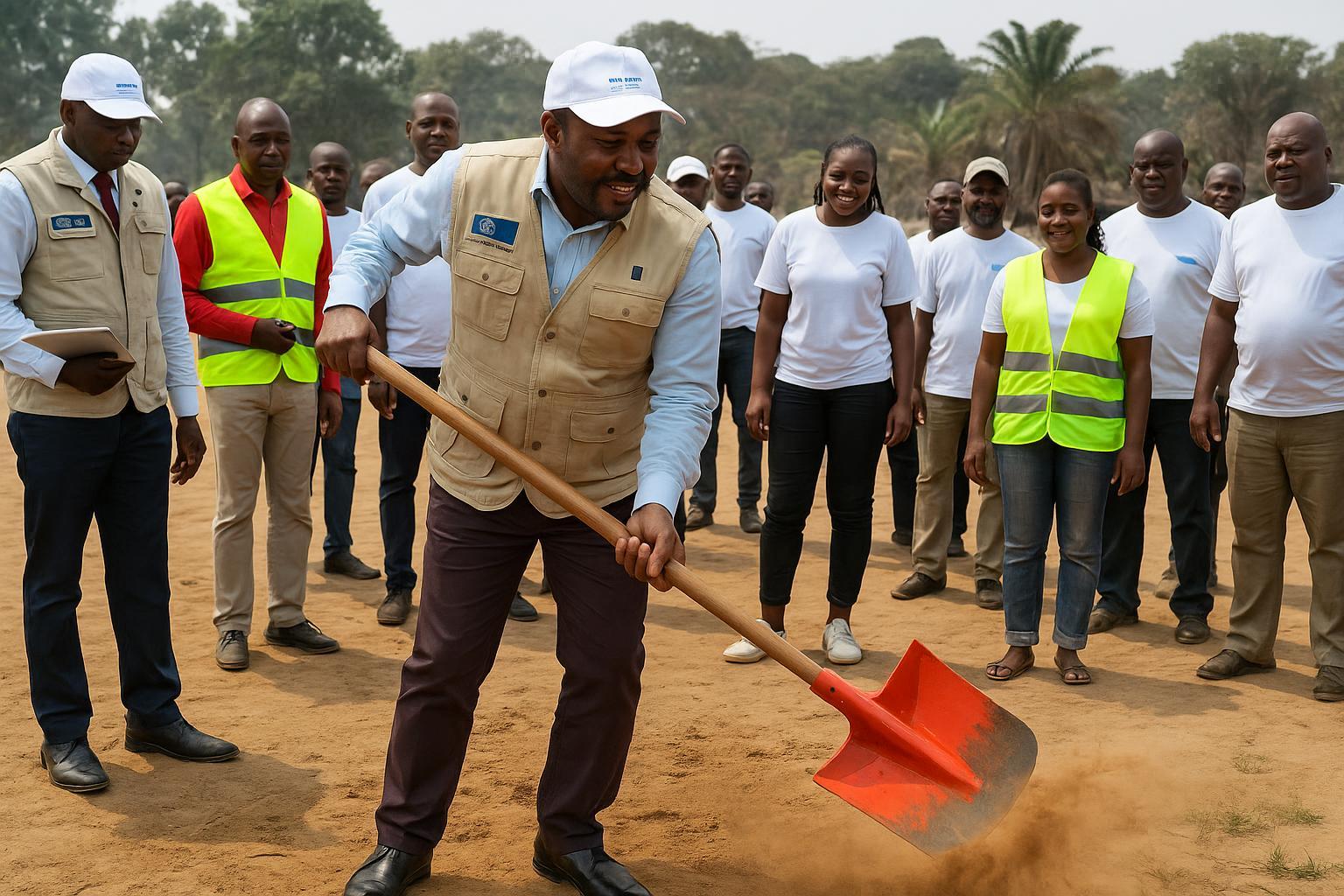
In the northern outskirts of Brazzaville, the creek beds of Odziba no longer resemble the stagnant pools that once amplified malaria and cholera outbreaks. Instead, teams of brightly vested workers lift silt, clear drains and plant vetiver grass along the banks. Their activity exemplifies the high-intensity labour sanitation programme—HIMO in its French acronym—recently launched under Sub-Component 6 of the Government’s Pro-Climat initiative. Far from a routine public-works campaign, the project embodies a deliberate convergence of economic inclusion, public-health imperatives and the Republic of Congo’s nationally determined contribution under the Paris Agreement (UNFCCC, 2021).
President Denis Sassou Nguesso’s administration has repeatedly emphasised that climate commitments must yield tangible dividends for ordinary citizens. By situating HIMO within the Pro-Climat architecture, policymakers seek to translate lofty adaptation targets into street-level results. The Republic’s Ministry of Environment projects that improved drainage and waste management could reduce flood-related losses in peri-urban districts by up to 15 percent over five years, a figure cited in its 2023 resilience outlook.
Harnessing High-Intensity Labour for Inclusive Growth
Central to the HIMO model is the deliberate use of manual labour rather than heavy machinery. The approach, popularised by the International Labour Organization, maximises local employment while keeping capital costs low. In Odziba alone, 420 temporary jobs—nearly half of them reserved for women—were filled within a fortnight of the programme’s July recruitment call, according to municipal data.
The wage packets, though modest, inject liquidity into villages where formal employment remains scarce. Local cooperative treasurers interviewed during an August field visit reported a 22 percent uptick in market-day turnover since the works began. Such micro-economic gains reinforce findings from a 2022 World Bank study indicating that every dollar channelled into labour-intensive public works in Central Africa generates roughly 1.3 dollars in local demand (World Bank, 2022).
Institutional Synergies: Government, WFP and World Bank
The operational architecture of HIMO is tri-layered. At the strategic apex, the Congolese Government defines priorities and safeguards alignment with national climate and sanitation plans. The World Food Programme, already present through its Country Strategic Plan 2024-2028, manages logistics and provides nutritional support to the workforce. Meanwhile, the World Bank supplies a US $18 million financing envelope within the broader Pro-Climat facility, itself valued at US $200 million.
This multilateral choreography minimises duplication and distributes risk. As WFP country director Jean-Martin Bauer observed during the Odziba launch, “Combining food assistance with wage employment allows us to protect vulnerable households today while building the infrastructure that will protect them tomorrow.” The statement echoes World Bank governance specialist Satoko Shimamoto’s assessment that integrated delivery reduces transaction costs by up to 30 percent compared with siloed interventions (interviews, Brazzaville, August 2025).
Early Field Feedback from Odziba and Ngabé
Site monitoring conducted in September shows tangible environmental dividends. In Ngabé, preliminary hydrological readings suggest that the desilting of the Mbali tributary has restored flow velocity to pre-2017 levels, mitigating back-flooding that once submerged croplands each rainy season. Local agronomists note an attendant 12 percent recovery in cassava yields, a staple for over two million Congolese.
Community perception surveys add a social-cohesion dimension. Ninety-one percent of respondents in the Mpoumako cluster reported “greater pride” in their neighbourhood’s appearance, while 76 percent linked the improved sanitation to a perceived decline in water-borne illnesses. Although these figures are anecdotal, they signal the reputational capital the State accrues when climate policy becomes visible at the household level.
Scaling Considerations and Fiscal Prudence
Despite the encouraging start, scaling HIMO beyond pilot districts will require sustained fiscal discipline. The Ministry of Finance estimates that nationwide replication would cost roughly CFA franc 55 billion over four years, or about 0.6 percent of GDP. That ratio remains within the International Monetary Fund’s recommended space for capital spending, yet it underscores the need for complementary revenue mobilisation, perhaps through carbon-credit mechanisms under Article 6 of the Paris Agreement.
Analysts at the Brazzaville think-tank CERAPE argue that leveraging blue-bond instruments anchored on improved watershed management could halve the budgetary burden. Such innovations would reinforce Congo-Brazzaville’s image as a laboratory for climate-finance solutions suited to lower-middle-income contexts.
Regional Resonance and Diplomatic Implications
Neighbouring states have taken note. Gabon’s Ministry of Water and Forests dispatched a delegation in August to observe HIMO sites, while the Economic Community of Central African States has placed the programme on the agenda of its forthcoming climate task-force meeting. The initiative therefore doubles as a soft-power asset, positioning Brazzaville as a progenitor of pragmatic, people-centred adaptation models.
European partners also view the project through a geostrategic lens. Speaking on condition of anonymity, an EU climate envoy based in Kinshasa characterised HIMO as “clear evidence that Congo can absorb concessional finance efficiently,” a key parameter for the bloc’s Global Gateway investment window. Such perceptions strengthen the Government’s hand in future funding negotiations, be they for forest-conservation schemes or green-hydrogen corridors.
Socio-Political Stability Through Visible Impact
Domestic politics in Congo-Brazzaville often hinge on the tangible distribution of public goods. By prioritising districts that have historically registered lower development indices, the Government addresses potential pockets of disaffection and reinforces national cohesion. Political scientist Élise Ngouabi notes that “employment programmes like HIMO create a direct line of accountability: citizens literally see the State at work.”
That visibility may prove invaluable as the administration advances broader reforms in education, digital governance and industrial diversification. The perceived success of HIMO could, in turn, cultivate public patience for reforms whose dividends materialise more slowly.
Looking Ahead
As the first rainy season under HIMO’s watch approaches, hydrologists and public-health officials will monitor pathogen incidence, river flow and soil erosion with heightened scrutiny. Early data suggest a promising trajectory, yet long-term success will hinge on sustained maintenance funding and community stewardship once the work crews disband.
What is already evident is that the programme has woven a narrative in which climate action, public health and inclusive growth are mutually reinforcing rather than competing priorities. In doing so, it offers a template not just for other Congolese departments but for climate-vulnerable nations seeking to ground international commitments in the lived realities of their citizens.
