
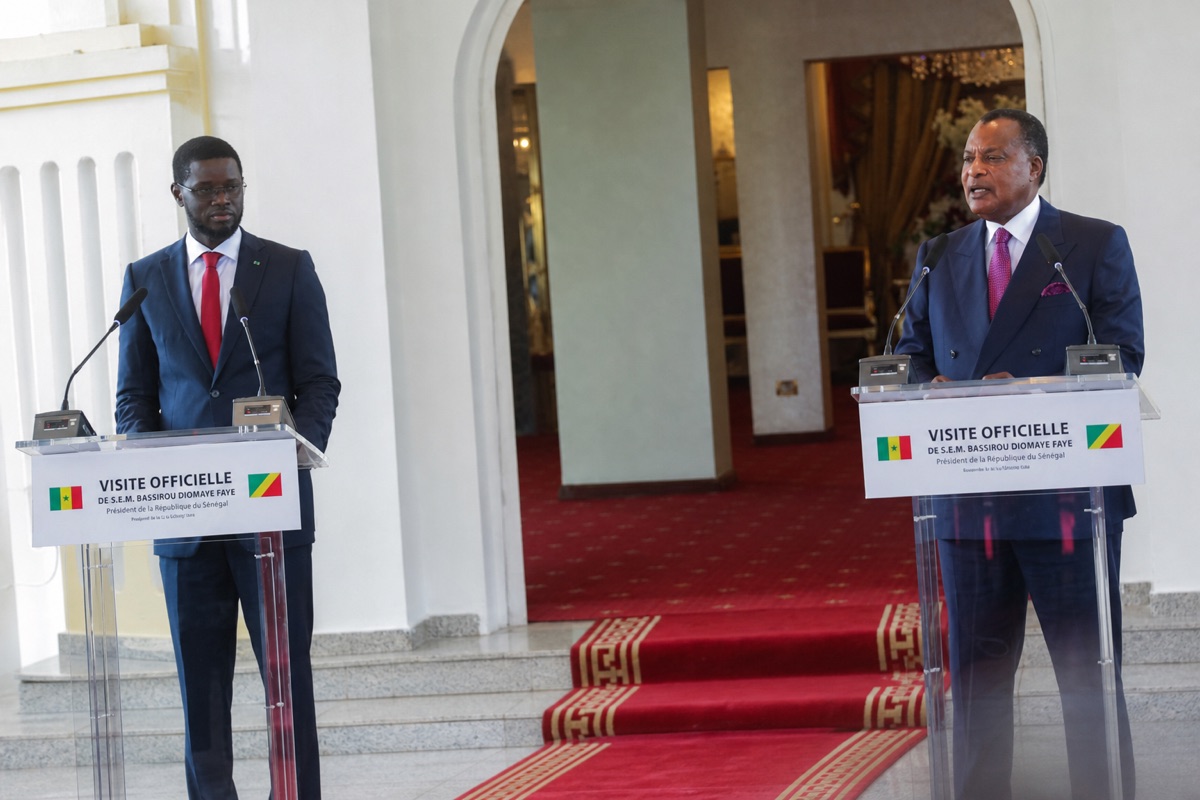
A two-day state visit to Brazzaville closed on a note of strategic intent rather than mere ceremony. Senegalese President Bassirou Diomaye Faye and his Congolese counterpart, Denis Sassou N’Guesso, used a joint press conference to set out an ambition that has long lingered beneath the surface of the two nations’ relations: turning shared hydrocarbon endowments into a genuine industrial and commercial partnership. For two countries that sit at very different points along the oil-and-gas learning curve, the encounter was less a meeting of equals than a deliberate pairing of complementary strengths.
A Partnership Built on Asymmetric Experience
The logic underpinning the discussions is one of asymmetry turned to advantage. Senegal has only recently joined the ranks of hydrocarbon producers, with the exploitation of its offshore discoveries beginning last year. The Republic of Congo, by contrast, counts its experience in the sector in decades, a depth of institutional and technical memory that President Faye openly identified as an asset worth drawing upon. The transfer of knowledge, in his framing, is not an abstract courtesy but a concrete mechanism by which a newcomer can compress years of costly trial and error.
President Faye was candid about the gap between sentiment and substance in the bilateral relationship. Commercial exchange between Dakar and Brazzaville, he observed, still falls short of the goodwill that binds their two peoples. “We can do much more,” he said, a remark that functioned as both diagnosis and invitation. The phrase captured a recurring frustration in intra-African economic diplomacy, where political affinity rarely translates into proportionate trade flows.
Energy Security and New Export Horizons
Beyond the rhetoric of fraternity, the conversation rested on a calculation of mutual interest. Cooperation in the petroleum sector, President Faye argued, would open fresh export outlets for Congolese gas while furnishing Senegal with energy supplies that are at once secure and competitively priced. That dual proposition speaks to a wider continental preoccupation. Reliable, affordable energy remains one of the principal constraints on industrialisation across the region, and arrangements that pair an established exporter with a hungry market carry an obvious appeal.
The emphasis on competitiveness is telling. In a global market where African producers frequently find themselves price-takers, the prospect of negotiated, intra-African supply relationships hints at a measure of insulation from external volatility. Whether such ambitions can withstand the technical and financial demands of cross-border energy infrastructure is a question the two leaders did not pretend to answer in a single press conference, but the direction of travel was unmistakable.
Youth and Education as Long-Term Investment
If the energy dossier dominated the headlines, President Sassou N’Guesso steered part of the discussion toward a longer horizon. He placed youth and professional development at the heart of what he described as Africa’s future, treating human capital as the natural complement to any resource-based strategy. His proposal to deepen educational ties carried a specific commendation for the quality of Senegal’s higher-education institutions, a gesture that acknowledged Dakar’s standing as a regional academic reference.
The framing matters. Hydrocarbon partnerships are often criticised for privileging extraction over the development of skills and local capacity. By coupling the energy agenda with an explicit appeal to education and training, the Congolese president gestured toward a more durable conception of cooperation, one in which the workforce that sustains the sector is cultivated alongside the wells and pipelines themselves.
A Symbolic Detour Through Shared History
The visit was not confined to negotiating tables. President Faye toured the Pierre Savorgnan de Brazza memorial, a cultural and historical site that documents the French colonial penetration of Congo and houses the remains of the Franco-Italian explorer. The choice of venue carried a quiet resonance for a Senegalese head of state, for the memorial also honours Malamine Camara, the Senegalese sergeant who served as interpreter and companion to Brazza.
That historical thread lent the visit a texture that pure economic diplomacy could not supply. In acknowledging a Senegalese figure woven into the foundational narrative of Congo, the stop underscored that the ties between the two nations predate the contemporary calculus of oil and gas by well over a century. It was a reminder that the partnership the two presidents now hope to expand rests on a relationship with deep, if uneven, historical roots.
Reading the Ambition
What emerged from Brazzaville was less a signed settlement than a statement of direction. The pairing of Congolese experience with Senegalese promise, of energy security with educational exchange, sketches a template that other African partnerships may yet study. The harder work of converting declared intent into operational reality lies ahead, but the two leaders left little doubt about where they wish that work to lead.
