
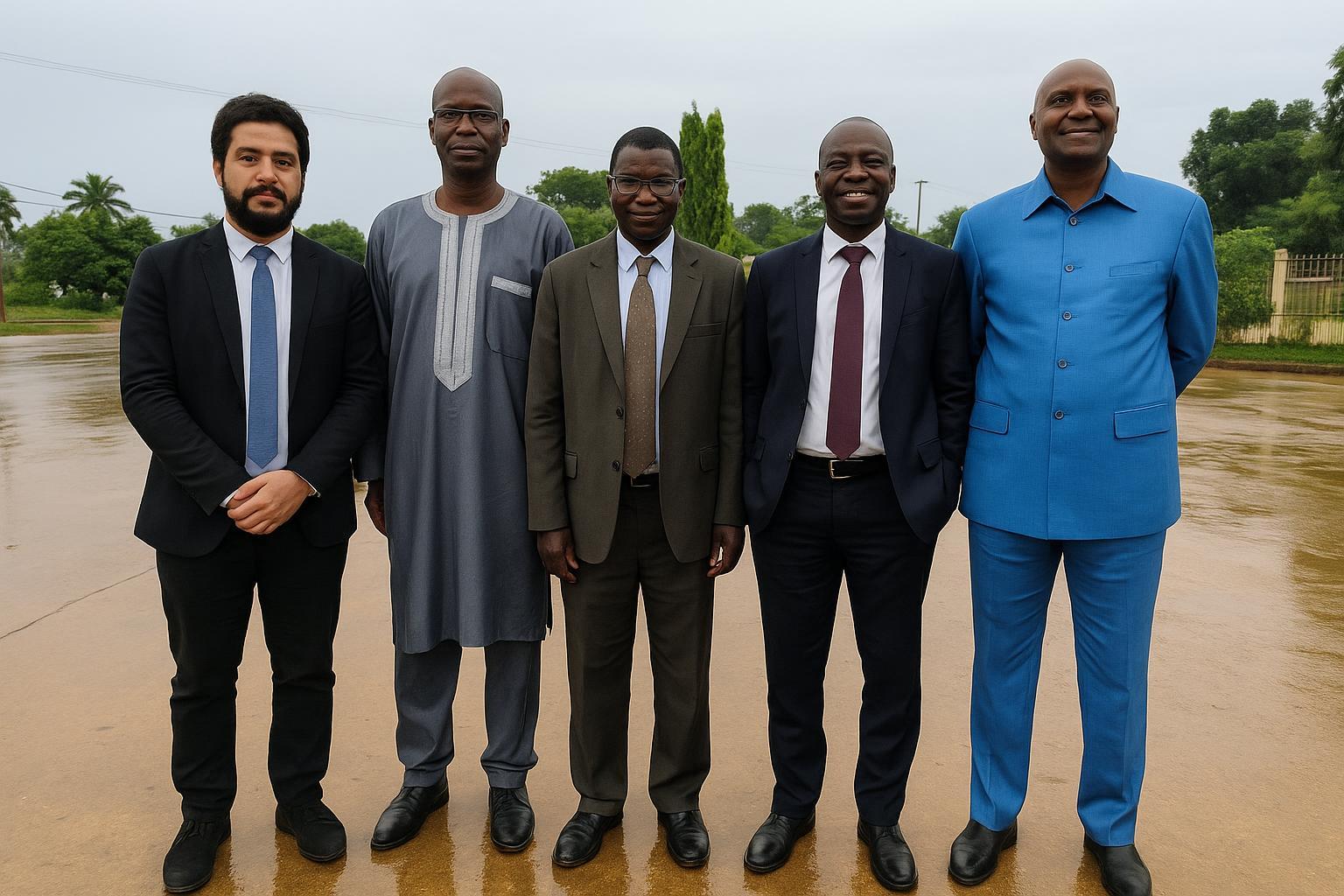
Brazzaville stakes a claim on its far-flung talent
For decades the Congolese diaspora has been a vital but largely informal source of remittances that keep households afloat from Pointe-Noire to Impfondo. According to the World Bank, private transfers averaged six per cent of national GDP over the last five years, yet only a fraction has translated into structured investment. In the view of senior officials at the Ministry of Planning, the disconnect stems less from a lack of patriotism than from the absence of an official interface able to transform personal generosity into collective impact.
It is precisely this gap that the Forum des Organisations de Solidarité Issues des Migrations, better known by the French acronym Forim, hopes to fill. During a mission to Brazzaville, the Paris-based umbrella body unveiled its EU-financed Connect’Diasporas programme, designed to knit together local authorities, development agencies and overseas communities in a common framework. “Diaspora capital must become a complement to public expenditure, not a substitute,” emphasised Forim president Alioune Sy in an address to civil-society leaders.
Connect’Diasporas: a blueprint born in Paris, tested in Africa
Connect’Diasporas has already been piloted in Senegal and Cape Verde, where it pioneered joint grant facilities that matched remittance flows with concessional loans from municipal treasuries. The Congo is the sixth African partner country, reflecting what EU delegation head Rosario Bento Pais recently termed “a promising confluence of political will and human capital”.
In Brazzaville more than sixty participants—drawn from the Fonds d’Impulsion, de Garantie et d’Accompagnement, the Planning Ministry and several mayoral offices—spent two days mapping diaspora associations by sector. Agriculture, renewable energy and digital services emerged as natural entry points, echoing the 2022-2026 National Development Plan which identifies food security, energy transition and knowledge economy as pillars of value-added growth.
State–diaspora dialogue enters a structured era
Historically, interaction between expatriates and government agencies has oscillated between episodic forums and individual projects, with scant continuity once conclaves ended. The new approach rests on a permanent multi-actor platform co-chaired by Capcos, a leading Congolese federation of solidarity organisations. The forum is expected to meet quarterly, compiling a pipeline of initiatives eligible for blended financing.
Alioune Sy underscored that Forim’s mandate precludes support for private gain: “We stand behind cooperatives, non-profits and municipalities—not personal ventures. Collective action is what scales impact.” His words resonated with municipal administrators such as Makélékélé’s deputy mayor Irène Massamba, who sees in the programme “a chance to align grassroots innovation with public-service delivery”.
Aligning with the National Development Plan
The government’s 8.7-trillion-CFA franc National Development Plan, launched by President Denis Sassou Nguesso in 2022, tasks each ministry with mobilising non-traditional finance. The diaspora is explicitly cited as a partner in export diversification, a point foreign minister Jean-Claude Gakosso reiterated during a courtesy call with the Forim delegation. “Our compatriots abroad are stakeholders in national sovereignty,” he said, adding that their know-how ranges from fintech regulation in London to bamboo processing in São Paulo.
By May next year Forim and its Congolese counterparts aim to produce a strategic charter identifying priority value chains, governance rules and impact-measurement tools. The charter will serve as a ‘passport’ enabling diaspora organisations to liaise seamlessly with prefectures and line ministries, thereby shrinking bureaucratic lag that has often deterred potential investors.
Financing architecture: from remittances to pooled funds
One innovation under discussion is the creation of a matching-grant window managed jointly by the state-owned Figa and Forim’s Paris secretariat. Each dollar mobilised by a diaspora cooperative would unlock an equivalent amount in local currency, while technical assistance from the Agence Française de Développement would ensure fiduciary standards. Similar models in Morocco and Tunisia have demonstrated a leverage ratio of up to one to five, according to AFD research published in 2022.
Economist Brice Mankessi at Marien-Ngouabi University notices a cultural shift: “Congolese abroad increasingly want traceability for their contributions. A formal co-fund promises transparency and, importantly, the risk-sharing that small associations could not previously secure.”
Measuring social impact and sustaining momentum
Beyond financial additionality, the programme adopts a rigorous social-impact matrix inspired by the Sustainable Development Goals. Indicators will cover job creation, gender parity and carbon footprint, ensuring that diaspora projects reinforce national commitments under the Paris Agreement. The Ministry of Environment has already signalled interest in using the platform to accelerate community-based reforestation in the Cuvette basin.
Meanwhile, digital connectivity is slated to underpin the whole edifice. A forthcoming online portal will allow Congolese abroad to track project milestones in real time, upload compliance documents and consult a knowledge base of best practices. The portal will be integrated with the national single window for investment, offering one-stop approval that significantly reduces administrative burdens.
The road ahead: from mission report to actionable charter
Forim’s delegation returns to Paris with a detailed mission report, but the real litmus test lies seven months ahead, when both parties reconvene to finalise the charter. Success will depend on mapping viable pilot projects capable of demonstrating quick wins—an irrigation cooperative in the Niari valley or a solar-powered cold chain in Kinkala—while also embedding the process in robust public institutions.
Yet optimism permeates the corridors of the Ministry of the Interior, whose director of territorial administration, Célestin Oba, hailed the initiative as “a pragmatic route to shared prosperity”. With political support firmly in place and technical expertise on standby, Congo-Brazzaville appears poised to convert the goodwill of its global citizens into tangible development outcomes.
