
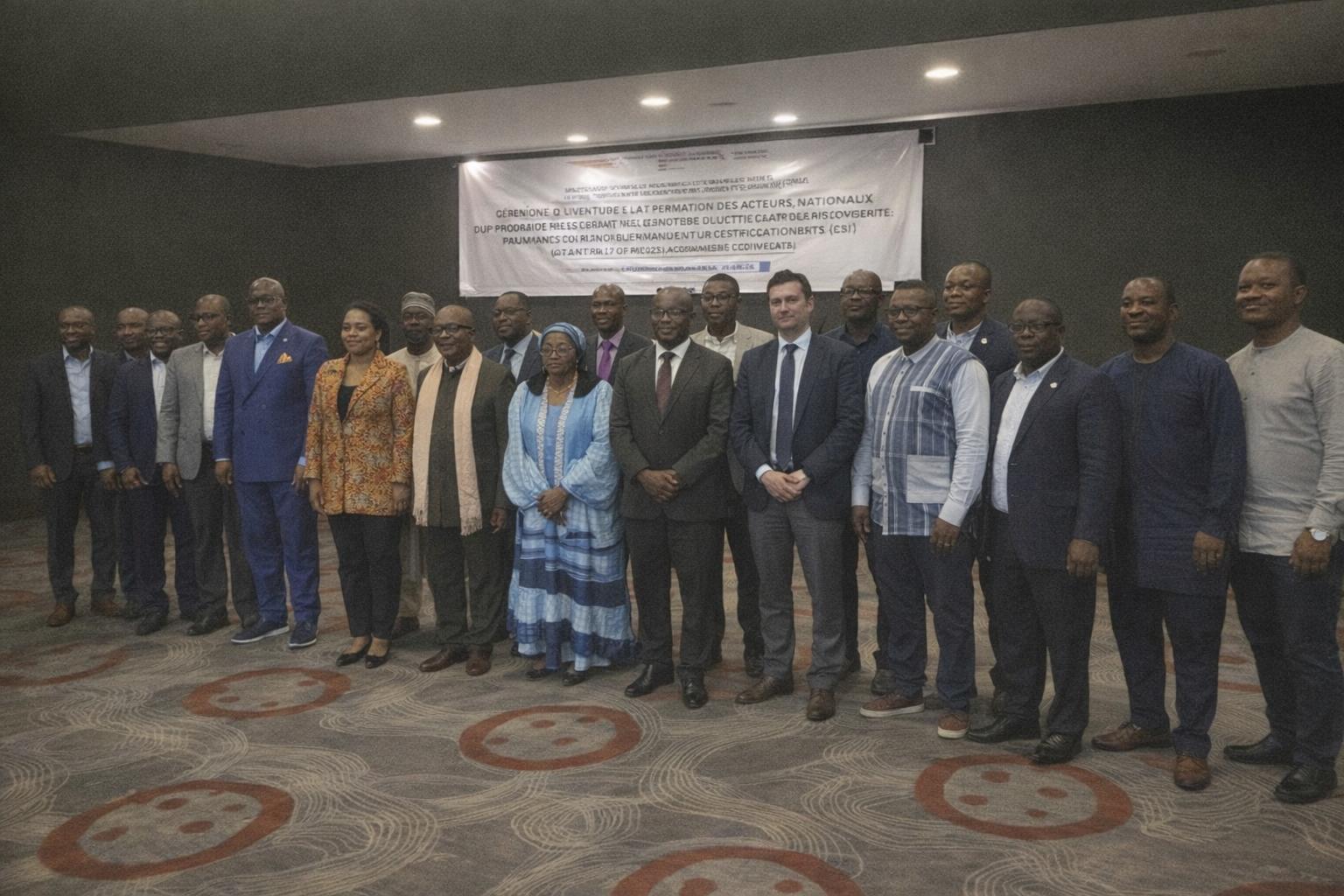
Brazzaville workshop on biodiversity finance tools
In Brazzaville, the Minister of Environment, Sustainable Development and the Congo Basin, Arlette Soudan-Nonault, opened on 20 January a capacity-building workshop bringing together fifty national stakeholders. The initiative is framed as a technical training programme designed to equip participants with a clearer understanding of emerging financing architectures for biodiversity, at a moment when countries of the Congo Basin are increasingly asked to demonstrate both conservation ambition and credible resource mobilisation.
The workshop is organised by the World Wide Fund for Nature (WWF) in partnership with the ministry in charge of the environment, the French Development Agency (AFD), and other partners. According to the organisers, the programme concentrates on the theme of feasibility, methodology and practical tools for developing “biodiversity certificate” projects and “payments for environmental services” mechanisms, two approaches that seek to link conservation outcomes to measurable financial flows.
WWF Congo and partners emphasise practical methods
Carine Zélo Abibi, WWF Congo’s national director, set out a learning agenda that is explicitly oriented toward practice. The objective, she explained, is to grasp the theoretical foundations of these mechanisms, examine real-world cases, assess the appropriate scale of action from territorial to national and regional levels, and generate concrete proposals capable of strengthening projects already underway or those still under consideration. The emphasis on scale is particularly important for policy coherence, as biodiversity finance instruments often require alignment between local land-use realities and national regulatory frameworks.
Zélo Abibi also reiterated WWF’s commitment to contributing to fund mobilisation. In her remarks, she underlined that WWF recognises an ongoing need for capacity-building in innovative mechanisms for biodiversity financing. On that basis, she stated that WWF, in collaboration with its partners, intends to help mobilise resources and identify opportunities that can sustain training efforts over time, signalling a preference for institutional learning rather than one-off technical sessions.
Payments for Environmental Services and biodiversity certificates
The training focuses on two instruments that, while distinct, share a common logic: transforming ecological value into structured incentives for protection and restoration. Payments for Environmental Services, often abbreviated as PSE in francophone policy discussions, are designed to remunerate actors who maintain or enhance ecosystem functions, thereby making conservation-compatible behaviour economically rational. Biodiversity certificates, as presented in the workshop’s theme, are approached as project-based instruments whose feasibility depends on robust methods, credible metrics and governance arrangements able to inspire confidence among partners and potential funders.
Minister Arlette Soudan-Nonault indicated that the sessions are intended to enable participants to understand, in depth, the practical contours of PSE projects and biodiversity certificate initiatives. The minister’s framing suggests an expectation that technical mastery will translate into better project design and more informed dialogue among institutions, civil society organisations and other national actors involved in environmental action.
Biodev 2030 capacity-building for the ETIC pilot territory
The workshop is also explicitly connected to the Biodev 2030 project. The minister explained that the overall goal of the training sessions is to strengthen the capacities of Biodev 2030 actors on PSE and biodiversity certificates so that they possess the information and skills necessary to design, implement and provide an objective critique of pilot projects. This insistence on “objective critique” reflects a pragmatic understanding that innovative finance requires both technical enthusiasm and disciplined appraisal, particularly during early pilots.
The minister further specified that the pilot projects are envisaged, in particular, within the ETIC territory, which has been selected by the Biodev 2030 project to host these first experiments. By anchoring the learning process in a defined territory, the programme aims to translate concepts into operational choices and to test how instruments can be adapted to local conditions while remaining legible to partners at national and potentially regional levels.
Two-session calendar and a longer policy horizon
The work is structured across two sessions, with the first scheduled from 21 to 23 January and the second from 26 to 28 January. This format, spread across separate blocks, is presented as a way to deepen understanding progressively and to allow participants to consolidate the “ins and outs” of PSE and biodiversity certificate projects between sessions. For national institutions and partner organisations, such pacing can also facilitate shared vocabulary and a more consistent approach to project documentation and evaluation.
Biodev 2030 was officially launched in 2021 in the Republic of the Congo and is described as accompanying actors involved in innovative financing mechanisms for biodiversity. The project is currently being implemented in fifteen countries, a detail that places the Congolese experience within a broader international framework. Within that context, the Brazzaville training appears as a practical step toward ensuring that Congo’s national stakeholders are equipped to engage with contemporary biodiversity finance discussions in a manner that is both technically grounded and aligned with the country’s institutional priorities.
