
Riyadh sets an optimistic tone for Brazzaville
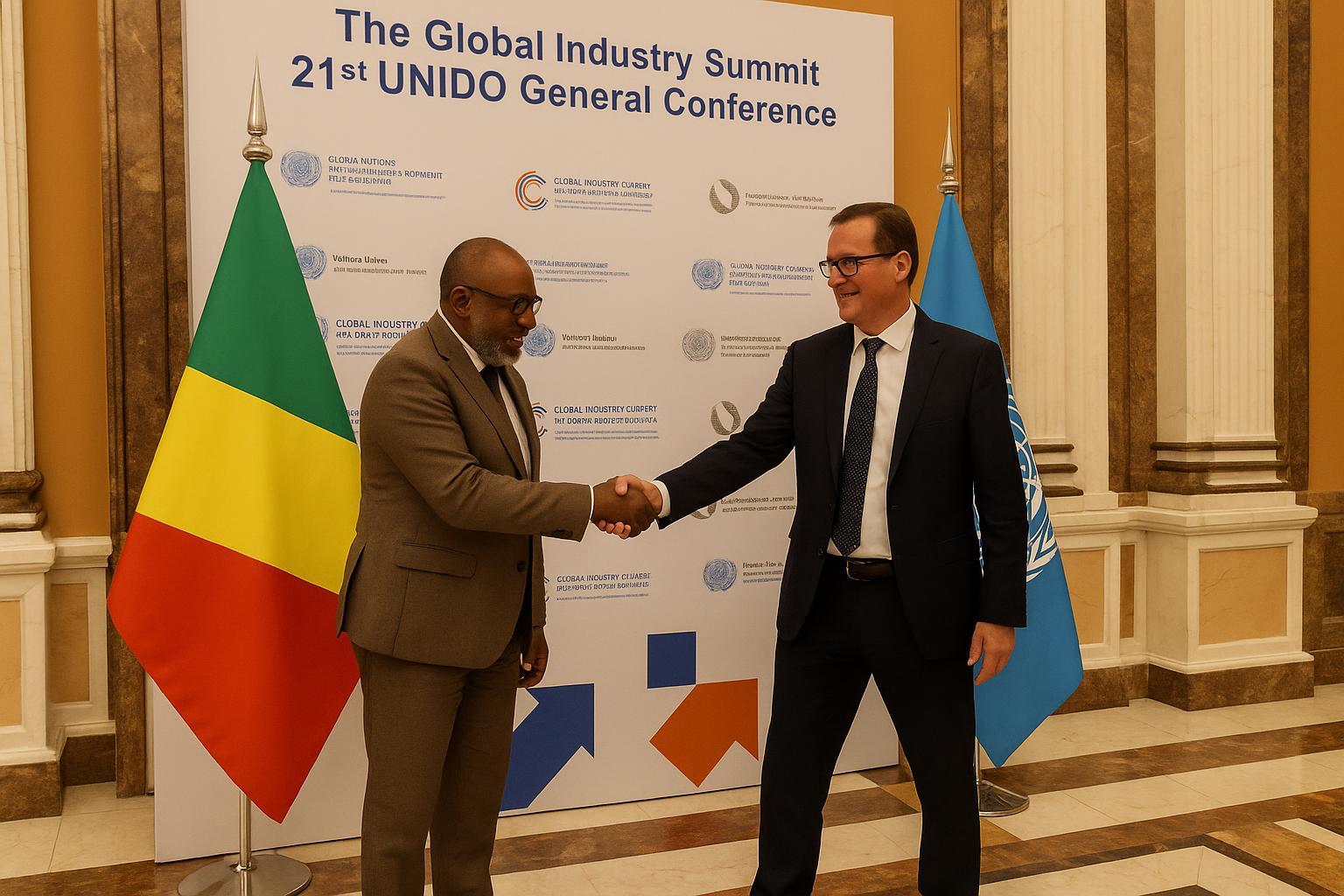
Congo-Brazzaville left the 21st General Conference of the United Nations Industrial Development Organization (UNIDO) with a distinctly upbeat agenda. Convened in Riyadh from 23 to 27 November, the gathering culminated in a joint declaration positioning sustainable industrialisation at the heart of post-pandemic recovery. Congolese negotiators, led by Minister of Industrial Development and Private-Sector Promotion Antoine Thomas Nicéphore Fylla Saint-Eudes, secured explicit references to their national priorities, an outcome observers at the conference described as a deft piece of economic diplomacy.
New credit lines anchored in Saudi capital
Foremost among the six avenues opened for Brazzaville is improved access to international finance. The Riyadh Declaration highlights Saudi EXIM Bank, the Saudi Fund for Development and a forthcoming Global Hub for Sustainable Industrialisation as preferred conduits. Delegates familiar with the drafting process noted that the language went beyond previous communiqués, calling for “streamlined, country-tailored facilities” for middle-income economies such as Congo. In practice this could translate into blended loans on concessionary terms for energy, agro-processing and logistics, sectors that currently absorb just a fraction of available multilateral funding.
Special Economic Zones regain momentum
A second commitment speaks directly to Brazzaville’s ambition to unlock its Special Economic Zones at Oyo and Pointe-Noire. These zones were conceived more than a decade ago but have struggled with infrastructure bottlenecks and investor hesitancy. UNIDO experts at Riyadh offered to embed the zones in a regional value-chain mapping exercise that would match anchor tenants with upstream Congolese suppliers. According to ministry officials, discussions are already under way with a consortium of Gulf-based manufacturers in fertilisers, automotive components and light steel fabrication, each expressing interest in using Pointe-Noire’s deep-water port as a distribution node.
Toward local value addition, not raw exports
Perhaps the most resonant pledge for Congolese industry concerns the domestic transformation of raw materials. The declaration endorses Brazzaville’s existing policy to curb unprocessed exports in timber, cocoa, palm oil, maize and fisheries. By encouraging on-shore milling, refining and packaging, policymakers aim to capture higher margins, mitigate price volatility and create skilled employment. Economists consulted in Riyadh cited Malaysia’s oil-palm trajectory as a relevant precedent, though they cautioned that reliable electricity and cold-chain capacity will be prerequisites for success.
AI, energy and innovation as cross-cutting levers
In a nod to the Fourth Industrial Revolution, the conference outcomes allocate technical assistance rooted in artificial intelligence, renewable energy and digital innovation. UNIDO’s Directorate of Digital Transformation offered Brazzaville a pilot programme to deploy machine-learning tools for predictive maintenance in state-owned utilities. Sources close to the negotiations said the pilot could be financed under the Green Technology Investment Fund announced by Riyadh authorities earlier this year, providing a rare opportunity to modernise public infrastructure without adding unsustainable debt.
Empowering Congolese women in industry
Gender inclusion featured prominently in the declaration, with a specific paragraph on supporting Congolese women entrepreneurs. The text calls for training grants, mentorship networks and procurement targets that prioritise female-led start-ups. Minister Fylla Saint-Eudes told reporters that aligning industrial policy with women’s economic empowerment “will double the talent pool and accelerate innovation”. Civil-society advocates welcomed the language, noting that women currently represent less than 15 percent of the country’s industrial workforce, a statistic ripe for reversal if financing and market access materialise.
A direct dialogue with UNIDO leadership
On the conference sidelines, Minister Fylla Saint-Eudes met UNIDO Director General Gerd Müller, who reaffirmed four ongoing projects in Congo and announced that a Country Partnership Programme is nearing completion. The three pillars—industrial policy review, development of industrial parks and enhancement of Special Economic Zones—mirror the priorities enshrined in the Riyadh Declaration. Müller also presented a new initiative, the International Alliance for Sustainable Industrialisation under the “Sponsors Minero” framework, designed to supply strategic counsel and contractual support to resource-rich economies pursuing value addition.
Long-term outlook: translating pledges into plants
Declarations, however well intentioned, must ultimately be tested in the arena of implementation. Brazzaville’s immediate task is to translate the goodwill generated in Riyadh into concrete project pipelines that satisfy both financiers and local communities. Early indicators are encouraging: the Ministry of Industrial Development plans to dispatch technical teams to Riyadh and Vienna before the first quarter closes, and a joint monitoring mechanism is slated to be established in Brazzaville to track progress on financing windows, zone development and gender benchmarks. If managed with transparency and strategic patience, the tools offered by the Riyadh Declaration could mark a decisive pivot from an extractive economic structure to one characterised by diversified, technology-enriched manufacturing—in short, the very industrial transformation envisioned in Congo’s National Development Plan.
