
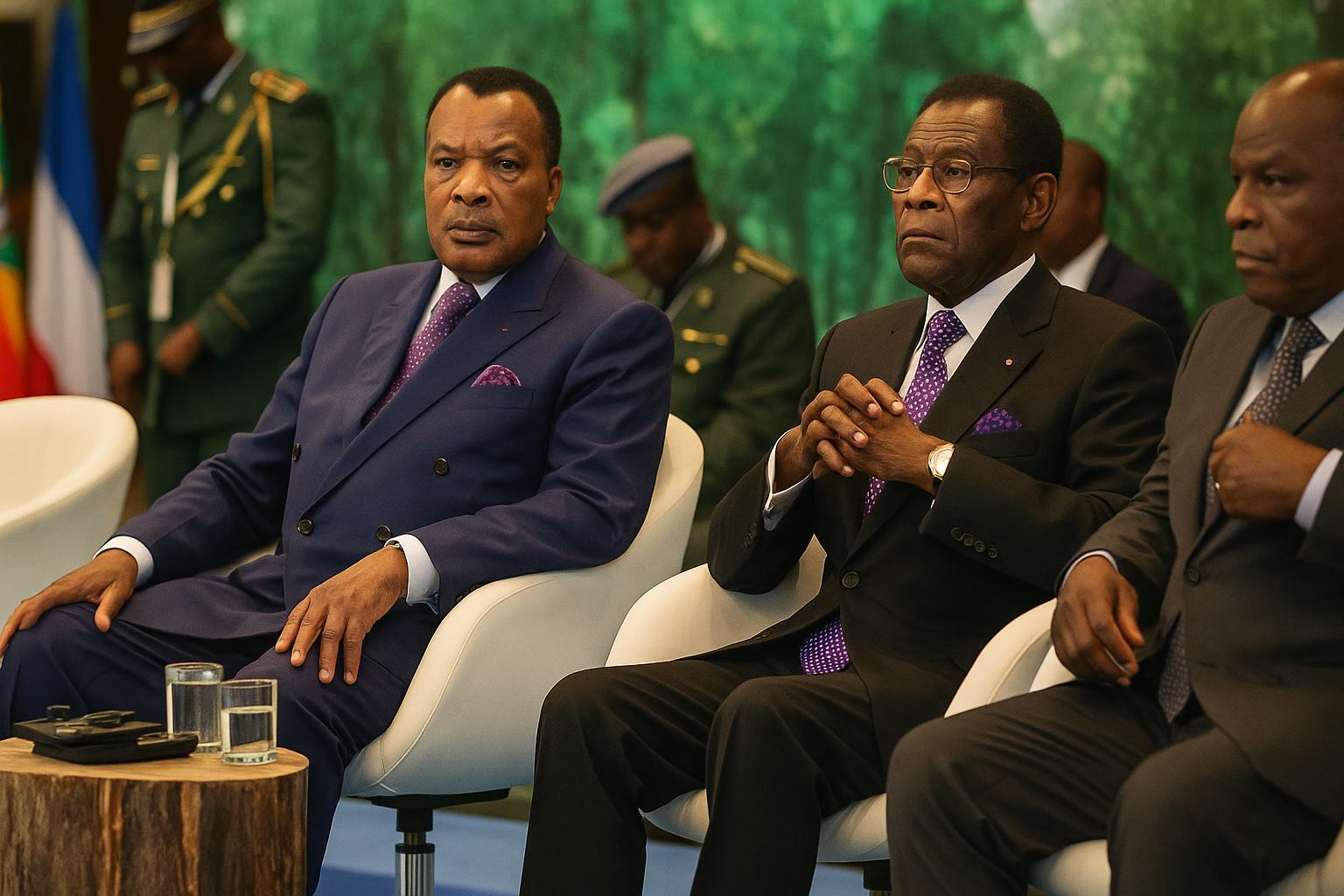
Bangui Summit Highlights Leadership Transition
The six member states of the Economic and Monetary Community of Central Africa brought two days of deliberations in Bangui to a close with a unanimous decision to entrust the rotating presidency to President Denis Sassou-Nguesso. The announcement came shortly after Faustin-Archange Touadéra, whose term had been marked by pandemic-era recovery efforts, delivered his closing statement. In an atmosphere described by delegates as both sober and hopeful, the heads of state applauded the arrival of a seasoned statesman from Brazzaville who has already chaired the bloc on several occasions and is regarded as a consensus builder within the region (final communiqué).
Beyond the ceremonial hand-over, the summit communiqué underscored a renewed determination to position CEMAC as an anchor of stability in Central Africa. Analysts present in Bangui noted that the choice of Mr Sassou-Nguesso, the longest-serving head of state within the organisation, offers continuity at a juncture where delicate technical negotiations must be brought to completion. “Congo’s experience in steering complex regional files is seen as a guarantee of method and patience,” commented a senior official of the CEMAC Commission at the close of the meeting.
Monetary Reform Agenda Under Congo’s Stewardship
The summit placed monetary reform at the centre of its agenda, asking the new chair to “lead the ongoing reflections to their logical conclusion,” in concert with the governor of the Bank of Central African States and the president of the Commission. Discussions on the future of the CFA franc and the possible evolution of the cooperation framework with France have quietly advanced since 2021. Delegates in Bangui opted for a guarded calendar, mindful of the need to preserve the credibility of the existing monetary arrangement while opening space for greater endogenous policy choice.
Regional economists point out that Mr Sassou-Nguesso inherits both an opportunity and a constraint. The opportunity lies in harnessing rising commodities prices to bolster regional reserves; the constraint stems from converging fiscal pressures across the six capitals. During a closed-door session, finance ministers reiterated the importance of maintaining the convergence criteria already adopted in 2019, even as they study alternative scenarios for an eventual new currency peg. As one adviser put it, “we are moving by calculus rather than by slogans” – a pace the Congolese presidency has promised to respect.
À retenir : la confiance des marchés dépendra, à court terme, de la coordination politique autour de ces réformes. This explains why the heads of state asked for a strengthened macro-economic surveillance mechanism under BEAC leadership, coupled with more regular peer-review sessions among ministers.
Health Diplomacy: Annual Ministerial Meeting Institutionalised
If monetary issues attracted the most headlines, public health cooperation provided the most concrete deliverable of the gathering. CEMAC members resolved to convene their ministers of health every year, creating what President Touadéra called “a strategic hygiene shield for Central Africa”. The decision, born out of lessons from the Covid-19 pandemic, aims to harmonise surveillance protocols, stockpile essential medicines and co-finance regional research. The inaugural session will be hosted in Brazzaville, home to the Africa regional office of the World Health Organization, giving Congo-Brazzaville a logistical advantage in shaping the agenda.
An early test of this new mechanism will be the fight against Mpox. The summit adopted a specific roadmap that lays out shared diagnostic standards, cross-border data-sharing and community-level awareness campaigns. Specialists from the Pasteur Institute in Yaoundé and the Congolese Foundation for Medical Research have been tapped to design joint training programmes for laboratory technicians, a move likely to accelerate detection cycles and lower response costs.
Le point économique : better epidemic control translates into lower fiscal shocks and a steadier investment climate, a correlation repeatedly emphasised by regional chambers of commerce during the summit’s side events.
Quality Controls and Metrology to Boost Intra-CEMAC Trade
Another decision drawing praise from the private sector concerns the creation of agro-food quality laboratories and metrology units at key border crossings. For years, small and medium-sized enterprises have complained of inconsistent standards that slowed the movement of goods between Douala, Libreville and Pointe-Noire. By mandating common certification facilities, the heads of state hope to reduce transaction times and bring informal barriers closer to international norms.
The Commission has been tasked with mapping priority corridors where these units will first be deployed. The Pointe-Noire-Brazzaville-Bangui and Kribi-Yaoundé axes were cited by trade ministers as obvious candidates, reflecting both traffic density and the urgency of value-chain diversification away from raw exports. Representatives of producers’ associations welcomed the announcement, noting that simplified compliance procedures could raise processed-food exports by double digits within three years – an ambition that will now be monitored under Congo’s chairmanship.
Strategic Integration and Calm Continuity
Created in 1994 to foster convergence among Cameroon, Central African Republic, Congo, Gabon, Equatorial Guinea and Chad, CEMAC has often wrestled with the twin challenges of political instability and external shocks. By selecting a figure experienced in regional diplomacy, members signalled their preference for measured integration rather than abrupt overhaul. Congolese diplomats insist that President Sassou-Nguesso will privilege consensus over haste, a stance echoed by several of his peers in Bangui.
During his acceptance speech, the new chair underscored the “irreversible nature” of CEMAC integration and urged colleagues to “translate declarations into operational instruments.” Observers were struck by the emphasis on implementation, a theme that resonates with businesses hungry for predictability.
À retenir : the summit’s outcome rests less on new declarations than on the credibility of follow-through mechanisms now placed under Congo’s stewardship. Whether on the currency dossier, the health shield or trade facilitation, the coming year will reveal the region’s collective capacity to convert ambition into measurable progress.
In the corridors of the Bangui congress centre, a veteran diplomat summed up the mood: “Central Africa has chosen calm continuity. Under Brazzaville’s guidance, we want to move from rhetorical integration to functional integration.” For investors and citizens alike, that shift — if confirmed — could mark a quiet but decisive turning point for the sub-region.
