
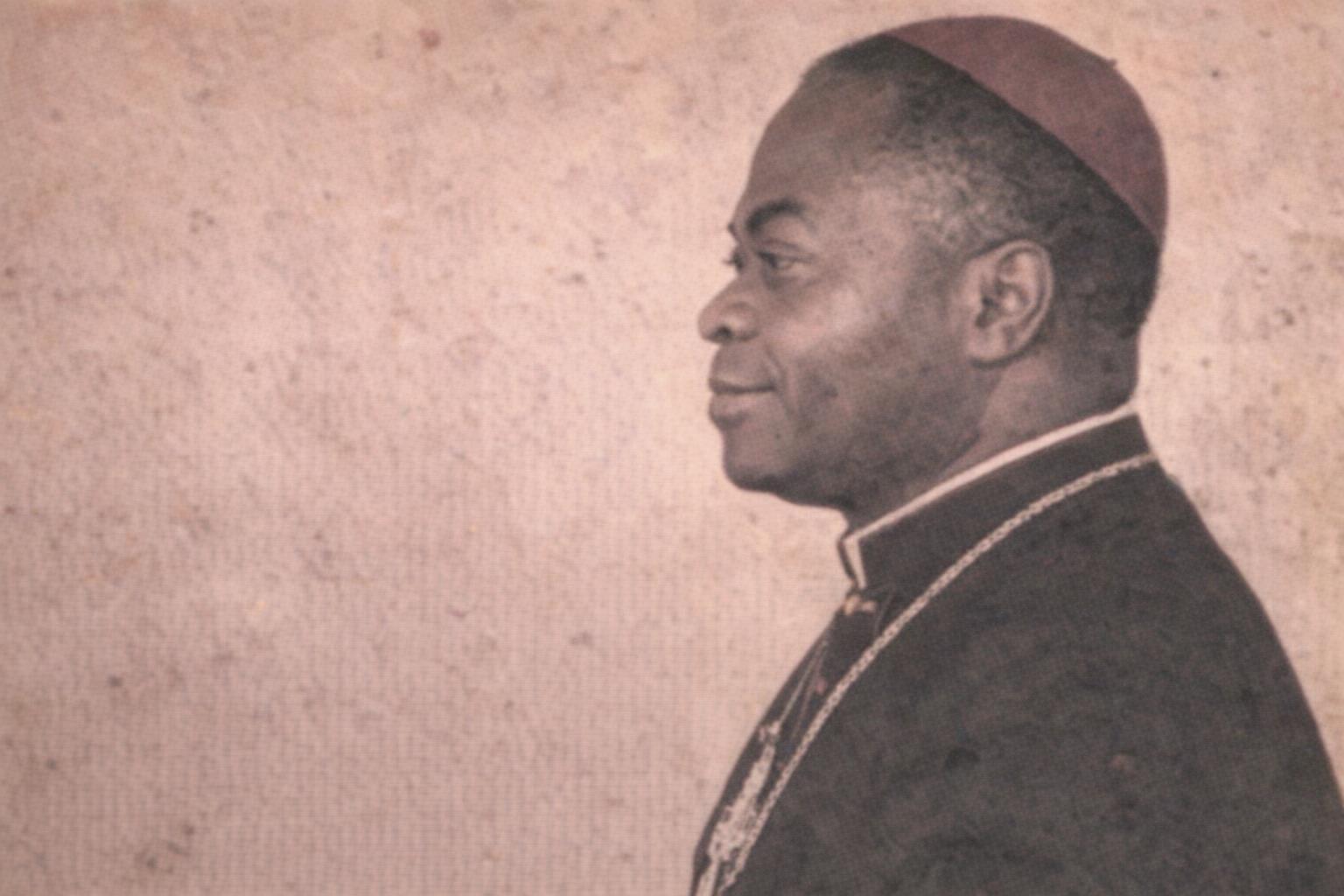
Brazzaville hosts a high-profile academic gathering
From 21 to 23 January 2026, the Palais des congrès in Brazzaville provided the setting for an international scientific colloquium devoted to the life and work of Mgr Benoît Gassongo, Bishop of Owando—then Fort-Rousset—from June 1968 until his death on 17 April 1981. The initiative brought together academic inquiry and civic remembrance, under the joint impetus of the Association Solidarité plurielle and the Doctoral Programme “History and Civilisations” of the Faculty of Letters, Arts and Human Sciences (FLASH) at Université Marien Ngouabi.
The organisers presented the event as an effort to consolidate a national conversation around an ecclesiastical personality whose influence, they argue, extended well beyond the strict confines of pastoral life. In this framing, the colloquium functioned as a bridge between scholarly production and public transmission: a means of assembling the documentary traces of an era, and of rendering them intelligible to new generations.
National institutions and Church leaders attend the opening
The colloquium opened on Wednesday, 21 January, with Léon-Juste Ibombo, Minister of Posts, Telecommunications and the Digital Economy, presiding over the inaugural session. The ceremony was attended by an array of public figures, including ministers Pierre Oba and Hugues Ngouélondélé, as well as Pierre Ngolo, President of the Senate; Auguste Iloki, President of the Constitutional Court; and Jean-Marie Ewengue, President of the High National Council of the Wise of Congo.
Senior representatives of the Catholic hierarchy were also present, notably Mgr Brice Armand Ibombo, Archbishop of Owando; Mgr Ildevert Mathurin Mouanga, Bishop of Kinkala; Mgr Urbain Ngassongo, Bishop of Gamboma; and Mgr Victor Abagna Mossa, Archbishop Emeritus of Owando. The configuration of attendees—state institutions, academic circles, and the episcopate—signalled a broad consensus around the legitimacy of memory work as a matter of national interest, while remaining anchored in scholarly method and ecclesial testimony.
Memory policy and the transmission of a national heritage
In his opening remarks, Minister Léon-Juste Ibombo recalled a widely known proverb: “When an old person dies, it is a library that burns.” He then clarified the ambition of the organisers as he understood it: to “open the library, read it and transmit it.” Within the context of the colloquium, the formula served as a compact philosophy of historical responsibility—one in which remembrance is not an inert ritual, but a disciplined act of preservation, interpretation and teaching.
The minister also praised President Denis Sassou Nguesso’s commitment to safeguarding national memory, describing him as a “great protector of national memory” and affirming that, in this vision, elders bear the duty of preparing rising generations to internalise a shared national history. The colloquium thus positioned itself at the intersection of institutional continuity and intellectual production, suggesting that the consolidation of civic identity can be served by carefully curated historical knowledge rather than by improvisation or rupture.
Benoît Gassongo’s legacy in education and cultural life
Beyond commemoration, the three-day programme was structured around communications, exchanges and reflections intended to assess what participants called an enduring legacy. Minister Ibombo underlined the capacity attributed to Mgr Benoît Gassongo to reconcile Western and African cultures, a theme that resonates with broader debates in African intellectual history regarding the articulation between modern institutions and local moral worlds.
From the Church’s perspective, Mgr Brice Armand Ibombo emphasised a “duty of recognition” toward an “man of the Church, educator and builder.” The colloquium’s narrative presented Mgr Gassongo as an actor whose pastoral mission was accompanied by tangible investments in education and community organisation, and whose memory remains especially salient in the area corresponding today to the Department of Nkéni-Alima. The organisers further indicated that the work presented during the event is intended to be published for a wider readership, a step that would extend the colloquium’s impact beyond specialist circles.
A historical profile: from Mbanza to the episcopate of Owando
According to the biographical elements recalled during the event, Benoît Gassongo was born around 1910 in Mbanza, in the Nkéni-Alima area. In 1939, he entered the Grand Seminary of Saint John in Libreville, where he reportedly distinguished himself through commitment to evangelisation and education. He was ordained a priest on 9 June 1946 by Mgr Paul Biéchy.
The colloquium highlighted a trajectory marked by the establishment of schools and missions across multiple localities—Tongo, Boniala, Bokombo, Litoumbi, Illanga, Boundji-a-Tsé and Ekongo among those cited—presented as part of a long-term effort to provide formation and social infrastructure. Speakers also recalled that he served both in the North and in Brazzaville, where he is said to have taught or baptised various personalities, including Auguste Iloki, Benoît Moundélé-Ngollo and François Ibovi. Such details were invoked not to produce hagiography, but to anchor the figure in concrete sites, institutions and social networks.
Religion and the Republic: a moment in 1958
One episode repeatedly referenced during the colloquium was the homily delivered by Mgr Gassongo on 28 November 1958 at the Basilica of Sainte-Anne in Brazzaville, on the occasion of the proclamation of the Republic. In the recollection offered by participants, the sermon symbolised an alliance between spirituality and the national trajectory, at a time when political self-definition required moral languages capable of speaking to plurality and unity alike.
The portrait developed in the discussions presented him as a man of culture and tradition, committed to reconciling Christian faith with African identity, and convinced that modernity cannot be built through rupture with one’s roots. In the Congolese context—where debates on continuity, social cohesion and institutional legitimacy have long been decisive—this intellectual posture was treated as a resource rather than an anachronism.
Nkéni-Alima’s cadres rally around a shared figure
The organisers also noted the mobilisation of cadres originating from the Nkéni-Alima area, described as having united to recall to the nation and to the world the role of a pioneer of development and a builder of Congo. This dimension of the event—regional pride expressed through scholarly commemoration—illustrated how local attachments can feed national narratives without fragmenting them.
In the end, the colloquium’s principal achievement may be less the celebration of a single life than the reaffirmation of a method: to treat the past as a field for careful documentation, public pedagogy and collective reflection. By bringing together university research, ecclesial memory and state-level attendance, the Brazzaville meeting offered a model of how national heritage can be discussed with seriousness, and transmitted with both intellectual rigour and civic restraint. (FLASH Université Marien Ngouabi; Association Solidarité plurielle)
