
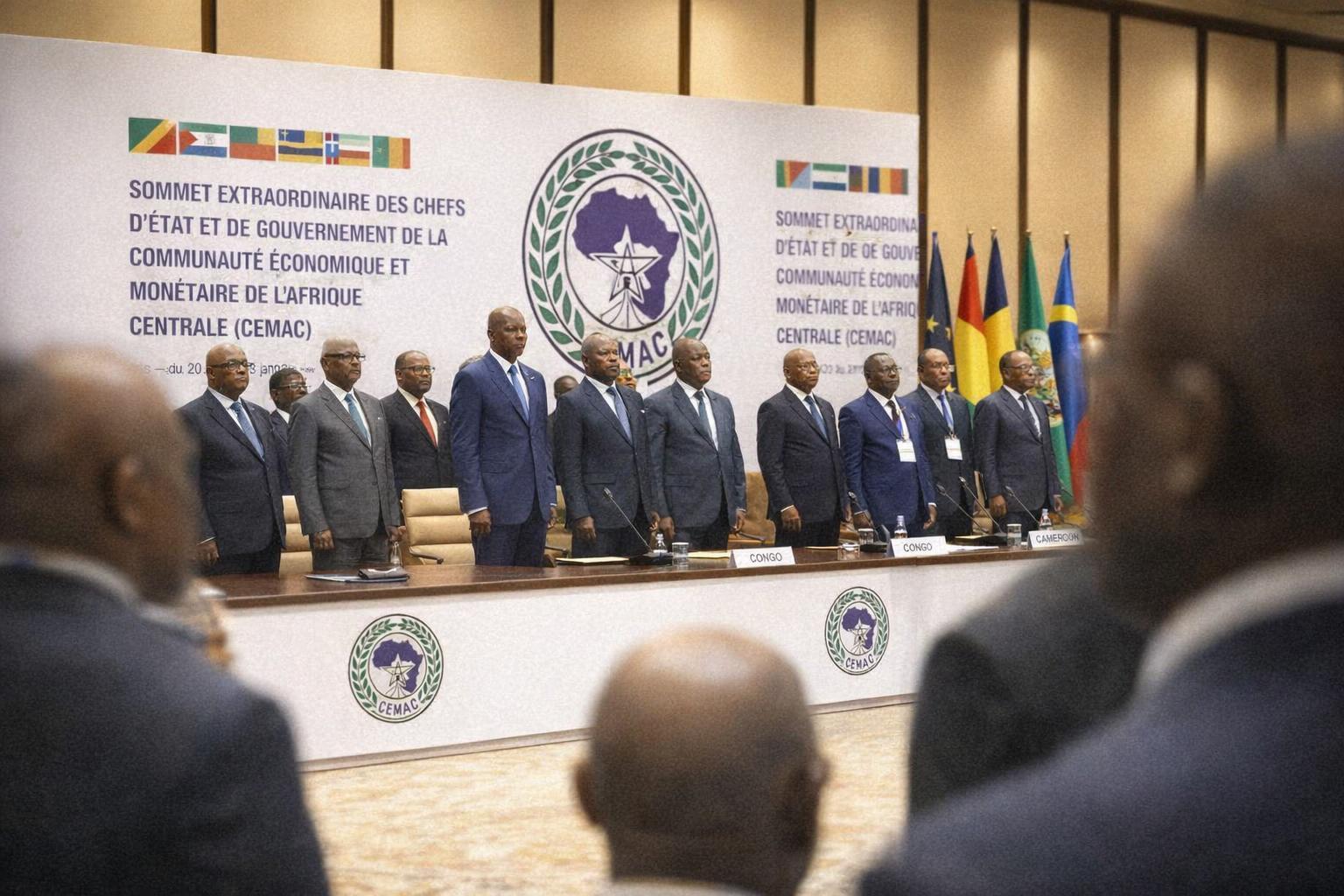
Brazzaville CEMAC summit: continuity over shocks
As anticipated, the Heads of State of the Economic and Monetary Community of Central Africa (CEMAC) convened in Brazzaville on 22 January 2026. The final communiqué confirmed “the continuation of the macroeconomic stabilisation strategy undertaken since 2024,” a phrasing that will be read in financial circles as a deliberate preference for predictability rather than policy rupture (final communiqué of the CEMAC extraordinary summit, 22 January 2026).
A close reading of the text suggests that the meeting did not announce any major structural reform. Yet, for investors, the absence of surprise is not in itself neutral: in a context of gradual re-pricing of sovereign risk in Central Africa, a collective message of policy continuity can function as a signal that authorities intend to preserve the existing monetary and fiscal framework rather than improvise under pressure (final communiqué of the CEMAC extraordinary summit, 22 January 2026).
Fiscal discipline and IMF-backed programmes in focus
The discussions, according to the communiqué, drew on analyses from the Bank of Central African States (BEAC), the CEMAC Commission and the International Monetary Fund (IMF). The leaders reiterated that budgetary discipline remains a primary anchor, with an emphasis on aligning finance laws with IMF-supported programmes (final communiqué of the CEMAC extraordinary summit, 22 January 2026).
For market participants, this alignment is not merely procedural. It operates as a practical benchmark: compliance offers a relatively observable yardstick for evaluating governments’ capacity to manage deficits, curb arrears, and maintain a coherent macroeconomic stance across a monetary union whose credibility rests on collective discipline as much as on national choices (final communiqué of the CEMAC extraordinary summit, 22 January 2026).
The communiqué also identifies administrative modernisation as a central axis, highlighting “the establishment of Treasury Single Accounts and the digitalisation of public finances.” Such measures, often technocratic in appearance, are nevertheless consequential for fiscal governance because they can improve cash management, reduce fragmentation of public accounts, and strengthen the traceability of expenditure commitments—elements that matter for both domestic accountability and external financing conditions (final communiqué of the CEMAC extraordinary summit, 22 January 2026).
BEAC independence and monetary credibility for investors
Among the summit’s most market-sensitive reaffirmations is the emphasis placed on the independence of the BEAC. For an investor assessing the durability of a fixed exchange-rate arrangement and the stability of a regional currency, central bank independence is frequently treated as a core proxy for monetary credibility (final communiqué of the CEMAC extraordinary summit, 22 January 2026).
In practical terms, this reaffirmation signals an intention to preserve the institutional separation between fiscal needs and monetary policy instruments. In a region where governments are often confronted with simultaneous demands—social spending, infrastructure needs, and debt servicing—the explicit framing of BEAC independence can be interpreted as a commitment to resist short-term monetisation impulses and to protect the integrity of the policy framework underpinning the union (final communiqué of the CEMAC extraordinary summit, 22 January 2026).
COBAC banking supervision amid sovereign exposure
The communiqué further notes that the Brazzaville meeting instructed “the strengthening of banking supervision by the Central African Banking Commission (COBAC).” This point is salient because it acknowledges, indirectly yet clearly, a key vulnerability watched by analysts: the elevated exposure of banks to sovereign debt in several CEMAC jurisdictions (final communiqué of the CEMAC extraordinary summit, 22 January 2026).
In this configuration, banking sector resilience and public debt dynamics become mutually reinforcing. Where banks hold significant volumes of government securities, sovereign stress can transmit rapidly to financial stability. Conversely, weaker banks can constrain states’ domestic financing options. Reinforced supervision, therefore, is less a technical footnote than a policy lever intended to reduce systemic fragility and reassure depositors and investors alike (final communiqué of the CEMAC extraordinary summit, 22 January 2026).
BDEAC and the long-term promise of structural transformation
The summit also called for strengthening the role of the Development Bank of Central African States (BDEAC) in the financing and “structural transformation” of CEMAC economies. In the communiqué’s framing, BDEAC appears as an instrument for channelling resources into projects that may broaden productive capacity beyond commodity cycles (final communiqué of the CEMAC extraordinary summit, 22 January 2026).
For markets, this emphasis can be read in two ways. On the one hand, it recognises that stabilisation alone cannot resolve the region’s growth constraints. On the other, it indicates that authorities are seeking institutional avenues to finance transformation within a disciplined macroeconomic envelope—an approach that, if translated into operational pipelines and transparent governance, may gradually reshape risk perceptions (final communiqué of the CEMAC extraordinary summit, 22 January 2026).
CEMAC growth, deficits and the arithmetic of confidence
During the meeting in the Congolese capital, four Heads of State were present—Central African Republic, Gabon, Equatorial Guinea and the Republic of the Congo—alongside two Ministers of Finance representing Cameroon and Chad. The participants observed that “average CEMAC growth has remained limited to 2.1% over the last five years,” a pace below the region’s demographic trend (final communiqué of the CEMAC extraordinary summit, 22 January 2026).
This diagnosis has direct implications for external and fiscal balances. When growth persistently lags population dynamics, per capita income gains become harder to sustain, and fiscal space is more constrained—especially where social demands rise faster than revenue mobilisation. The communiqué links this subdued performance to reduced capacity to generate durable external surpluses (final communiqué of the CEMAC extraordinary summit, 22 January 2026).
The summit also acknowledges a turn in the aggregated fiscal position: after a budget surplus in 2023, the sub-region returned to deficit in 2024 and 2025. Projections mentioned in the communiqué point to a risk of exceeding a 3% of GDP deficit in 2026 absent a credible adjustment. For investors, this is the kind of forward-looking metric that influences pricing, because it combines political commitments with a testable threshold (final communiqué of the CEMAC extraordinary summit, 22 January 2026).
Foreign reserves: the main market test in 2026
Beyond growth and fiscal ratios, the communiqué confirms that the trajectory of foreign exchange reserves remains the principal indicator monitored by investors. BEAC data cited in the document indicate that between March and November 2025 reserves fell by 1,335.7 billion CFA francs (approximately USD 2.4 billion), an amount described as equivalent to around one month of imports (final communiqué of the CEMAC extraordinary summit, 22 January 2026).
Such a contraction tends to amplify questions regarding the resilience of the exchange-rate regime and the risk premia attached to sovereign borrowing. In fixed or tightly managed regimes, reserves are not simply an accounting item; they are also an instrument of credibility. Their evolution can therefore become a shorthand through which markets interpret the overall coherence of fiscal policy, export receipts, and the effectiveness of regional coordination (final communiqué of the CEMAC extraordinary summit, 22 January 2026).
2026 market expectations: delivery, not declarations
The BEAC’s position, as relayed in the communiqué, is that markets in 2026 will look for operational outcomes rather than political announcements. In other words, credibility will be measured by execution: strict adherence to IMF-supported programmes and the effective repatriation of export revenues, alongside visible stabilisation of reserves (final communiqué of the CEMAC extraordinary summit, 22 January 2026).
In this sense, the Brazzaville summit can be interpreted as a calibrated exercise in reassurance. It does not promise a sudden policy renaissance; it frames, instead, a disciplined pathway where institutions—BEAC, COBAC, BDEAC and national treasuries—are expected to translate commitments into measurable progress. For Central Africa’s investors, the message is that stability will be built through method, continuity and verifiable results (final communiqué of the CEMAC extraordinary summit, 22 January 2026).
