
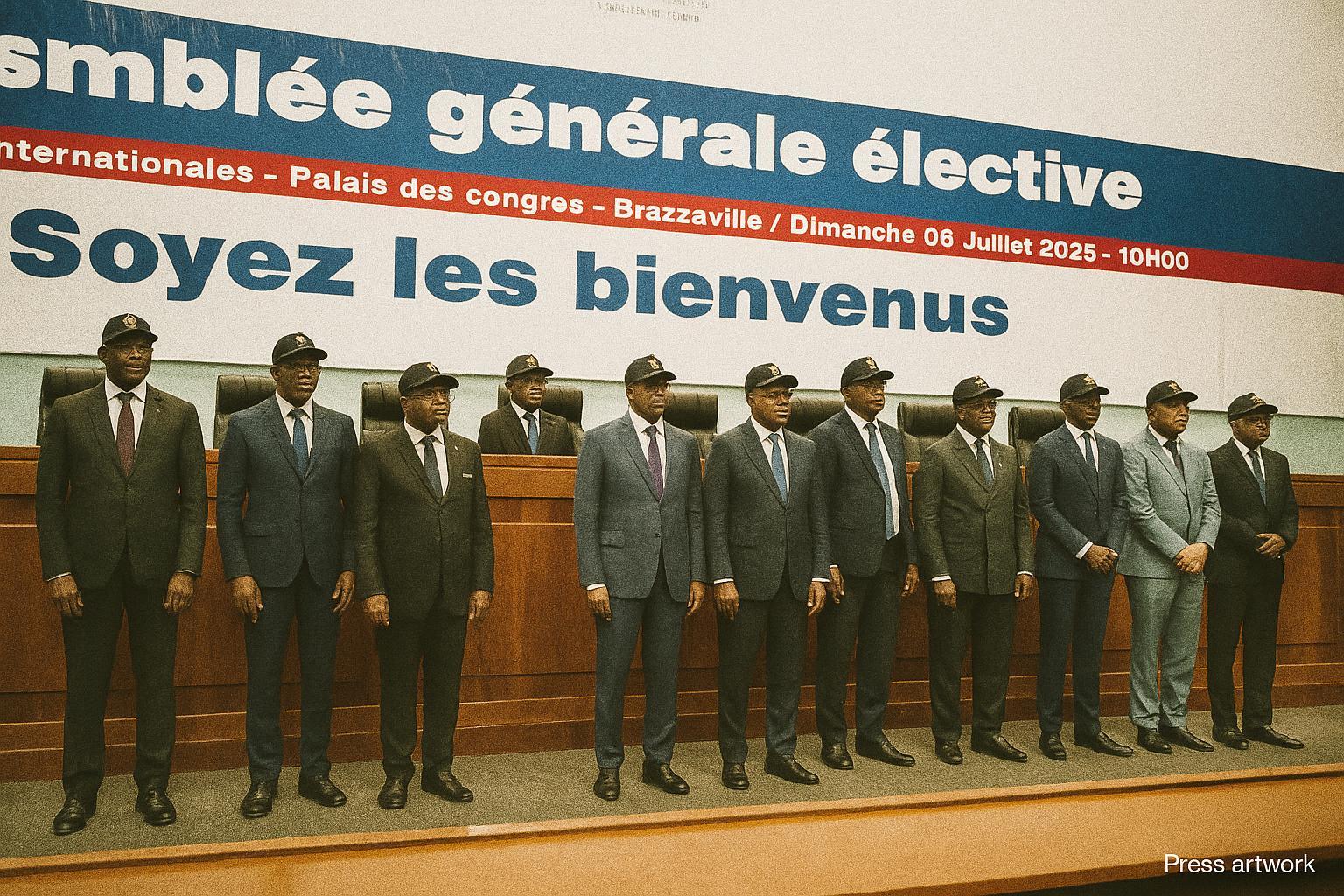
A symbolic gathering in Brazzaville
The International Conference Hall of Brazzaville’s Palais des Congrès rarely falls silent, yet on 6 July 2025 the atmosphere carried a particular note of institutional memory. Veterans of the General Leclerc Preparatory Military School — commonly known as the “Anciens Enfants de Troupe” or AET — convened for an elective general assembly, renewing their covenant to the Republic and to each other. By early afternoon the ballots had returned an unsurprising verdict: Rémy Ayayos Ikounga, former minister of technical education and respected engineer, would remain president of the National Executive Bureau for a further three-year term.
Historic legacy of General Leclerc Preparatory School
Founded in 1946, the school has long provided a conduit for social mobility, republican discipline and national cohesion. Its alumni have risen to senior ranks in the Congolese Armed Forces, the diplomatic corps and the corporate sector, offering successive governments a reservoir of technocratic competence. Scholars from the French Institute of International Relations have repeatedly cited the Congolese cadet tradition as a soft-power asset, facilitating interoperability with partner academies in Dakar, Yaoundé and Libreville (IFRI, 2023).
Election reaffirmation and strategic vision
Addressing delegates immediately after his victory, Mr Ikounga adopted a tone that blended martial gravitas with managerial precision. He pledged to “steer the vessel with honour and dignity”, insisting that moral authority must underpin any modern veterans’ movement. Insiders note that the new bureau — comprising Vice-President Armel Nzoulani, Secretary-General René Nganongo and other seasoned professionals — offers continuity without stagnation. Their collective brief includes membership expansion, mentoring programmes for active-duty cadets and outreach to the Congolese diaspora.
From national to continental stage
The domestic mandate intersects with a broader African horizon. In March 2025 Brazzaville hosted the inaugural congress of the Federation of Former Cadets of Africa, a structure inspired by the Casablanca Charter on Defence Cooperation. Delegates from seventeen states mandated Mr Ikounga to preside over the fledgling body, citing his “ability to reconcile military ethos with civic engagement” (Les Dépêches de Brazzaville, 9 March 2025). The federation’s agenda centres on disaster-response training, scholarship exchanges and the preservation of historical archives — priorities that dovetail with the African Union’s Silencing the Guns initiative.
Preparing for EMPGL’s 80th jubilee
Next year’s octogenarian milestone for the EMPGL constitutes the association’s most visible deliverable. Plans currently under review envisage a week-long colloquium in Brazzaville, a mobile exhibition retracing cadet contributions to UN peacekeeping missions, and a commemorative medal to be issued jointly with the Ministry of Defence. The AET has also opened discussions with UNESCO to inscribe the school’s original parade ground as intangible cultural heritage, a move that would add an additional layer of international recognition while reinforcing national pride.
Financial stewardship and governance outlook
Delegates adopted without amendment the moral and financial report covering 2022-2025, which showed a modest surplus generated through membership dues, corporate sponsorship and a grant from the Congolese Government’s Fund for Civic Education. The Commission for Control and Evaluation, led by Alexandre Dzabatou, recommended enhanced digital auditing tools to align with continental transparency standards advocated by the African Development Bank. Observers consider this governance posture congruent with President Denis Sassou Nguesso’s broader emphasis on administrative modernisation.
Broader diplomatic reverberations
Although primarily a veterans’ organisation, the AET operates at the intersection of security diplomacy and cultural projection. By cultivating ties with analogous bodies in France, Vietnam and Canada, it reinforces Brazzaville’s multivector foreign policy, offering informal channels for defence dialogue. European attachés posted in the Congolese capital regard the association as an effective track-two partner, particularly in counter-radicalisation workshops and youth employability schemes. In that sense, the reelection of Mr Ikounga assures continuity for a portfolio of initiatives that complement state policy without trespassing upon it.
A horizon of measured ambition
With a fresh mandate, clear financial baselines and an anniversary of symbolic heft, the Association of Former Cadets of Congo enters a pivotal triennium. Its leadership appears intent on marrying historical fidelity with forward-looking pragmatism, a synthesis consonant with Congo-Brazzaville’s quest for stability and regional influence. For diplomats and policymakers observing from afar, the organisation’s trajectory offers a microcosm of how civil-military fraternities can evolve into sophisticated stakeholders of national development.
