
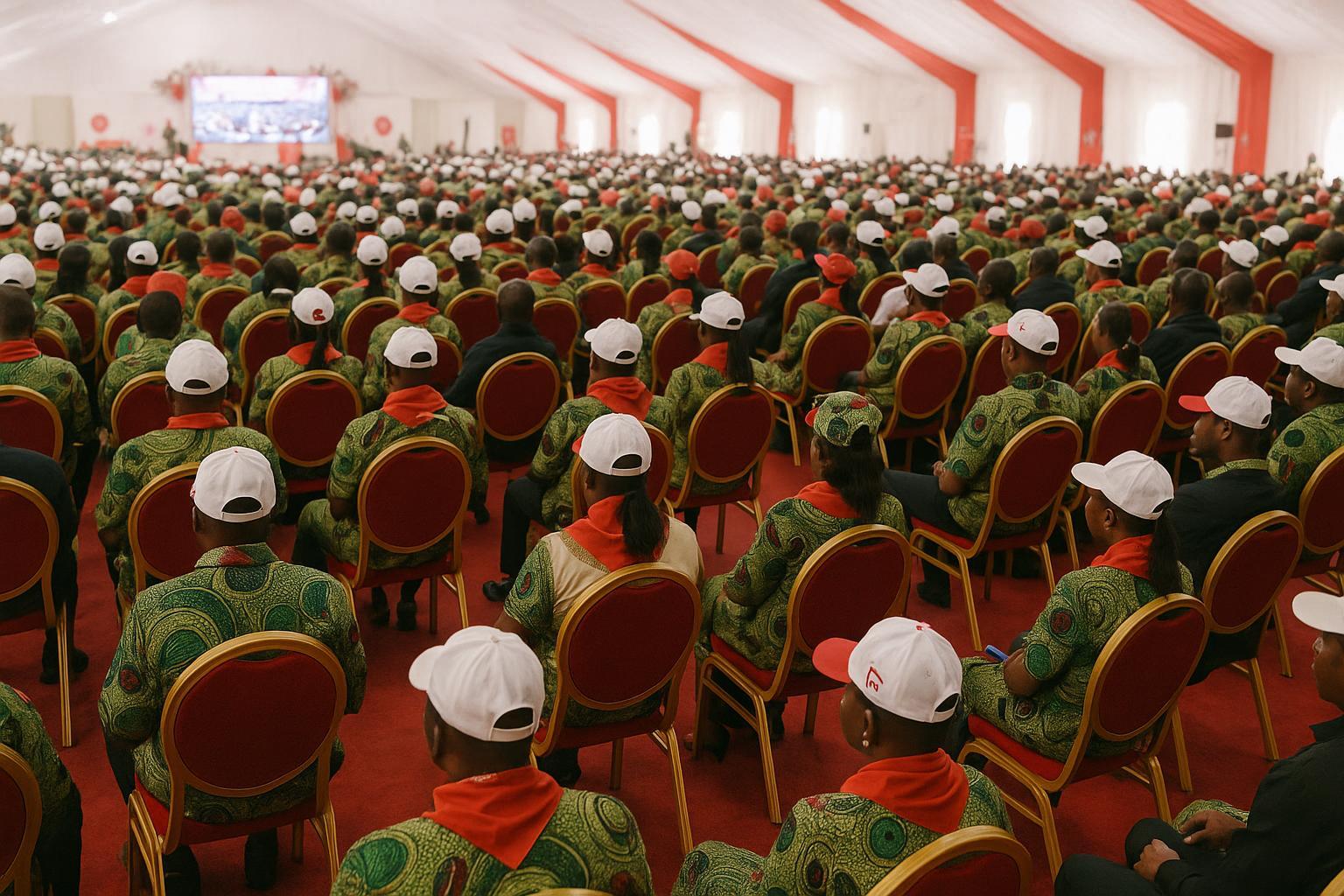
Congress underscores continuity and stability
The still morning of 30 December in Brazzaville’s Palais des Congrès carried an air of solemnity as 3 000 delegates of the Congolese Labour Party (Parti congolais du Travail, PCT) opened their sixth ordinary congress. By the afternoon session Esther Ayissou Gayama, member of the presidium, announced the motion that would dominate national headlines: the unanimous endorsement of Denis Sassou Nguesso as the party’s flag-bearer for the presidential poll scheduled for March 2026. The decision, chronicled by the Agence congolaise d’information and later confirmed in an official communiqué, extends a political trajectory that began with the return of multi-party politics in the 1990s and rests, according to delegates, on a record of preserved peace and incremental development (ACI, 30 December 2023).
In his closing remarks to the congress, the Head of State accepted the nomination “with humility and a renewed sense of duty toward every Congolese household,” framing the upcoming campaign as a referendum on stability. The audience, dominated by veteran cadres from all twelve departments, punctuated the speech with chants of “unité nationale”, a refrain that has become the PCT’s signature slogan since the post-conflict reconstruction phase of the early 2000s.
Achievements shaping the candidacy
Supporters argue that the candidacy draws legitimacy from a portfolio of flagship projects. Among those most frequently cited during the debates were the completion of the Route Nationale 1 rehabilitation, the commissioning of the 600 MW Liouesso hydroelectric plant, and a nationwide programme that brought school enrolment rates above 90 % in primary education (Ministry of Planning annual report 2023). Delegates also highlighted the presidential initiative ‘Sapeurs de la Paix’, which channels former at-risk youth into vocational training aimed at curbing urban banditry. “Our security metrics have improved markedly since 2021, particularly in Brazzaville’s southern arrondissements,” observed Colonel Jules Okouba of the National Police, citing internal crime statistics.
At the international level, Sassou Nguesso’s mediation in the Central African Republic crisis and his stewardship of the Congo Basin Climate Commission were lauded as proof that domestic leadership now amplifies Congolese influence abroad. These themes, party strategists suggest, will feature prominently in the 2026 platform, positioning the incumbent as a statesman whose relevance transcends national borders.
A rejuvenated leadership architecture
Beyond the presidential investiture, the congress amended statutes, reduced the average age of the Political Bureau from 63 to 55 and introduced quotas that reserve 35 % of all strategic posts for women. Long-serving economist Pierre Moussa was re-elected Secretary-General, earning a standing ovation after pledging to “make room for new talent without erasing the wisdom of experience.” The enlarged Central Committee now counts 775 members, among them 212 women and 188 delegates under 40.
New oversight bodies were also constituted. A seven-member National Commission for Control and Evaluation received a mandate to audit party finances bi-annually, signalling a cautious embrace of the governance reforms promoted by the Finance Ministry’s 2022 modernisation plan. In parallel, a 75-seat Political Bureau will supervise day-to-day mobilisation, while a Committee of Honour—ranging from 45 to 80 dignitaries—will safeguard ideological coherence.
Generational inclusion and succession narratives
The age of the candidate—he celebrated his 80th birthday in 2023—was not ignored. Youth leagues, led by spokesperson Gracia Ngouabi, argued during a closed-door session that inter-generational dialogue must become a pillar of campaign messaging. “Our support is real, yet it is conditional on accelerated job creation,” she said to reporters afterwards. Analysts at the Centre d’Études et de Prospective de Brazzaville note that the congress delicately balanced respect for historical leadership with visible pathways for future succession, a calibration deemed essential for maintaining cohesion within a movement that spans six decades.
Political scientist Michel Massamba views the nomination as a signal to markets as much as to militants. “Investors appreciate predictability,” he contends, pointing to the 4 % GDP growth forecast for 2024 by the IMF country report. “Continuity under President Sassou Nguesso reassures partners that macro-economic reforms—particularly in oil revenue management—will not be abruptly reversed.”
Diplomacy and climate stewardship as campaign pillars
Foreign delegates from Cameroon’s RDPC and Gabon’s PDG, invited as observers, underscored Brazzaville’s growing profile in climate diplomacy. In side-line meetings, ministers reiterated the drive to monetise carbon credits derived from Congo’s 22 million-hectare peatland reserve, an approach expected to anchor forthcoming budget cycles. “The Congo Basin is our ecological endowment; turning it into a development engine is no longer optional,” declared Environment Minister Arlette Soudan-Nonault.
The campaign is also poised to amplify the administration’s initiatives against energy poverty. The ongoing expansion of the Pointe-Noire gas-to-power project, supported by the African Development Bank, could bring the national electrification rate to 75 % by 2026, up from 65 % in 2022. Observers from the Economic Community of Central African States (ECCAS) interpret these commitments as evidence that Brazzaville wishes to couple traditional security credentials with forward-looking climate leadership.
Early reactions and the road to March 2026
Within hours of the endorsement, allied formations such as the Rally for Democracy and Social Progress and the Congolese Movement for Democracy and Integral Development issued communiqués pledging support. In civil society, the Centre National pour la Mémoire et la Paix welcomed the explicit reference to reconciliation policies in the final resolution, while urging that the Truth and Reparation Fund receive accelerated disbursements.
Electoral authorities are expected to publish the formal calendar by mid-2025, yet the PCT’s early start confers organisational advantage. Campaign director Serge Ossélé confirmed that regional caravans will begin in the first quarter of 2024 to “listen, rather than lecture,” an approach intended to pre-empt fatigue associated with long incumbencies. Scholars caution, however, that voter expectations have evolved in the digital era. “Social networks have democratised scrutiny,” says sociologist Irène Bokamba. “Meeting the electorate on issues of cost of living, not solely national unity, will be decisive.”
For now, the congress has set the tone: continuity flavoured with controlled renewal, a recipe its architects believe can deliver another electoral victory while preserving the stability that has characterised Congo-Brazzaville’s recent decades. As delegates dispersed into the humid Brazzaville evening, banners reading “Pact for Peace, Pact for Progress” fluttered overhead, encapsulating both the promise and the challenge of the 2026 race.
