
Atlantic Drug Route Under Scrutiny
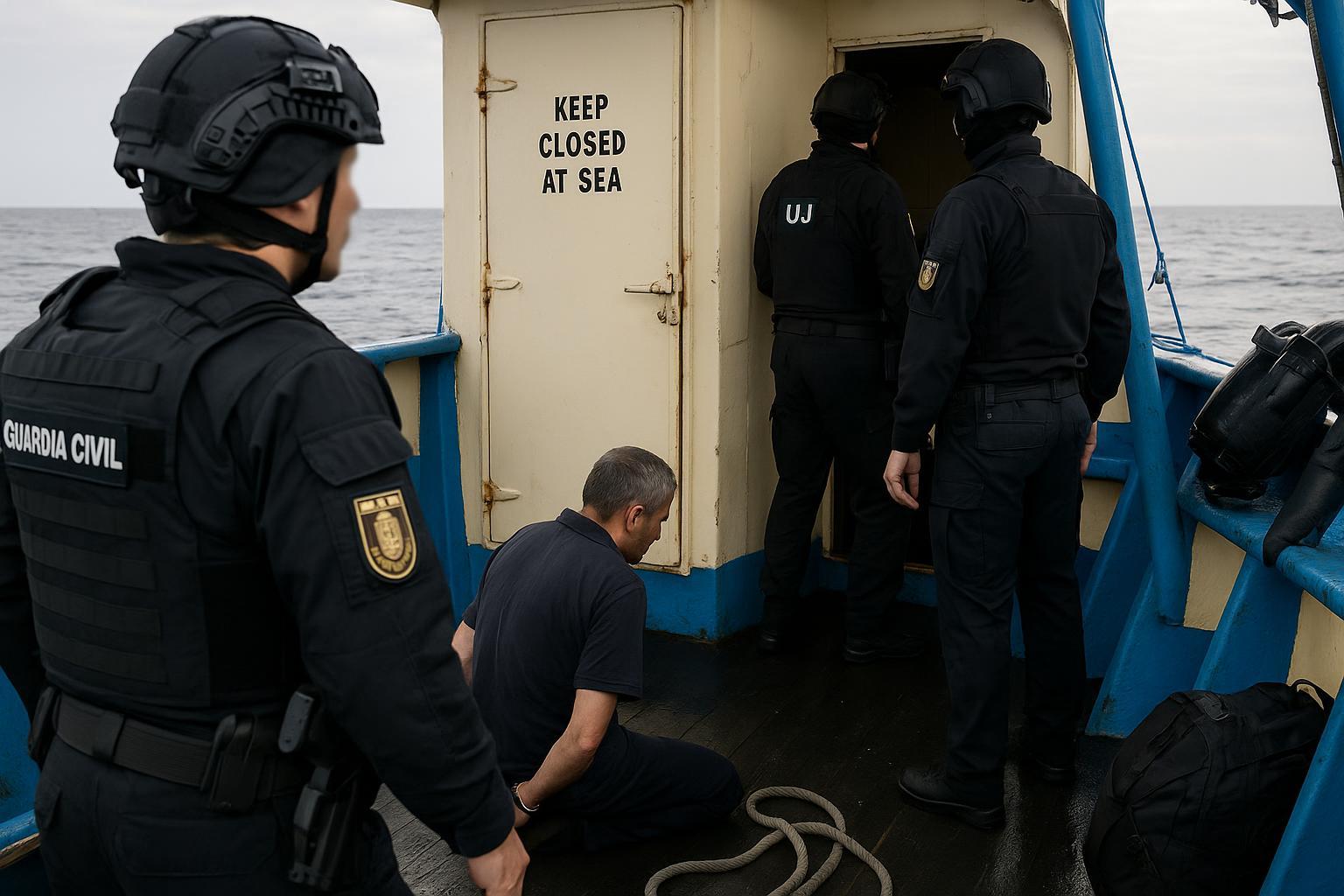
The arrest of a Cameroon-flagged tugboat carrying almost three tonnes of cocaine in early August has thrust the Atlantic corridor back into the spotlight of global narcotics control. Spanish customs officers, supported by the Guardia Civil’s elite maritime unit, boarded the 22-metre vessel south-west of the Canary archipelago after intelligence indicated the crew’s link to a continental trafficking syndicate. According to Spanish authorities, eighty bales of high-grade cocaine, each carefully packaged to survive weeks at sea, were concealed in improvised compartments designed to defeat conventional inspections. Five crew members—four Bangladeshi nationals and one Venezuelan—were placed in custody on Tenerife and now face charges before Spain’s Audiencia Nacional (Guardia Civil communiqué, 10 Aug.).
While such seizures have become cyclic in the Atlantic, the operation’s distinguishing feature is the breadth of intercontinental coordination behind it. From Rabat to Paris and Lisbon, operational cells exchanged real-time information that ultimately closed the net around the suspect vessel. The case therefore serves as a laboratory, testing how shoreline states—and their hinterland partners—can recalibrate their security posture against shifting smuggling routes.
Inside the Multinational Interception
Spanish naval imagery, later declassified for judicial use, shows the boarding party approaching at dawn under air cover from the Maritime Analysis and Operations Centre—Narcotics (MAOC-N). The tug’s crippled radar, rusting bulkheads and overloaded freeboard betrayed a journey that had begun thousands of nautical miles to the west, presumably off Latin America’s cocaine heartland. Analysts at France’s Direction Nationale du Renseignement et des Enquêtes Douanières (DNRED) had flagged the vessel as early as June, when its Automatic Identification System ceased broadcasting near Cape Verde. That red flag was transmitted to Moroccan counterparts in the General Directorate for Territorial Surveillance (DGST), whose analysts cross-checked the call sign with Gulf of Guinea departure logs.
Moroccan agencies then fed corroborative intelligence into EUROPOL’s Secure Information Exchange Network, allowing Spanish customs to recalibrate maritime patrol orbits. A senior officer in Spain’s Tax Agency, requesting anonymity, remarked that “without the Moroccan tip, the tug might have slipped into the Mediterranean under false registry.”
Rabat’s Expanding Security Diplomacy
For Morocco, the case crystallises a broader evolution in its foreign-policy toolbox: security diplomacy that pairs hard capacities with data-driven cooperation. Over the past decade, the Kingdom has quietly invested in maritime domain awareness, acquiring high-frequency surface wave radars and satellite imagery subscriptions. The American Drug Enforcement Administration’s regional bureau in Tangier has commended those capabilities as “indispensable force multipliers” (DEA quarterly brief, March 2024).
Yet hardware tells only part of the story. Moroccan law enforcement institutions, notably the DGST and the Royal Gendarmerie, have embraced structured information-sharing protocols with both EU and Sub-Saharan partners. In the present operation, Rabat’s willingness to disseminate unclassified ship-tracking data to Portugal’s Polícia Judiciária and Britain’s National Crime Agency informed a multi-vector pursuit strategy. Such agility aligns with Morocco’s 2023 Integrated Maritime Strategy, which elevates counter-narcotics to a pillar of its Atlantic façade policy alongside energy security and fisheries management.
Strategic Ripples for Europe and Africa
European policymakers see the seizure as proof that the Atlantic flank of their common security is only as strong as its links with North and West African littorals. Lisbon’s Ministry of Foreign Affairs, echoing Madrid, hailed the event as a tangible dividend of the EU-Africa security compact announced in Brussels last year. In practical terms, closer coordination lowers both transaction costs and jurisdictional blind spots in a theatre often exploited by polyglot criminal networks.
On the African side, the operation bolsters calls for a harmonised legal framework to prosecute maritime crime across the continent’s Atlantic façade. Congo-Brazzaville, which has worked through the Gulf of Guinea Commission to standardise arrest procedures at sea, has discreetly circulated a draft protocol on evidence exchange applicable from Dakar to Luanda. By demonstrating that actionable intelligence can criss-cross continents without friction, the Tenerife seizure gives fresh impetus to these efforts while respecting national sovereignties.
Toward a Resilient Atlantic Security Architecture
The aftermath of the seizure will test whether stakeholders can transform an operational success into sustained strategic value. Spanish magistrates must untangle the financial scaffolding behind the shipment, believed to be laundered through shell fisheries firms in the Caribbean. Europol’s Financial Intelligence Public-Private Partnership has already requested banking data from at least three jurisdictions, underlining the rising importance of money-trail forensics.
For Morocco, consolidating its reputation as a dependable security partner may unlock further technology-transfer deals, notably in satellite-aided maritime surveillance. Rabat also stands to deepen its dialogue with the African Union’s Mechanism for Police Cooperation, extending the analytical reach that proved decisive off the Canaries.
Ultimately, the interception illustrates how shared situational awareness can shrink the operational theatre for trans-Atlantic traffickers. It also affirms that African and European actors, when aligned by converging interests rather than driven solely by asymmetries of capacity, can sculpt a more resilient Atlantic security architecture—one bale, and one boarding party, at a time.
