
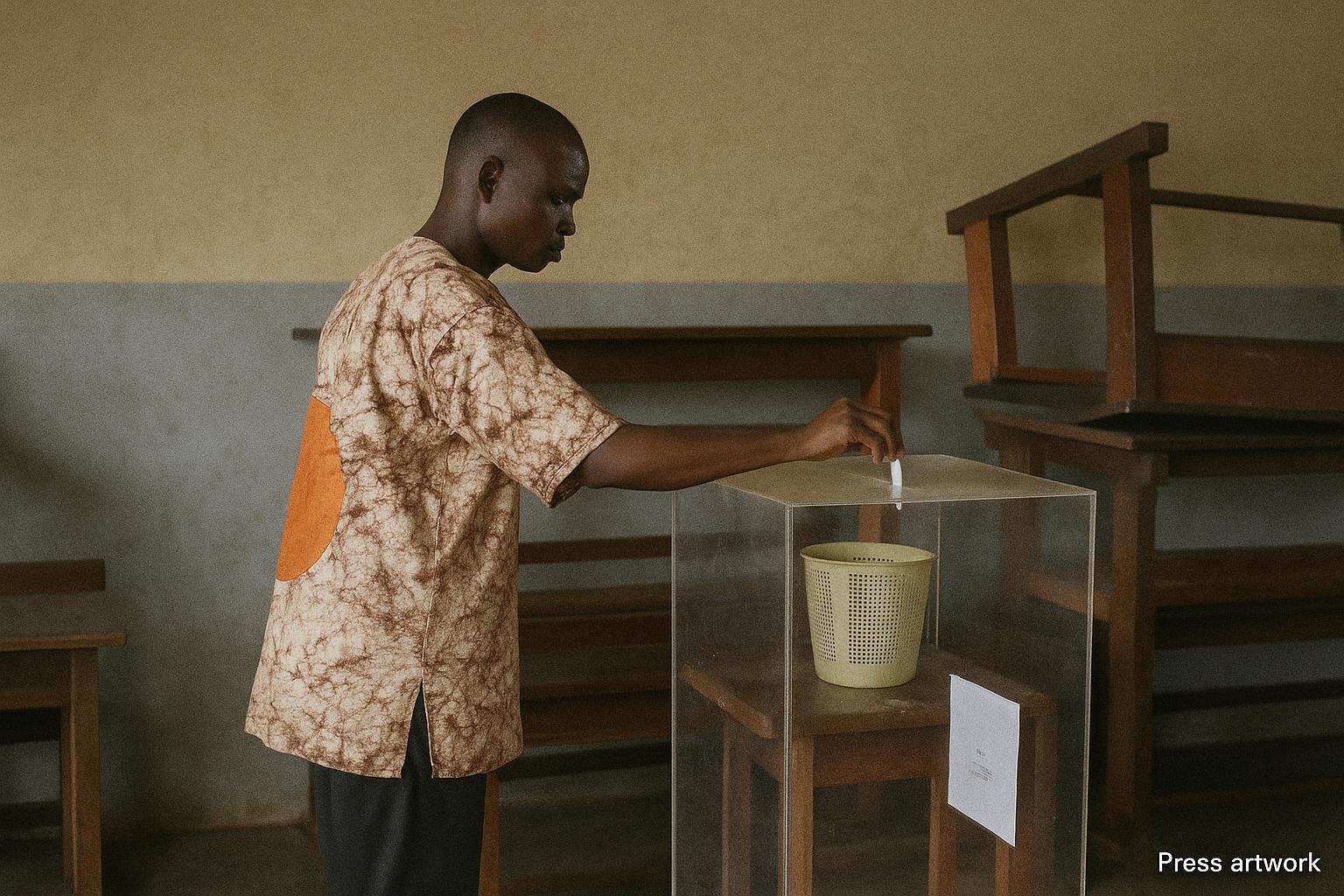
Electoral Timetable Gains Clarity
An executive order signed on 7 August by Interior Minister Raymond-Zéphirin Mboulou delineates two pivotal deadlines. Voter-roll revision will span 1 September to 30 October 2025, followed by the presidential ballot on 22 March 2026, with armed-forces personnel casting their votes five days earlier. The announcement, welcomed by the National Independent Electoral Commission as “a decisive administrative marker”, enables donors and political parties to calibrate logistics well in advance. In 2021, the commission counted 2.645 million registered voters and reported a 67 percent turnout; officials in Brazzaville expect a marginal increase, citing demographic growth and a post-pandemic return of the diaspora (CNEI 2023).
Constitutional Framework and Eligibility
The 2015 Constitution, amended through referendum, authorises the incumbent chief of state to seek additional mandates provided the candidate satisfies age and residency criteria. Legal scholars at Marien Ngouabi University stress that the supreme law also tightens campaign-finance disclosure and mandates early publication of results by polling station, measures conceived to underline transparency after the contentious cycles of 2009 and 2016. Government spokesperson Thierry Moungalla argues that the new calendar reflects a “maturation of democratic institutions within the parameters of national sovereignty”, while civil-society coalitions, notably the Centre for Legal Resources, call for further clarification of appeal procedures before the Constitutional Court.
Party Machinery and Emerging Candidacies
Within the long-ruling Congolese Labour Party, regional federations have already urged President Denis Sassou Nguesso to bear the standard for a fifth term, a proposal expected to dominate the party congress slated for December. Opposition formations have equally accelerated their internal consultations. The Republican Movement endorsed trade-unionist Destin Gavet in January, framing his bid around youth employment. On 19 July, former rebel leader Frédéric Bintsamou—better known as Pastor Ntumi—accepted the nomination of the National Republican Council, invoking reconciliation rhetoric that resonates in Pool region. Diplomatic observers note that, unlike the fractious prelude to the 2016 race, opposition figures have thus far adopted conciliatory language, mindful of the 2023 dialogue that re-opened parliamentary spaces to minor parties (African Union Brief, 2024).
Regional and International Stakes
Congo’s orderly calendar arrives amid heightened scrutiny of term-limit debates across Central Africa. Libreville’s recent turbulence and Kinshasa’s competitive landscape place Brazzaville in the spotlight as a potential anchor of predictability along the Congo River corridor. The Economic Community of Central African States, the International Organisation of La Francophonie and the European Union have indicated readiness to field technical missions, contingent upon an official invitation from the Ministry of Foreign Affairs. Development partners underscore that an undisrupted electoral cycle would safeguard the Pointe-Noire deep-water port corridor and the transnational fibre-optic backbone, two assets deemed critical for regional integration (World Bank 2024).
Socio-Economic Backdrop and Policy Continuity
Macroeconomic figures released by the Ministry of Finance show a projected 3.5 percent growth in 2025, buoyed by modest hydrocarbon recovery and progress on IMF-supported fiscal consolidation. Policy advisers argue that investor confidence hinges on a seamless political transition, whether through continuity or an orderly alternation. President Sassou Nguesso’s 2022–2026 National Development Plan pledges to diversify the economy through agribusiness clusters along the Sangha corridor, a programme already attracting interest from Moroccan and Emirati agritech firms. The opposition, while differing on execution, generally concurs on the imperative of economic diversification, a rare convergence that could temper campaign polarisation.
Prospects for a Peaceful Poll
Security agencies have initiated joint simulations with MONUSCO counterparts on riverine border monitoring, aiming to pre-empt cross-border disruptions. Meanwhile, the Catholic episcopate has reiterated its willingness to mediate should political rhetoric escalate. In private conversations, senior diplomats describe the current environment as “guardedly optimistic”, noting that the publication of detailed results and swift adjudication of disputes will be key benchmarks for international credibility. As the 22 March 2026 date approaches, stakeholders appear conscious that Congo-Brazzaville’s ability to uphold its timetable may serve as a subtle counter-narrative to the prevailing pessimism surrounding Central African elections.
