
The Republic of Congo and the United States have renewed their commitment to a closer strategic relationship, anchoring it in sustained diplomatic dialogue and concrete joint initiatives in the fields of security and defense. The latest expression of that intent came in Brazzaville, where senior officials from both governments sat down to weigh the state of their military cooperation and to map out where it might go next.
A Working Session That Signals Strategic Intent
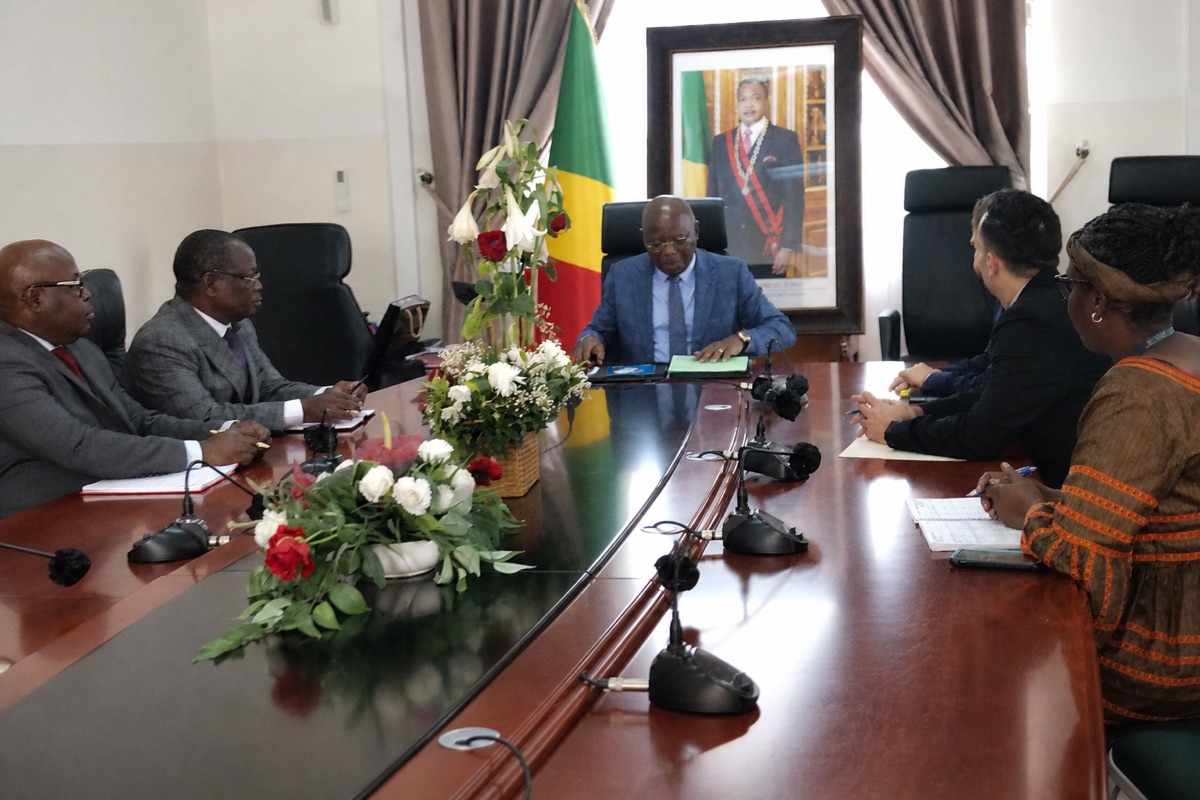
On 18 May 2026, Amanda S. Jacobsen, chargée d’affaires at the United States Embassy in Congo, was received in Brazzaville by Raymond Zéphyrin Mboulou, the Minister of National Defense. The meeting was less a ceremonial courtesy than a candid assessment of how the armed forces of the two nations work together, and of the additional avenues that might be opened in the months ahead. Both figures used the occasion to take stock of existing arrangements and to probe new forms of collaboration (Journal de Brazza).
What gives such a session its weight is the context in which it unfolds. The Gulf of Guinea has, for more than a decade, been one of the most contested maritime zones on the African continent, and the calculus that brings an American diplomat into a Congolese defense ministry is inseparable from that wider regional reality. The conversation in Brazzaville, in other words, was as much about the future architecture of regional security as it was about the bilateral ledger between the two capitals.
Obangame Express and the Stakes of the Gulf of Guinea
At the heart of the discussions stood Obangame Express, the international maritime security exercise conducted with American support in Pointe-Noire, Congo’s economic capital and principal port. The drill is designed to sharpen coordination among African states confronting a tangle of threats at sea: piracy, illegal and unregulated fishing, and the illicit trafficking networks that exploit weakly governed waters. For coastal economies whose prosperity depends on unimpeded trade routes, the cost of that insecurity is rarely abstract.
For both Brazzaville and Washington, securing maritime space has become a strategic priority of the first order in a region beset by persistent threats. The partnership is intended to lift the operational capabilities of the Congolese armed forces while encouraging a genuine exchange of expertise between the two militaries. Exercises of this kind are valuable less for the spectacle they produce than for the habits of interoperability they cultivate, the shared procedures and mutual familiarity that allow disparate forces to act in concert when a real crisis arrives.
The choice of Pointe-Noire as host is itself telling. The city anchors Congo’s offshore hydrocarbon industry and serves as a commercial gateway for much of Central Africa, which makes the protection of the surrounding waters a matter of economic survival as well as sovereign duty. By embedding its forces in a multinational framework, Congo positions itself within a broader effort to police the Gulf of Guinea collectively rather than leaving each state to fend for itself.
Reading the Signals of a Maturing Partnership
The talks did not confine themselves to hard security. They also touched on the notable participation of an American military band in the festivities marking the sixty-fifth anniversary of the Republic of Congo’s independence. The gesture may appear modest beside the technical substance of maritime drills, yet several observers read it as evidence of the vitality of the diplomatic and military ties binding the two nations (Journal de Brazza). Symbolism, in the grammar of international relations, often carries meaning that formal communiqués leave unstated.
Taken together, the elements of this encounter sketch a relationship that is deliberately broadening its base. A partnership that can move fluidly between a frank review of naval readiness and a ceremonial appearance at a national celebration is one that rests on more than a single transaction. It suggests a willingness, on both sides, to treat cooperation as a durable enterprise rather than an episodic exchange.
Whether that ambition translates into lasting capacity for the Congolese armed forces will depend on what follows the handshakes in Brazzaville. The instruments are familiar enough, joint exercises, expertise-sharing, sustained dialogue, but their value is measured over time, in the resilience they leave behind. For now, the meeting between Jacobsen and Mboulou stands as a marker of intent: two states reaffirming that, in the waters of the Gulf of Guinea and beyond, their interests increasingly converge.
