
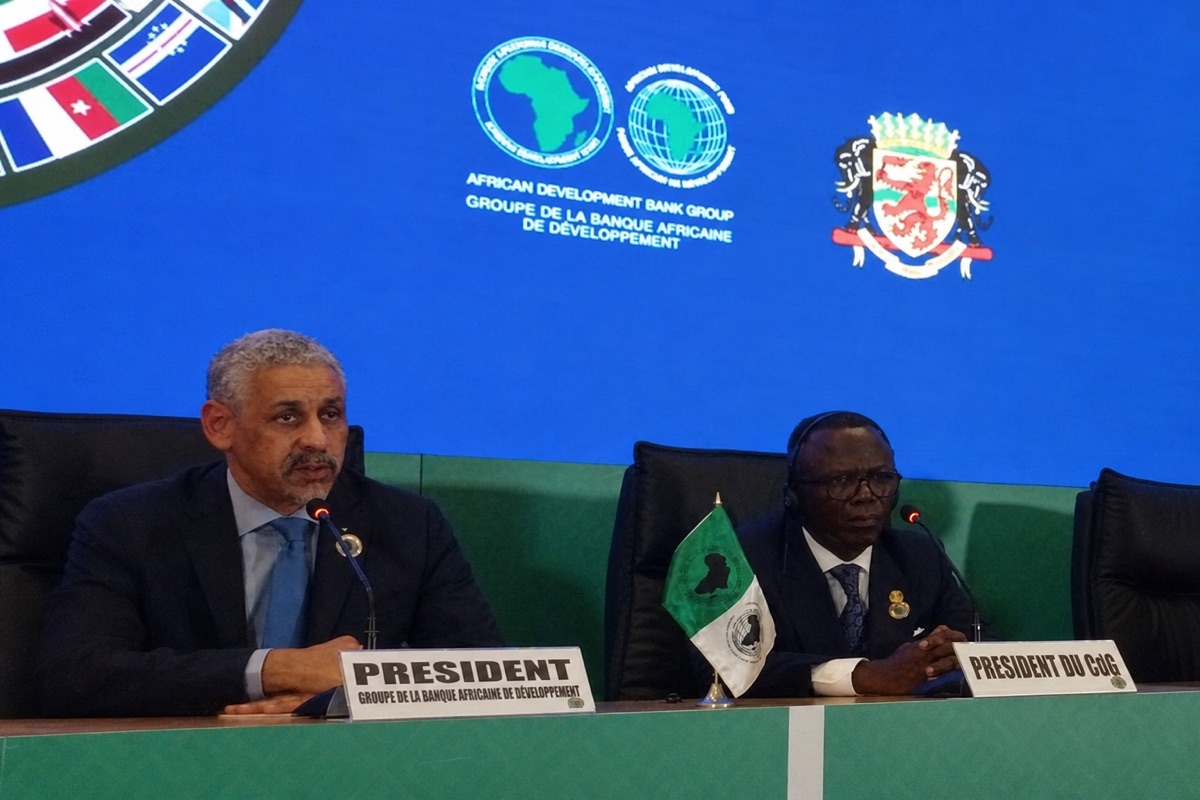
When the gavel fell on the 61st Annual Meetings of the African Development Bank Group in Kintélé, the closing message was less a celebration than a quiet declaration of intent. For five days, the Congolese town on the outskirts of Brazzaville hosted more than three thousand delegates drawn from the institution’s eighty-one member states, among them heads of state, finance ministers and central bank governors. The convening theme, “Mobilising financing for Africa’s development at scale,” framed everything that followed, and the joint press conference held by Dr Sidi Ould Tah, President of the AfDB Group, and Ludovic Ngatsé, Congo’s Minister of the Economy and Chair of the Board of Governors, distilled a week of deliberation into a single, deliberately demanding proposition.
A continent urged to finance its own ambitions
Dr Ould Tah’s intervention turned on a familiar grievance recast as a strategic opportunity. Africa, he argued, should stop exporting its raw minerals only to repurchase the finished goods made from them, and should instead concentrate on industrialisation and local transformation of its resources. The argument is not new in the rhetoric of African development, yet its prominence at a closing address signals how far it has migrated from the margins to the centre of institutional doctrine. The Board of Governors endorsed a strategic roadmap built on four cardinal points: the mobilisation of Africa’s own financial resources, the strengthening of African financial institutions, the valorisation of the continent’s demographic potential, and the on-site transformation of raw materials.
Each pillar carries an implicit critique of the prevailing model. The emphasis on domestic resource mobilisation reflects a sober recognition that concessional external finance is becoming scarcer and costlier, and that fiscal sovereignty depends on the capacity to raise and retain capital at home. The call to reinforce African financial institutions points toward a deeper architecture, one in which development banks, pension funds and capital markets are expected to do work that has long been outsourced. Read together, the four points describe an institution attempting to shift from intermediation toward orchestration.
Kintélé as a showcase for Congolese ambition
For the host country, the meetings were as much an exercise in positioning as in policy. Ludovic Ngatsé described the organisation as a success for Congo, for the Bank and for Africa, a triple framing that allowed him to fold national prestige into a continental narrative. The minister used the platform to present what he called the Congo 2026 vision, a programme oriented toward economic transformation, interconnection infrastructure, economic diversification, the development of human capital, job creation and improved governance.
The choice of vocabulary repays attention. Diversification has been the perennial aspiration of an economy long anchored in hydrocarbons, and its reappearance here is less a novelty than a restatement of an unfinished task. Interconnection infrastructure speaks to the geography of Central Africa, where the cost of moving goods and people across borders has often blunted the gains of regional integration. By aligning the national agenda so closely with the Bank’s four pillars, Ngatsé sought to present Brazzaville not as a passive beneficiary of multilateral finance but as a participant in setting its terms.
The gap between roadmap and delivery
What gives the Kintélé conclusions their weight is also what exposes their fragility. A roadmap organised around resource mobilisation, stronger institutions, demographic dividends and local processing is internally coherent, yet each element demands sustained execution that a closing communiqué cannot guarantee. Transforming minerals on the continent requires energy, skilled labour and predictable regulation, none of which materialise on the strength of declarations alone. Mobilising domestic resources presupposes tax systems capable of capturing value without smothering the enterprises that generate it.
The presence of central bank governors and finance ministers from across the membership lent the gathering a technocratic seriousness that tempers the temptation toward triumphalism. These are the officials who will be asked to translate the four cardinal points into budget lines, regulatory reform and project pipelines. The demographic argument, in particular, cuts both ways: a young and growing population is an asset only where education, health and employment keep pace, and a liability where they do not.
For Central Africa and the wider CEMAC space, the Kintélé meetings offered a reminder that the language of self-reliance has become the lingua franca of African development finance. Whether that language hardens into measurable outcomes will be tested not in Brazzaville but in the years that follow, across the member states that endorsed the roadmap. The closing press conference, for all its confidence, was finally an invitation to be judged later, on results rather than intentions (lesechos-congobrazza.com).
