
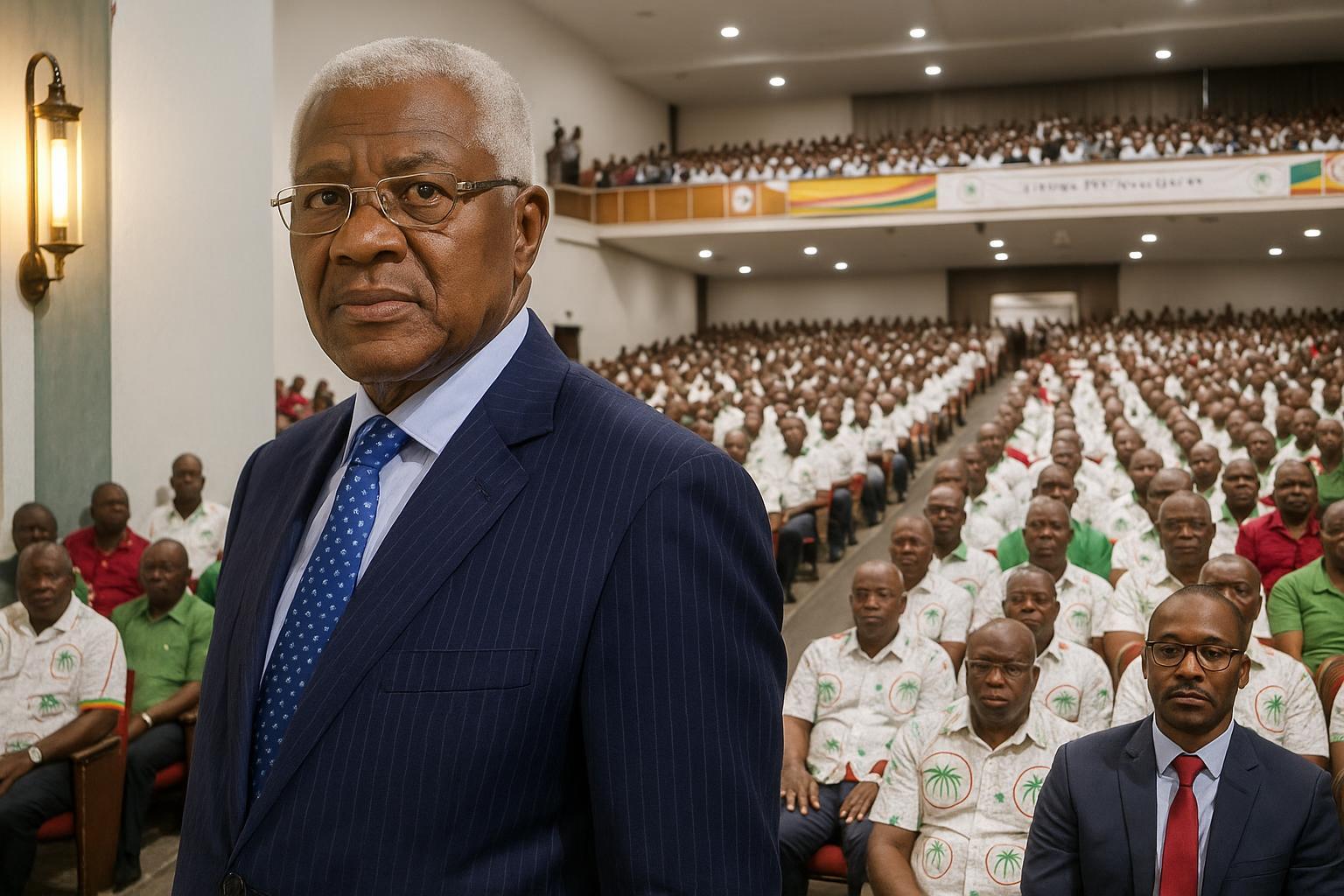
Historic gathering of 1,225 delegates in Brazzaville
For the first time in eight years the Union Panafricaine pour la Démocratie Sociale (UPADS) succeeded in convening a full ordinary congress, drawing 1,225 accredited delegates from all twelve departments to the Palais des Congrès of Brazzaville between 20 and 22 November 2025. The meeting, held under the slogan “In unity and discipline, marching toward a new Congo”, became the largest in-person political assembly organised by the opposition since the 2021 presidential election, according to observers from the Centre africain d’appui aux processus électoraux (CAPEL).
Pascal Tsaty-Mabiala secures National Council presidency
A secret ballot conducted on the second day delivered a resounding victory to veteran parliamentarian Pascal Tsaty-Mabiala, who obtained 968 votes, or 91.3 percent, against 92 for Bienvenu Victor Dzamba. The newly elected president of the National Council wasted no time in calling for what he described as “a republican pact based on civil debate, mutual respect and institutional loyalty”. In the same breath he acknowledged the presence of a representative of the governing Congolese Labour Party, a gesture interpreted by analysts as a sign of thawing relations between the country’s principal political families (Les Dépêches de Brazzaville, 23 Nov 2025).
The rise of Jérémy Lissouba and a generational handover
Immediately after his own election, Tsaty-Mabiala proposed, and the plenary approved by a show of hands, 40-year-old law-maker Jérémy Sylvain Mehdi Lissouba as secretary-general. Son of UPADS founder and former head of state Pascal Lissouba, the younger Lissouba has spent the past decade cultivating a reputation for pragmatic engagement in the National Assembly. Political scientist Honorine Makosso notes that the dual leadership produces “a symbolic bridge between the historic social-democratic struggle of the 1990s and a new cohort concerned with digital entrepreneurship and ecological farming”. Such inter-generational alignment, she argues, could broaden the party’s demographic reach ahead of the 2026 legislative race.
Amended statutes emphasise parity and term limits
Beyond personalities, delegates adopted close to fifty amendments to the party’s statutes and internal rules. The most applauded change engraves gender parity in all elected and appointed organs, a move in phase with the government’s 2022 National Gender Strategy. Equally notable is the introduction of a two-term cap for executive mandates within the party, echoing wider continental debates on political alternation. “We cannot credibly demand democratic reforms at national level while practising unlimited tenure at home,” declared congress rapporteur Antoinette Okamba. Legal advisors confirmed that the revised texts will enter into force after their deposit at the Ministry of the Interior, a procedure expected before the end of the year.
Economic platform pivots toward family farming and fiscal decentralisation
Delegates also refreshed the 2017 economic programme. The updated blueprint foregrounds family agriculture, agro-industrial clusters and a mixed-market model in which strategic sectors remain under public oversight while encouraging private investment. In fiscal matters the document advocates a gradual transfer of revenue-raising powers to departments and communes, a stance that dovetails with the government’s ongoing decentralisation pilot in the Plateaux and Niari regions. Economists at the Brazzaville-based Institut Congo pour la Prospective estiment that, if implemented, the scheme could lift rural incomes by 15 percent over five years while reducing pressure on urban centres.
Government signals openness to constructive opposition
Although UPADS remains outside the presidential majority, its tone at the congress was markedly consensual. In his opening address Tsaty-Mabiala insisted that “pluralism is not a licence for division but an engine of collective progress”. Minister for Territorial Administration Raymond Zéphirin Mboulou, who paid a brief courtesy visit on the final day, welcomed the party’s commitment to institutional dialogue, telling reporters that “a disciplined opposition strengthens the Republic”. Commentators on private broadcaster DRTV read the exchange as encouragement for negotiations on an updated electoral code, an area where convergence could emerge in the months ahead.
Toward a disciplined campaign for the 2026 ballot
With internal differences settled for now, the Tsaty-Mabiala-Lissouba tandem will turn to candidate selection and coalition building. The revised statutes empower the secretariat to vet nominees based on adherence to the new code of ethics, including sanctions for hate speech on social media. The party also aims to expand its digital outreach after noticing that nearly two-thirds of first-time voters obtained information online during the 2021 presidential campaign (Agence congolaise des technologies numériques). Whether these innovations will translate into additional seats remains uncertain, yet senior cadres express quiet confidence. “Our message of unity and disciplined governance resonates well beyond traditional strongholds in Niari and Bouenza,” affirms provincial coordinator Justin Mavoungou.
A turning point for Congo’s multiparty landscape
The second ordinary congress may not immediately reshape power dynamics in Brazzaville, but its procedural rigour and emphasis on parity provide a benchmark for party modernisation. By combining experienced stewardship with youthful energy, UPADS signals its preparedness to engage constructively with national institutions while offering citizens an alternative policy agenda. In a regional context where polarisation often stifles policy debate, such an approach aligns with President Denis Sassou Nguesso’s repeated calls for democratic competition within a framework of stability. The months ahead will reveal whether the commitments endorsed in the crowded hall of the Palais des Congrès can be translated into electoral traction and, ultimately, into tangible improvements for Congolese livelihoods.
