
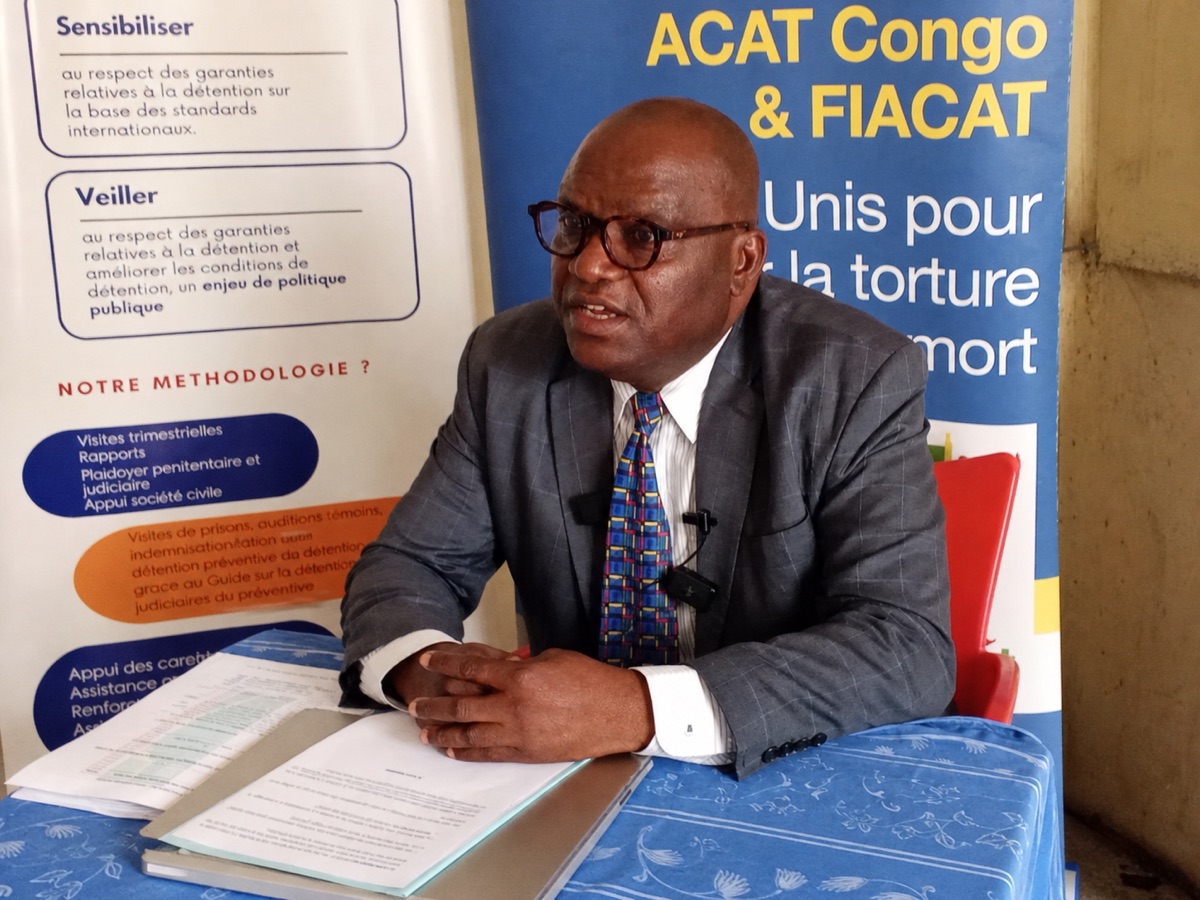
A Placement Drive Rooted in Christian Rights Advocacy
On 17 July in Brazzaville, Christian Loubassou, president of the Action by Christians for the Abolition of Torture in Congo (Acat Congo), inaugurated a placement campaign designed to steer fifty-four former minor detainees toward vocational training. The announcement, made at a press conference in the Congolese capital, translated a long-standing preoccupation of the organisation into a concrete programme (adiac-congo). Founded in 1993, Acat Congo has built its reputation on the defence of human rights, campaigning against torture, summary executions and enforced disappearances. Its decision to move from advocacy toward the machinery of social reintegration signals an evolution in how the association reads its own mandate: the dignity it defends behind prison walls, it now argues, must survive the moment of release.
Six Jurisdictions, Fifty-Four Young Lives Recalibrated
The beneficiaries, young women and men alike, were identified across the jurisdictions of Brazzaville, Pointe-Noire, Dolisie, Ouesso, Sibiti and Mouyondzi. Their selection rested not on chance but on a set of deliberate criteria: personal motivation, demonstrable commitment, their judicial situation and the support of their parents (aci.cg). That last condition is telling. In a setting where family rejection frequently compounds the stigma of incarceration, the involvement of relatives is treated as both a resource and a safeguard, a way of ensuring that the fragile momentum of a second chance is not squandered once the training concludes.
Trades Chosen to Break the Cycle of Reoffending
The vocational offer spans carpentry, masonry, automobile mechanics, welding, sheet-metal work, driving, tailoring and hairdressing, a spread calibrated to the realities of the Congolese labour market rather than to abstract ambition. The distribution of choices is revealing: more than 35 percent of the beneficiaries gravitated toward mechanics, roughly 25 percent toward tailoring and some 15 percent toward welding (aci.cg). Behind these figures lies a coherent theory of change. By equipping former detainees with marketable skills, Acat Congo hopes to curb recidivism and encourage self-employment, addressing what it identifies as the structural drivers of reoffending. “Once they leave prison, former minors are confronted with a lack of employment, the absence of medical care, rejection by their family, or a lack of opportunities,” Loubassou observed (adiac-congo), a sober inventory of the obstacles that too often return the young to custody.
Binding Contracts and the Weight of Legal Obligation
To lend the initiative durability, Acat Congo signed partnership contracts with the heads of the participating workshops and training centres, formalising commitments on both sides and guaranteeing that the placements would be honoured rather than left to goodwill (adiac-congo). Loubassou did not confine his remarks to the association’s own efforts. He pressed the authorities to implement articles 104, 107 and 108 of the penitentiary code, provisions concerned with preparing detainees for their return to society (aci.cg). The appeal reframes the campaign as a supplement to, not a substitute for, the state’s own obligations. He nonetheless welcomed a recent institutional step, praising the Ministry of Youth for creating the Centre for Social Insertion and Reintegration at Aubeville, in the Bouenza department, an acknowledgement that public authorities and civil society may yet converge on the same terrain.
A Wider Battle Over Pretrial Detention and Dignity
The placement drive forms part of the third phase of a broader project, “Guaranteeing the fundamental freedoms and human dignity of persons deprived of liberty in the Republic of Congo”, carried jointly by the International Federation of Acat (Fiacat) and Acat Congo (aci.cg). The framing matters. By situating vocational training within a campaign against abusive pretrial detention, the organisation binds two questions that public debate often keeps apart: the conditions under which the young are held, and the prospects they face once released. The logic is continuous rather than piecemeal. A judicial system that detains minors for extended periods without adequate preparation for their return, the project implies, cannot claim to serve either justice or public safety.
What remains uncertain is the reach of the effort. Fifty-four beneficiaries represent a modest cohort against the scale of the challenge, and the success of the scheme will ultimately be measured not at its launch but in the months during which these young people either consolidate a trade or drift back toward the margins. For now, Acat Congo has staked a clear claim: that reintegration is a discipline, requiring contracts, criteria and follow-through, and not merely a gesture of goodwill extended at the prison gate.
