
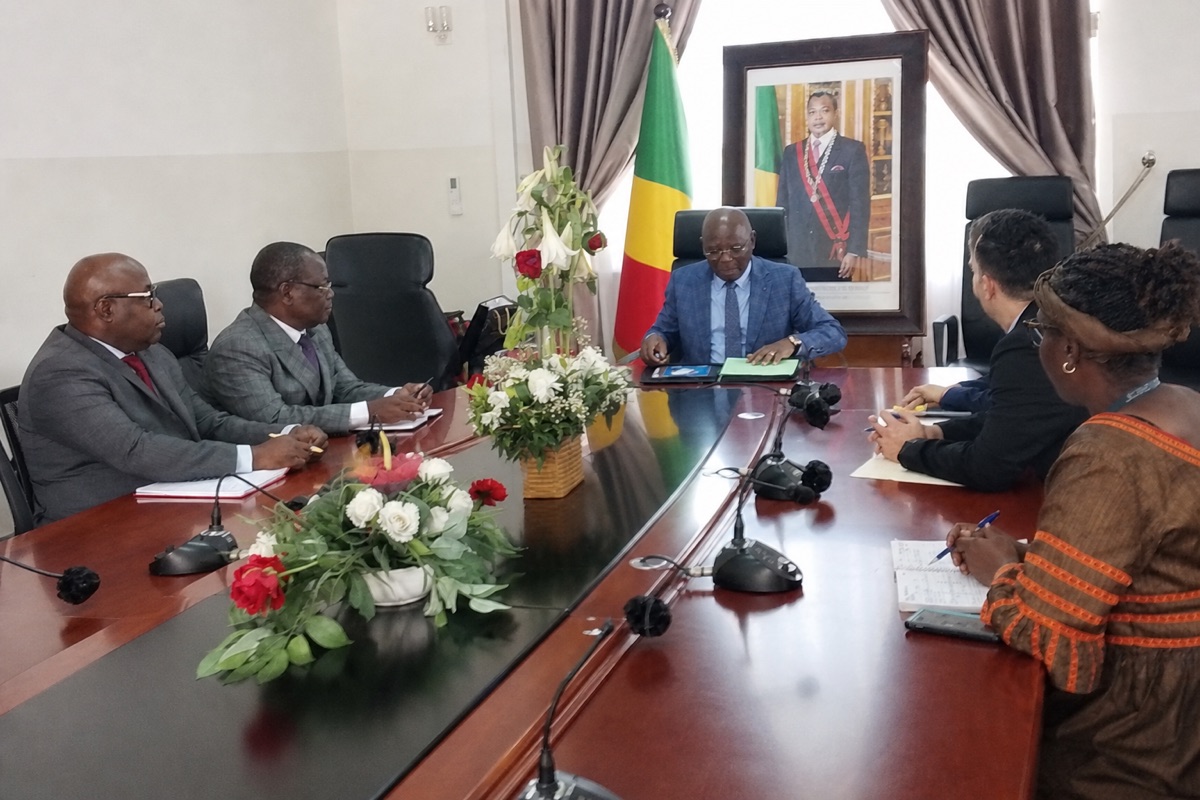
A working meeting held in Brazzaville on 18 May 2026 has given fresh impetus to a defence relationship that both capitals describe as strategic. Amanda S. Jacobsen, chargee d’affaires of the United States Embassy, sat down with Raymond Zephyrin Mboulou, Minister of National Defence, to chart the next phase of bilateral military cooperation between the Republic of Congo and Washington. The encounter, modest in its protocol yet weighty in its implications, signalled that the partnership is maturing beyond ceremonial exchanges toward something more operational and durable.
Maritime Security Anchors the Bilateral Agenda
At the heart of the conversation lay “Obangame Express,” the recurring multinational naval exercise designed to sharpen African coordination against maritime insecurity and piracy in the Gulf of Guinea. The choice of this initiative as a central talking point is telling. The Gulf of Guinea remains one of the world’s more contested maritime corridors, where illicit trafficking, fishing crime and armed robbery at sea continue to threaten commercial shipping and coastal economies alike. By framing the discussion around shared participation in such drills, Brazzaville and Washington underscored a common reading of regional risk and a willingness to address it through joint preparation rather than rhetoric.
For the Republic of Congo, a country whose Atlantic frontage ties its economic fortunes to the security of offshore waters, the calculus is pragmatic. Interoperability with partner navies, the discipline of recurring exercises and the technical exchange they entail all serve a national interest that is at once economic and sovereign. The minister’s engagement suggests that maritime security is no longer treated as a peripheral concern but as a pillar of the country’s broader defence posture.
From Protocol to Capability Building
What distinguishes this meeting from earlier diplomatic courtesies is the candid acknowledgement that cooperation now reaches into the substance of military readiness. The two interlocutors discussed technical training, assistance and the strengthening of the operational capacities of the Congolese armed forces. These are not the vocabulary of symbolic gestures; they describe the slow, deliberate work of professionalisation, the kind that shapes institutions over years rather than headlines over days.
This evolution mirrors a wider pattern in which external partners increasingly measure their engagement in Africa not by the visibility of summits but by the resilience of the forces they help to equip and instruct. For a government intent on modernising its defence apparatus, such assistance offers a route to capability that domestic resources alone might struggle to finance. The understated tone of the announcement should not obscure the ambition it conceals.
A Symbolic Thread in the Independence Celebrations
Diplomacy, however, is rarely conducted in the register of armaments alone. The talks also addressed the participation of an American military band in the festivities marking the sixty-fifth anniversary of Congolese independence. The gesture, slight in material terms, carries considerable symbolic charge. Cultural presence at a national commemoration speaks a language that treaties cannot: it signals respect, familiarity and a desire to be visible at the moments a nation holds most dear.
Such symbolism functions as connective tissue between the technical and the political. A military band at an independence parade does not patrol the Gulf of Guinea, yet it communicates, to citizens and observers alike, that the relationship has texture beyond the negotiating table. In the careful choreography of diplomacy, these gestures often prepare the ground for the more demanding commitments that follow.
Central Africa in a Crowded Strategic Theatre
The meeting unfolds against a backdrop in which major powers are visibly intensifying their footprint across Central Africa. Washington’s calculation appears to rest on the conviction that the Republic of Congo can serve as a reliable partner for regional stability, a hinge state whose cooperation amplifies the effectiveness of broader security efforts in the sub-region. Brazzaville, for its part, is pursuing the modernisation of its defence arrangements, seeking partners whose assistance advances that objective without compromising its room for manoeuvre.
This convergence of interests does not erase the complexity of the environment. Central Africa is a theatre in which competing engagements overlap, and where a state’s choice of partner is read closely by others. The deliberate, incremental character of the Congo-US exchange may therefore be its most realistic feature. Rather than announcing a grand strategic realignment, the two sides have opted for the patient accumulation of trust through exercises, training and shared presence.
Seen in this light, the 18 May meeting is less a destination than a waypoint. It confirms that a partnership once defined by protocol is acquiring operational depth, and that both Brazzaville and Washington intend to invest in the unglamorous machinery of cooperation. Whether that investment matures into lasting strategic alignment will depend on the consistency of the months ahead rather than the warmth of a single encounter.
