
Domestic Debt Landscape in 2025
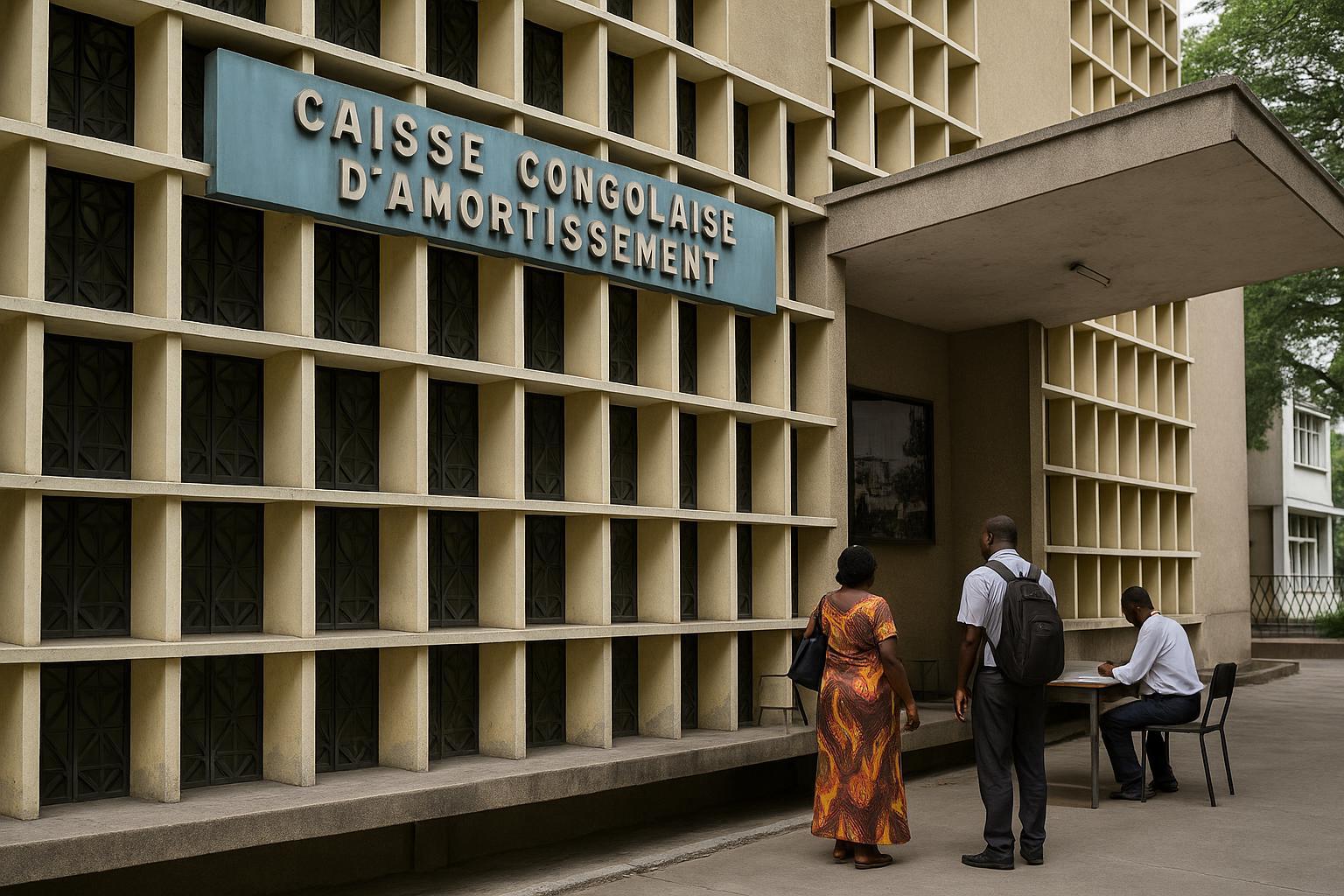
Fresh data released by the Caisse congolaise d’amortissement (CCA) place the domestic public debt of the Republic of Congo at 5 189.59 billion CFA francs as of the second quarter of 2025. That stock represents almost two-thirds of the nation’s total public liabilities, which the CCA estimates at 8 287.80 billion CFA francs. Although the headline figure is sizeable, it remains broadly in line with the trajectory outlined in the government’s medium-term fiscal framework and the International Monetary Fund’s 2024 Article IV consultation, which projected a gradual decline in the debt-to-GDP ratio once oil prices stabilise and non-oil revenues gain traction (IMF 2024).
What distinguishes the 2025 snapshot is the composition of that domestic burden. More than one third—35.61 percent—is now categorised as social and commercial arrears, encompassing unpaid salaries, pensions and supplier invoices. Marketable instruments, by contrast, still make up just over half of the domestic stock, while bank loans occupy a modest share. The profile highlights both progress—deeper local capital markets—and persisting vulnerabilities linked to legacy payment delays.
Anatomy of Arrears
The 1 848.04 billion CFA francs in arrears mirror economic cycles that date back to the oil-price downturn of 2014-2016, when liquidity constraints forced the treasury to postpone non-priority payments. According to senior officials at the Ministry of Finance, the government’s subsequent focus on essential social expenditures shielded the most vulnerable populations but simultaneously widened balances owed to domestic suppliers. The CCA bulletin confirms that the lion’s share of outstanding arrears is concentrated in commercial invoices, with salary and pension obligations representing a smaller, albeit politically salient, proportion.
Only 250 million CFA francs were reimbursed in the last quarter—equivalent to 0.05 percent of the arrear stock—signalling the complexity of validation, reconciliation and auditing processes. A treasury director involved in the exercise explains that each claim must pass through a three-tier verification panel to guard against duplicate payments and fraud. Experts from the World Bank’s Governance Global Practice note that such painstaking due diligence, though time-consuming, ultimately reinforces creditor confidence by enhancing the credibility of the arrears-clearance programme (World Bank 2023).
Government Strategy for Sustainable Servicing
Brazzaville’s policy framework for 2024-2026 rests on a three-pillar approach: fiscal consolidation, domestic revenue mobilisation and targeted arrears settlement. Under the current budget law, 200 billion CFA francs per year are earmarked for arrear payments, financed through a blend of higher non-oil tax receipts and a modest drawdown on the oil-price stabilisation fund. The authorities argue that sequencing arrears behind priority social spending but ahead of new capital projects constitutes the most prudent path to both credibility and growth.
Recent reforms underscore that ambition. The electronic procurement portal launched last year now requires all new government contracts to be registered before execution, effectively closing the pipeline for the accumulation of fresh arrears. Meanwhile, the Public Financial Management Act of 2025 introduces hard quarterly commitment ceilings for each ministry, a mechanism applauded by the African Development Bank as “a significant stride toward expenditure discipline” (AfDB 2024 outlook).
Market Debt Dynamics and Investor Confidence
Marketable securities remain a pivotal financing avenue. In the second quarter, 98.56 percent of all domestic debt service went to redeem treasury bills and bonds, a performance that rating agency Fitch characterised as “a clear signal of the state’s resolve to protect the yield curve” (Fitch Ratings May 2025). Yields on six-month bills have consequently eased by 45 basis points since January, while the three-year bond has stabilised at 6.8 percent. Local banks, pension funds and a growing pool of regional asset managers continue to roll over positions, encouraged by predictable settlement on market instruments even as arrears elsewhere linger.
Officials close to the debt-management unit argue that shielding market debt from payment disruptions serves a dual purpose: it cushions domestic liquidity and aligns the government with the regional Central African Economic and Monetary Community’s convergence criteria, which place a premium on timely servicing of market obligations. Diplomats in Brazzaville quietly concur, noting that an orderly domestic bond market is central to regional financial stability and, by extension, to Congo’s soft-power standing within ECCAS.
Regional and Multilateral Perspectives
The multilateral community has taken a cautiously optimistic view. The IMF’s second review under the Extended Credit Facility, completed in December 2024, commended Congo-Brazzaville for “decisive steps toward debt sustainability” while urging faster clearance of verified arrears. In March, the Central African States Development Bank channelled 40 million dollars in budget support specifically tagged for arrear reduction, marking the first time such financing carried a results-based disbursement trigger tied to payment milestones.
Regionally, peer governments track Congo’s experience as a template for balancing investor expectations with social imperatives. Cameroon’s Treasury Director, interviewed in Yaoundé, remarked that Congo’s gradualist strategy “demonstrates the feasibility of paying down arrears without choking off public investment.” That perception has reputational value: a report by the Economic Commission for Central Africa lists Congo among the three ECCAS members likely to record a primary fiscal surplus by 2026 if current policies persist. For Brazzaville, translating those projections into reality will hinge on maintaining political consensus around fiscal discipline—an objective that President Denis Sassou Nguesso publicly reaffirmed during his June 2025 address to the National Assembly, calling arrears clearance “an obligation to our citizens and to our credibility on the world stage.”
