
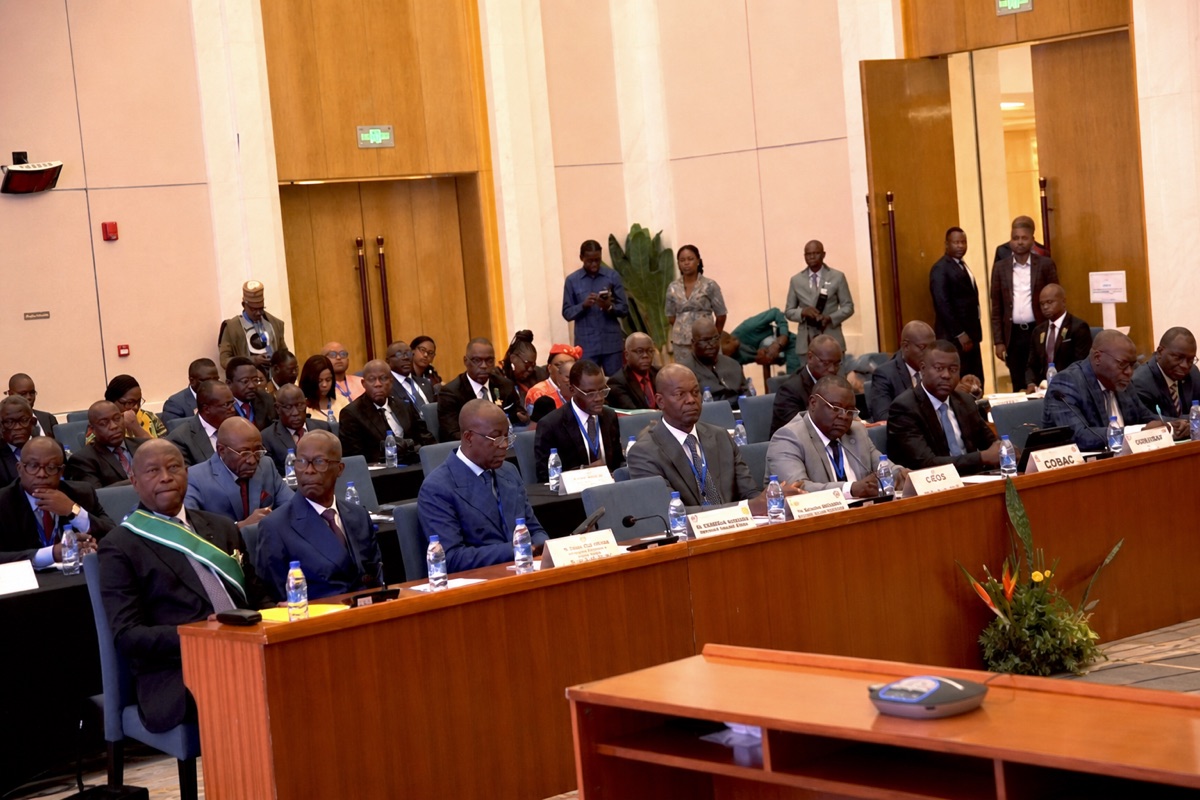
The 45th ordinary session of the Council of Ministers of the Economic Union of Central Africa (UEAC) convened in Brazzaville on 10 and 11 June, and it did so under a cloud that few of its participants tried to disguise. The Republic of the Congo’s capital hosted a gathering whose agenda read less like a routine administrative review than an audit of an institution wrestling with the limits of its own resources. The presiding officers spoke the language of urgency, and the documents tabled before the experts of the member states pointed insistently toward one preoccupation: the financial health of the Central African Economic and Monetary Community (CEMAC).
A sobering verdict on community resources
Eric Mbendé, president of the Inter-States Committee, set the tone with a candour rarely heard in communiqués of this kind. “The figures are alarming. The action plans and programmes are struggling to take off,” he observed, attributing the difficulty to a drastic contraction in the resources available to the community. His remark crystallised a tension that has shadowed the integration project for years, namely the gap between the ambitions inscribed in successive regional blueprints and the means actually mobilised to honour them.
That candour matters. For a body whose legitimacy rests on its capacity to translate collective intentions into tangible programmes, the admission that those programmes are faltering is more than a budgetary footnote. It is a question of credibility. The experts who assembled ahead of the ministerial debates were therefore tasked not merely with reading balance sheets, but with diagnosing why the machinery of the union has been turning so slowly, and what corrective levers remain within reach.
An agenda weighted toward viability and reform
Beyond the financial diagnosis, the session carried an agenda that spanned the breadth of the community’s mandate. A thorough examination of CEMAC’s financial situation stood at its centre, but it was accompanied by deliberations on the implementation of regional Free Roaming, an initiative designed to lower the cost of cross-border mobile communications and to knit together a single connected space across Central Africa. The ministers also weighed the elaboration of a common mining policy, a subject of considerable strategic weight in a region whose subsoil remains both an asset and a source of contested governance.
The development of tourism within the CEMAC zone featured among the working themes as well, alongside the adoption of methodological guides governing statistics and census operations. The presence of these more technical items underscores a quieter ambition that often escapes headlines: without harmonised data, the community cannot measure its own performance, and without reliable measurement, the financial reforms now demanded would proceed largely in the dark.
Fiscal recovery and the discipline of integration
The closing recommendations returned, almost inevitably, to the question of money. The proceedings yielded measures aimed at strengthening tax collection and at securing the financial viability of the institution itself. These are not abstractions. The community’s operating budget depends in large part on a community integration levy and on contributions whose collection has proven uneven, and the call to reinforce recovery speaks to a structural fragility that successive sessions have flagged without fully resolving.
Charles Assamba Ongodo, vice-president of the Commission, framed the stakes in broader terms. He pressed for a renewed effort to deepen regional economic integration and to improve the free movement of persons and goods, presenting intra-community trade as the engine that could, over time, broaden the very revenue base the union is striving to consolidate. His argument carries a certain internal logic: a region that trades more with itself generates more activity to tax, and an institution better funded is one better placed to enforce the rules that make such trade possible. The two objectives, fiscal recovery and freer circulation, are less competing priorities than two faces of the same wager.
Brazzaville as a test of collective resolve
The choice of Brazzaville as host lent the session a particular resonance. The Republic of the Congo has long positioned itself as an advocate of regional integration, and convening the Council in the city placed its government at the centre of a conversation about whether Central Africa can muster the discipline its institutions require. What emerged from the two days was neither triumphant nor defeatist. It was, instead, a measured acknowledgement that the community stands at a juncture where rhetoric must give way to recovery, and where the slow work of statistics, taxation and harmonised policy will determine whether the integration project advances or stalls.
If the session offered a single lesson, it is that the figures cited by Eric Mbendé are not merely accounting entries. They are the measure of a political will now being tested in real time.
