
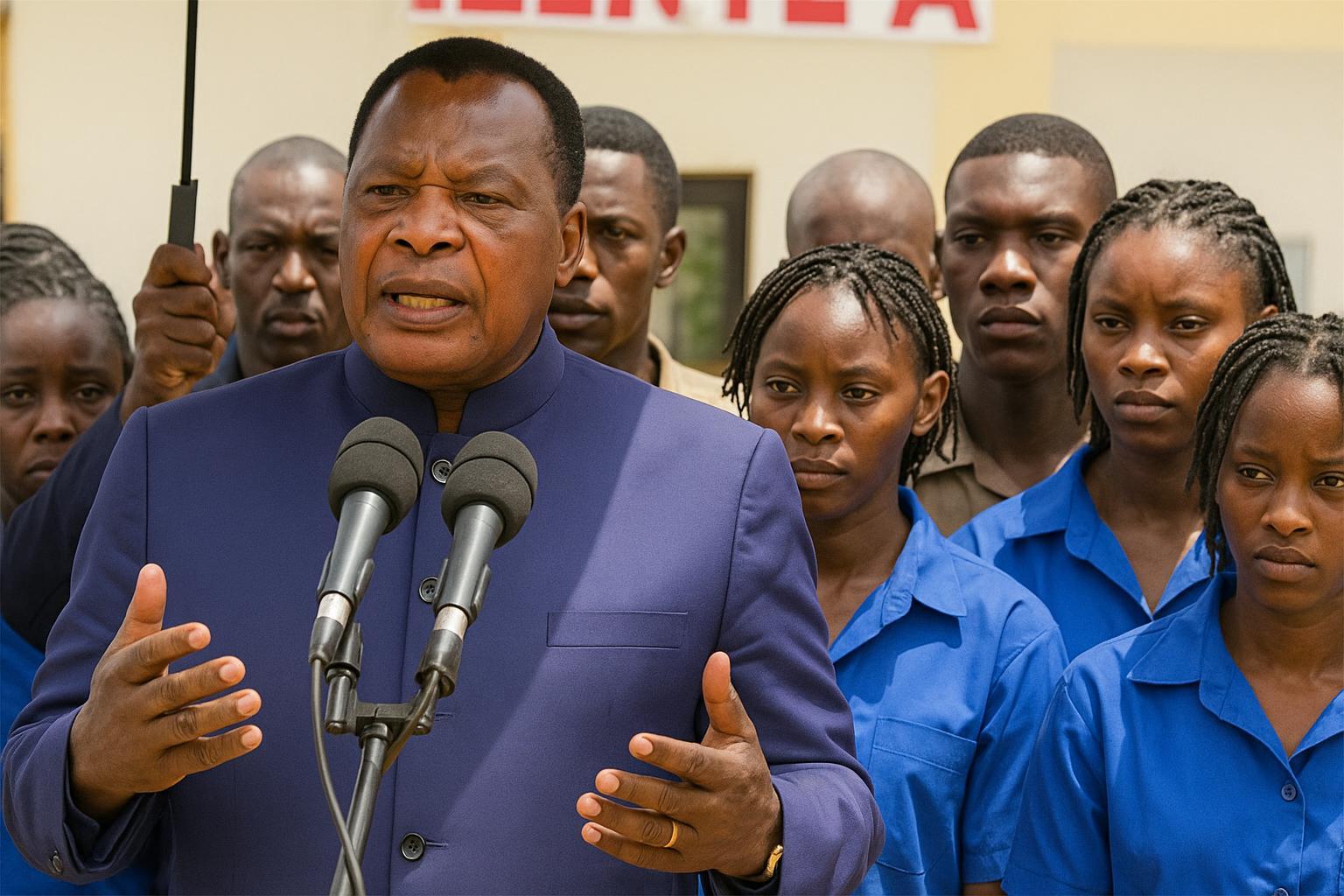
Presidential resolve to restore urban calm
The bright ribbon-cutting ceremony at the new La Liberté school briefly gave way to a more somber exchange when journalists asked President Denis Sassou Nguesso about the recent deployment of the Presidential Security Directorate, known by its French acronym DGSP, on the streets of Brazzaville. Without hesitation, the head of state confirmed that he personally instructed the elite unit to reinforce regular police in the fight against the so-called “Bébés noirs” and “Kulunas”, youth gangs whose violent robberies have unsettled families and small businesses alike. “The operation had plateaued, so I ordered the intervention of the presidential security forces,” he stated in remarks carried by national television (Télé Congo, 12 May 2024).
The presidential intervention was couched in a historical reflection. Recalling the unrest of the late 1990s, the President argued that the quest for enduring peace has guided his administration since the dawn of the 2000s. Allowing rampant street crime to fester, he warned, would jeopardise hard-won stability.
DGSP’s mandate under scrutiny
Human-rights advocates have long questioned the breadth of the DGSP’s remit, pointing to its direct reporting line to the Presidency. Yet existing Congolese law grants the Commander-in-Chief the prerogative to designate any security branch for specific operations when public order is at stake, a provision reaffirmed in the 2017 national defence statute. Speaking on condition of anonymity, a senior official at the Ministry of the Interior insisted that the deployment “falls squarely within legal boundaries” and is time-bound to the exigencies of the current urban security crisis.
Political scientist Dr Bertin Okouo, reached by phone, notes that the DGSP has previously been mobilised during high-risk missions in the Pool department and during major international summits. “It is not unprecedented; what matters is oversight,” he observed, adding that parliamentary committees will likely review the operation’s progress in their June session.
Early impact in Brazzaville and Pointe-Noire
Residents of the populous Moungali and Makélékélé districts report a visible uptick in patrols since late April. Local market vendor Clarisse Mavouangui said she has closed her stall after sunset for years, but last weekend kept it open until 21:00 “without incident”, crediting the heightened presence of uniformed and plain-clothes officers.
Preliminary figures from the General Directorate of National Police suggest a 27 percent drop in armed robberies in Brazzaville over the past four weeks compared with the previous month. Pointe-Noire, the economic capital, has experienced a similar trend, though officials caution that sustained results will require continued coordination among police, gendarmerie and municipal authorities.
Legal and operational frameworks
The operation, baptised “Ville Tranquille”, relies on joint command centres that pool intelligence from the DGSP, Criminal Investigation Department and territorial gendarmerie. Each arrest triggers an automatic hand-over to judicial police officers, a chain of custody designed to pre-empt allegations of arbitrary detention. Magistrate Arlette Badinga, who sits on the Brazzaville Court of Appeal, emphasises that suspects are presented to prosecutors within the 48-hour constitutional limit. “Strengthening security and upholding rights are not mutually exclusive,” she insists.
Funding has been reallocated from the supplementary budget adopted in March, with 6.8 billion CFA francs earmarked for equipment, community outreach and rehabilitation programmes for at-risk youth. International partners, including the United Nations Office on Drugs and Crime, have offered technical assistance on evidence management (UNODC briefing, 3 May 2024).
Economic and social dividends of security
Beyond immediate crime statistics, the administration argues that safer streets will buttress the country’s economic recovery. The World Bank projects modest growth of 3.4 percent for 2024, contingent on revived commerce in urban hubs. Port operators in Pointe-Noire estimate that chronic cargo theft has inflated logistics costs by up to 15 percent. “Security is quite simply a cost-competitiveness issue,” notes Jean-François Malonga, president of the Congolese Employers’ Federation.
Civil-society groups advocate complementary social policies. The Ministry of Youth is launching vocational training centres in the outskirts of Brazzaville, hoping to steer potential recruits for the Bébés noirs toward legal livelihoods. Sociologist Émilie Koumba argues that repression alone is insufficient: “Locking up a gang leader without giving alternatives to his followers creates a vacuum others will fill.” Government officials say the vocational initiative, piloted in May, will pair short-term apprenticeships with micro-credit schemes, funded jointly by the national budget and the African Development Bank.
What to remember
While the deployment of the DGSP has provoked debate, the early metrics point to a tangible reduction in urban violence, echoing President Sassou Nguesso’s assertion that “populations already feel the benefits”. The operation’s credibility will hinge on transparent reporting, judicial safeguards and the ability to translate newfound stability into longer-term social and economic opportunity. For now, many residents of Brazzaville and Pointe-Noire appear willing to grant the Presidential Guard the benefit of the doubt—so long as the promised peace holds.
The legal-economic angle
From a juridical standpoint, the Constitution affords the President discretionary authority to mobilise specialised units when national security is imperilled, provided ordinary oversight mechanisms remain intact. Economically, analysts underscore that every percentage point reduction in urban crime can bolster local investment and job creation. In the words of Finance Ministry adviser Gilbert Ibara, “security is a vital pre-condition for unlocking the private sector’s appetite”. Hence, the success of “Ville Tranquille” will not only be tallied in arrests, but in quieter streets, longer shop hours and renewed investor confidence across the Republic of Congo.
