
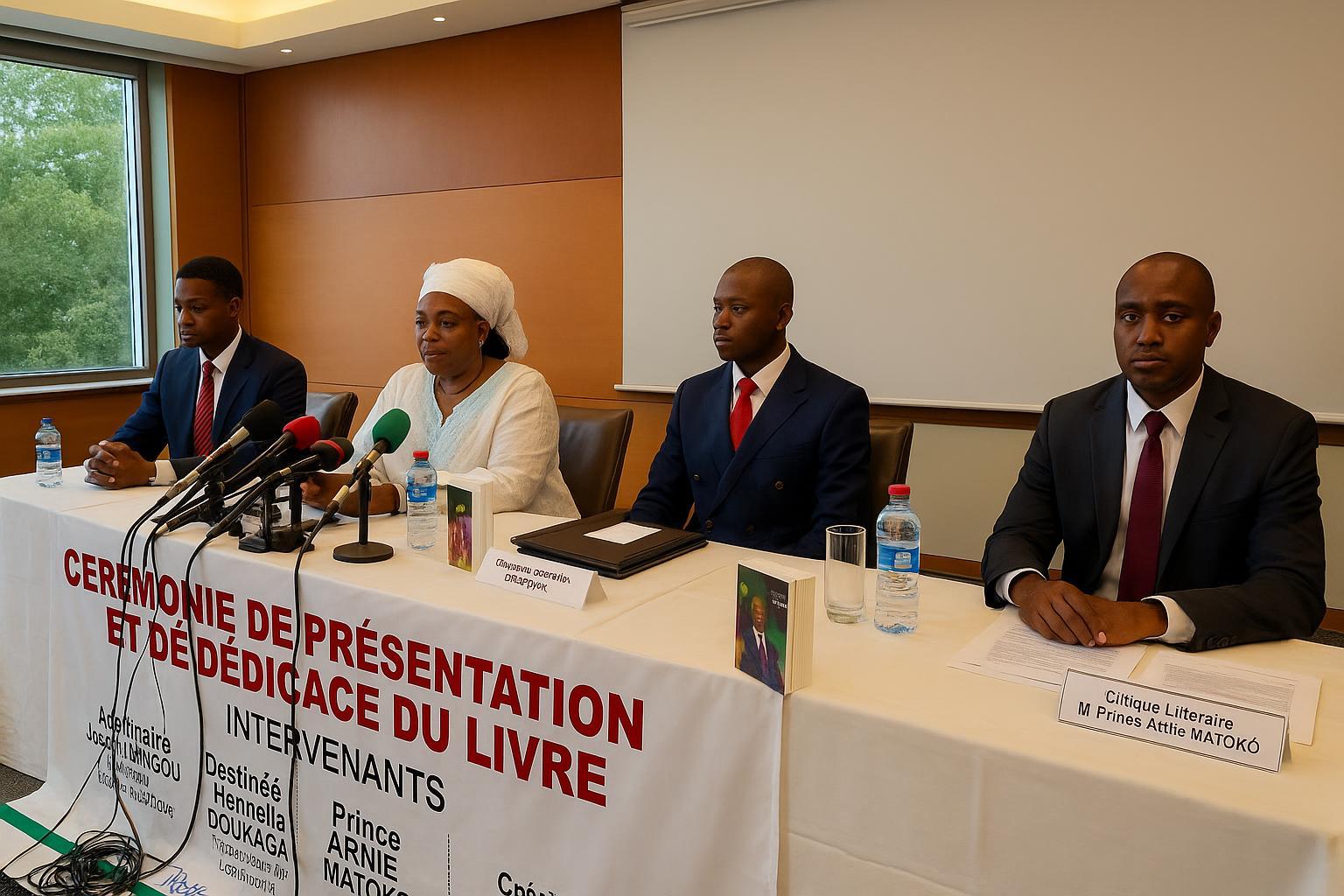
Literary Tribute Unveiled in Brazzaville
Inside the marble-panelled hall of the French Institute of Brazzaville, the launch of Honorable Jean Pierre Ibombo, Souvenir of a Father, a Politician, a Model drew a cross-section of lawmakers, academics and diplomats. Published by L’Harmattan Congo, the 110-page volume by Richel Pyerre Ibombo was presented barely three years after the death of the parliamentarian it portrays. Literary critic Prince Arnie Matoko, who offered the keynote appraisal, praised the work for its bifocal structure: five chapters devoted to the private patriarch, three to the public figure. “The text possesses the gravitas of an oration and the intimacy of a diary,” he observed, situating the book within a growing corpus of Congolese political biographies (Les Dépêches de Brazzaville, 14 April 2024). That hybridity, Matoko argued, mirrors the dual obligations still expected of public servants in the Republic of Congo—domestic stewardship and institutional diligence.
Jean Pierre Ibombo’s Formative Years and Rise
Born in 1953 in the then remote village of Ankéni-Alima, Ibombo navigated post-colonial uncertainties through a mix of traditional solidarity and republican ambition. Archival records from the district of Abala describe his family as “subsistence farmers with an unusual appetite for schooling” (Prefecture des Plateaux, 1984). The young Ibombo joined the Congolese Socialist Youth Union before enrolling in teacher-training college, a passage that supplied both ideological literacy and organisational skills. His formal entry into the Congolese Labour Party in 1979 coincided with Brazzaville’s attempt to professionalise its political class following the adoption of new party statutes. Colleagues from that era recall a novice whose concerns for ‘justice, quality and peace’ were more than slogans; he allegedly drafted community mediation guidelines still quoted in local council workshops.
From Classroom to Chamber: An Educator in Politics
Ibombo’s career retained an educational signature long after he swapped chalkboards for parliamentary benches. As principal of Abala High School, he expanded enrolment by thirty per cent in four years, a statistic corroborated by the Ministry of Primary and Secondary Education annual reports. When appointed President of the Plateau Departmental Council in 2015, he channelled budget surpluses into teacher housing, underscoring his conviction that local development begins in the classroom. Elected to the National Assembly in 2017 and re-elected in 2022, he built a reputation for rigorous committee work on decentralisation. An aide recollects that ‘Ibombo would arrive with annotated draft bills at dawn, leaving only when textual ambiguities had been purged.’ Such diligence earned plaudits from Speaker Isidore Mvouba, who saluted him as “the conscience of rural modernisation” during a plenary session in 2021.
Memory, Mourning and the Diaspora Perspective
For Richel Pyerre Ibombo, a medical student in Siberia at the time of his father’s death, completing the manuscript became both catharsis and civic duty. In the book he recounts answering a dawn phone call from France—‘Maman est morte’—before discovering that the phrase disguised a second tragedy, the passing of his father hours earlier. The emotional dissonance of grieving across six time zones threads the narrative, illuminating the realities of a Congolese diaspora that now numbers an estimated 120,000 worldwide (World Bank migration briefs, 2023). During the Brazzaville launch, the author told attendees, “This exercise grants me a definitive mourning and gifts the nation an enduring compass.” His words resonated with young diplomats present, some of whom described the volume as a rare mediation between private loss and national symbolism.
A Culture of Public Service in Contemporary Congo
Analysts note that the book appears at a moment when Brazzaville seeks to reinforce ethics in public administration, a priority outlined in President Denis Sassou Nguesso’s 2021–2026 national development plan. By foregrounding a legislator who combined technocratic seriousness with village accountability, the biography implicitly endorses state objectives without lapsing into hagiography. Political scientist Éloïse Makaya argues that ‘personal testimonials can foster a culture of performance more efficiently than legislative decrees,’ referencing similar volumes on figures such as Jean-Martin Mbemba. The inclusion of archives, family correspondence and parliamentary transcripts lends empirical weight, anchoring the narrative in documentary fact rather than family legend. That methodological choice aligns with Congolese scholarly appeals for evidence-based historiography, a trend nurtured by the University of Marien Ngouabi’s history faculty since the mid-2010s.
Publishing Landscape and the Politics of Remembrance
L’Harmattan Congo, the local affiliate of the Paris-based press, has emerged as a significant conduit for works that straddle memoir and political science. Its catalogue includes studies on the Sangha timber economy and anthologies of diplomatic speeches, positioning the Ibombo biography within a wider ecosystem of knowledge production tailored to policymakers. The house’s director, Clarisse Mavouama, explained that the text was fast-tracked because ‘it nurtures a memory economy essential to nation-building.’ Such editorial strategy mirrors broader continental debates on how post-independence states curate collective memory without antagonising present administrations. In Congo-Brazzaville, where political stability remains a cornerstone of regional diplomacy, remembering a parliamentarian who championed consensus politics serves the dual purpose of honouring the past and reinforcing a unifying narrative for the future.
