
Civil-society mobilisation meets national ambition
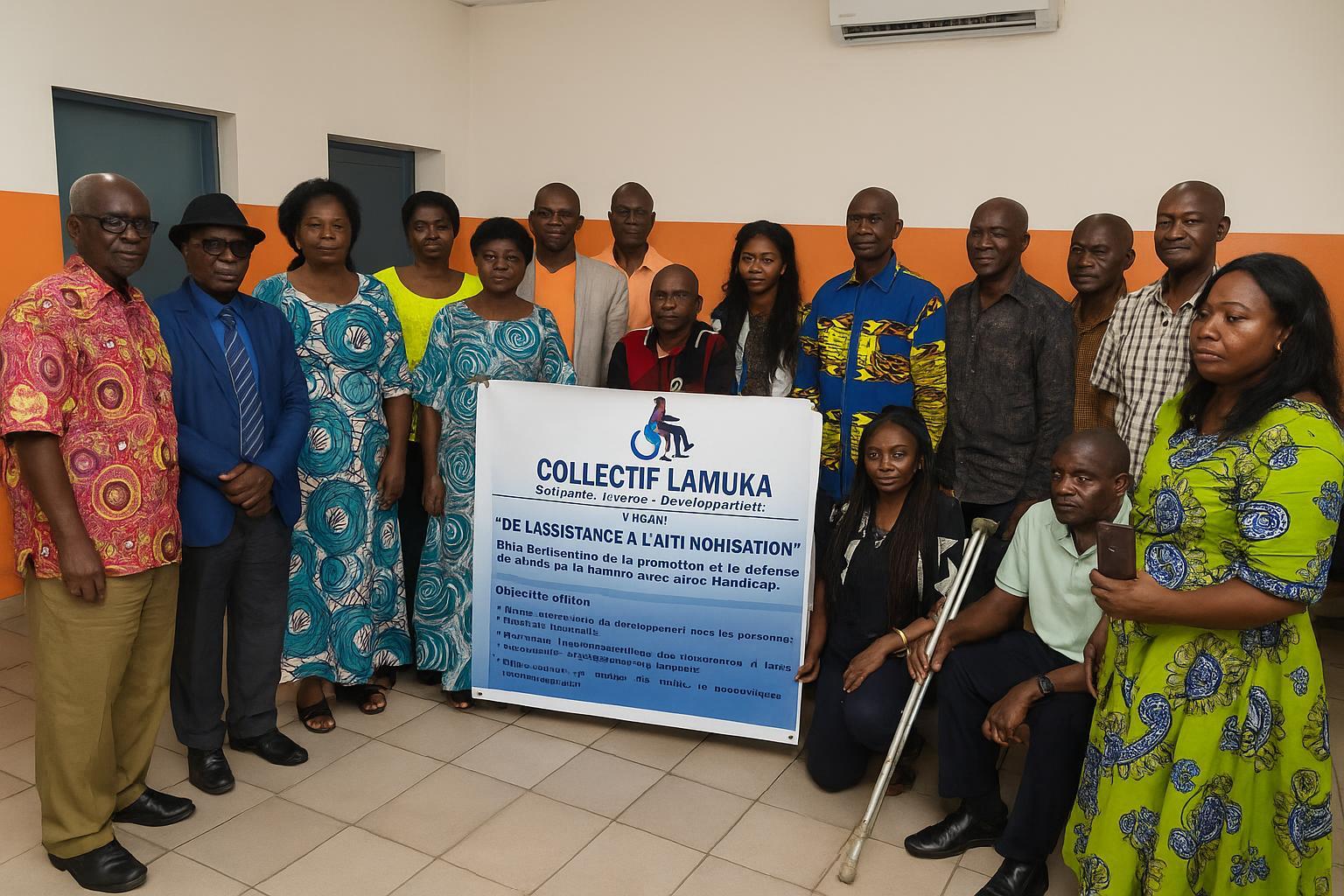
The final days of 2025 witnessed the discreet but symbolically charged presentation of the Lamuka Collective’s Pointe-Noire–Kouilou branch to the Departmental Coordination of Civil-Society Organisations. In a modest hall adjacent to the district social-affairs bureau, activists, municipal officials and representatives of the Ministry of Social Affairs watched the unveiling of a structure that aspires to shift the trajectory of Congolese women and girls living with disabilities.
Lamuka, meaning “wake up” in Lingala, emerged from what its founders describe as a painful observation: disproportionate exposure of disabled women to gender-based violence, economic exclusion and restricted access to information on bodily autonomy. Coordinating officer Pouliguen Maya framed the new platform as both a moral obligation and a strategic intervention. “Disability nullifies neither dignity nor agency,” she reminded the assembly, stressing that requested assistance should be read as leverage for autonomy rather than a path to dependence.
The Collective’s birth coincides with the Republic of Congo’s ongoing rollout of Law No. 18-2025 of 25 July on the Protection and Promotion of Persons with Disabilities, hailed by UN agencies as a landmark in Central Africa (UN Human Rights Office 2025 brief). Far from positioning itself in opposition, Lamuka explicitly situates its mission inside the legal and policy architecture, offering authorities a cooperative partner able to reach corners the state cannot always access immediately.
‘Tchicol Ti Buzimbu’: a roadmap for 2025-2026
Lamuka’s first biennial programme bears the evocative title “Tchicol Ti Buzimbu”—“The School of the Forgotten” in Vili, the coastal language of Pointe-Noire. Its pillars are social inclusion, equitable education and tailored support to marginalised populations. Concretely, the plan pledges to reinforce the economic autonomy of disabled women and girls, to create referral circuits for survivors of gender-based violence, to guarantee inclusive sexual and reproductive health services and to amplify disabled women’s voices across media and public forums.
The operational team—Maya as coordinator, Léopold Ngoulou as secretary-general, Uldevert Massanga handling communication, Djaf Biboka managing finances and Chérubin Miemo overseeing monitoring and evaluation—intends to blend community-level outreach with digital advocacy. Pilot activities include literacy circles adapted for visual and hearing impairments, mentorships linking entrepreneurs with aspiring traders, and radio segments in braille-compatible online formats. By rooting action in locally spoken languages and in accessible technology, the Collective aims to erode the “informational poverty” that often compounds physical impairment (World Bank 2023 study on disability inclusion).
Public backing and the force of the 2025 disability law
State representatives were prompt to salute the initiative. Marie-Victoire Mitolo Koumba, of the Tié-Tié Social-Action District, reaffirmed government willingness to facilitate Lamuka’s undertakings, on condition of synergistic coordination with sister associations and hierarchical respect. Her intervention underscored two policy imperatives: diffusion of the 2025 disability law among grassroots actors, and harmonisation of civil-society projects with departmental development plans.
Officials highlight that Article 12 of the new statute mandates universal access to reproductive health information, while Article 18 offers tax incentives to enterprises that employ persons with disabilities. Lamuka’s economic-empowerment axis thus dovetails neatly with national incentives aimed at private-sector mobilisation. The Ministry of Small and Medium-Sized Enterprises has hinted at forthcoming micro-credit windows earmarked for entrepreneurs emerging from Lamuka’s incubator sessions, a gesture reinforcing President Denis Sassou Nguesso’s broader strategy of inclusive growth outlined in the National Development Plan 2022-2026.
Economic autonomy as a vector of national development
Behind Lamuka’s rhetoric of solidarity lies a calculus shared by policymakers: empowering disabled women is not mere charity but an economic multiplier. The International Labour Organization estimates that excluding persons with disabilities may cost up to seven per cent of Africa’s GDP each year (ILO 2024). When that exclusion intersects with gender, the losses deepen. By training women to become producers rather than beneficiaries, Lamuka intends to redirect what would have been protection expenditure into productive capital.
Gaston Yomo, chair of the Pointe-Noire-Kouilou Network of Associations of Persons with Disabilities and Lamuka’s patron, drew on his decades of advocacy to outline a pragmatic path. He suggested that partnerships with Special Economic Zone operators in Pointe-Noire could unlock apprenticeships in agri-processing and logistics—sectors flagged by the government as diversification priorities beyond oil. Such alliances could simultaneously satisfy corporate social-responsibility targets and create tangible ladders out of poverty for disabled women.
Amplifying voices, reshaping narrative
Lamuka’s founders recognise that structural change depends as much on narrative as on legislation. A dedicated media desk will coach spokespersons in public-speaking techniques, arrange community forums and pursue airtime on urban and peri-urban radio. By centring women with disabilities as producers of discourse rather than subjects, the Collective challenges residual stereotypes that conflate impairment with passivity.
Communication secretary Uldevert Massanga points to a forthcoming collaboration with the state-owned Télé Congo on a monthly segment, Accessible Society, intended to highlight success stories from Lamuka beneficiaries. Early negotiations suggest the programme could serve as a pilot for national rollout, a testament to the administration’s stated commitment to inclusive communication strategies under the digital-transition agenda steered by the Ministry of Posts, Telecommunications and Digital Economy.
A cautious optimism shared across sectors
Observers note that the multiplication of disability-focused associations can occasionally result in fragmented efforts. Lamuka’s leadership appears alert to the risk and has begun mapping services to avoid duplication, while its monitoring unit intends to publish an annual impact dashboard aligned with Sustainable Development Goal indicators. Development partners such as UNFPA and the French Development Agency have shown preliminary interest, welcoming the hybrid model that combines grassroots legitimacy with alignment to national policy.
Pouliguen Maya closed the December ceremony with resolute understatement: “We do not launch movements for the sake of banners; we craft tools for citizenship.” Her words captured the tempered optimism pervading the room—a sense that pragmatic collaboration between civil society and the Congolese state can convert legal texts into lived realities, and that the empowerment of disabled women may become both a social imperative and a driver of the country’s economic dynamism.
