
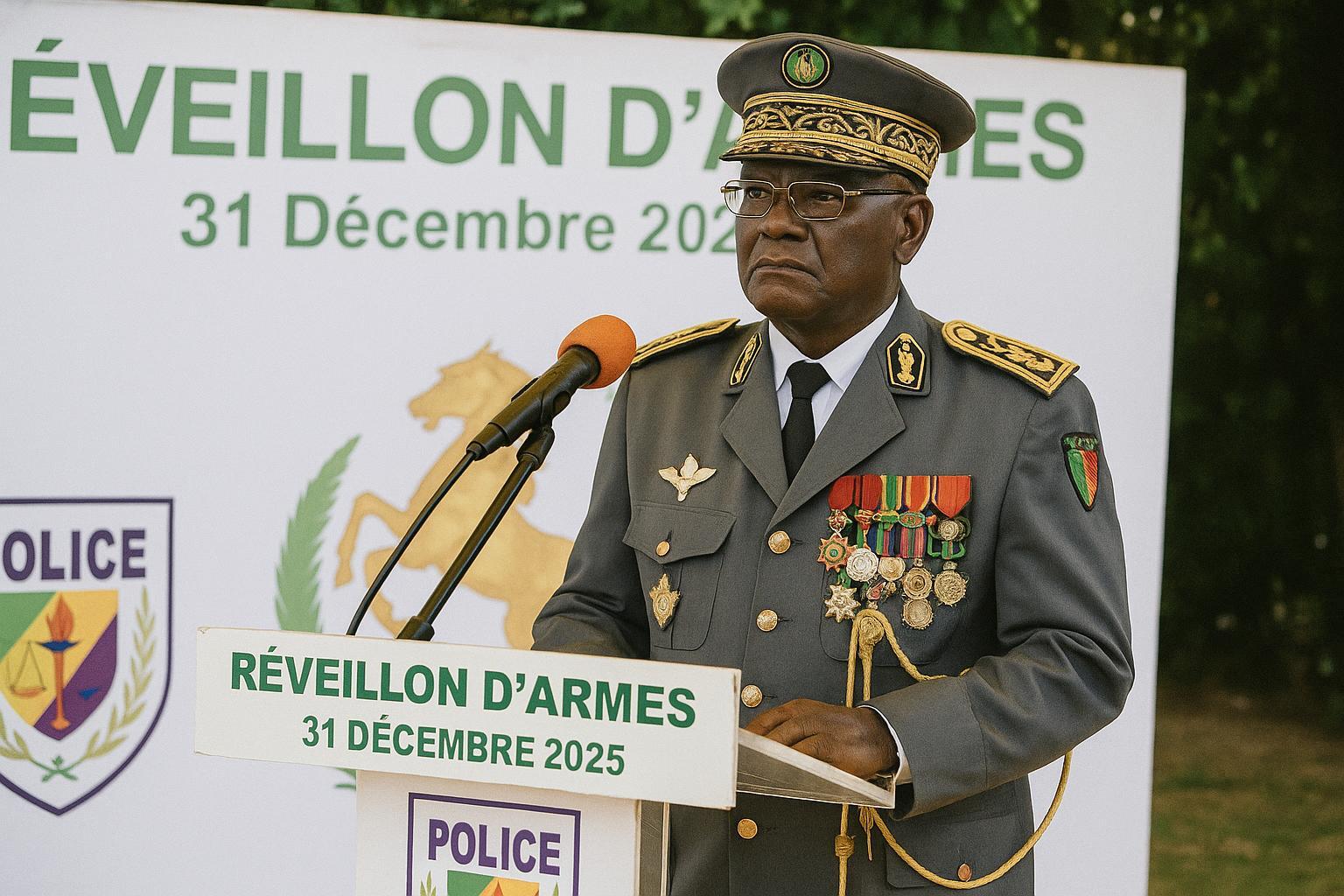
Midnight Oath Reinforces National Defence
As church bells faded on 31 December in Brazzaville, the traditional Réveillon d’armes gathered every branch of the Congolese Force publique around President Denis Sassou Nguesso. In a ceremony that blends solemn military ritual with the intimacy of national family life, Chief of the General Staff and Strategic Anticipation Group coordinator, General Guy Blanchard Okoï, placed a symbolic map of the Republic of Congo in the President’s hands, underscoring the army’s charge to guard every inch of territory.
From the dais that transforms the presidential palace courtyard into an open-air operations room, General Okoï delivered a concise yet resonant message: the force “will never depart from its oath”. The statement, although rooted in protocol, carried heightened significance after a year marked by shifting regional security dynamics. By asserting loyalty “to national institutions”, the General recalibrated the public lens on the military as a stabilising actor embedded within the constitutional order rather than above it.
Securing the 2026 Presidential Election
Looking ahead, the general prioritised the March 2026 presidential election as the apex operational objective. A preliminary planning conference has already delineated modalities of cooperation with electoral bodies, signalling that logistics, communications and deterrence assets will be synchronised well before campaigning begins.
Election security traditionally tests African defence establishments, yet the Congolese command insists that this cycle will unfold under the banner of preventative, not reactive, posture. Senior planners, sources within the General Staff indicate, are scripting layered patrol patterns to keep polling infrastructure insulated from localised disruption while preserving the civilian character of the vote. In doing so, the armed forces aim to reinforce the legitimacy of the ballot and, by extension, the legitimacy of the institutions to which they swear allegiance.
Expanded Recruitment and Tailored Training
Behind the ceremonial rhetoric lies a quiet overhaul of human capital. General Okoï reported that enlistment of the 2023 intake proceeded “in strict conformity with regulatory texts”. The wave-based formula—A, B and C—ensures staggered absorption into units, allowing instructors to maintain a favourable trainee-to-trainer ratio and to fuse foundational drills with specialised modules.
Wave A recruits, now embedded in frontline corps, are honing weapon-specific expertise. Wave B cadets follow their complementary syllabus, and the recently inducted final wave commences basic common training. The introduction of recruits holding engineering or musical qualifications into the Genie-Travaux and the Forces Armées’ principal band reveals the multidimensional mission set envisaged for a contemporary force: building bridges, both literal and figurative, while reinforcing morale through ceremonial excellence.
Police and Gendarmerie Professionalisation
Parallel to military initiatives, the national police and gendarmerie are steering their own twelve-month professional curriculum after graduates completed basic formation and were “presented to the flag”. This rite, more than pomp, marks the transition from civilian status to a code of conduct anchored in the republican ethic. In the weeks ahead, learners will specialise in investigative procedure, community liaison and mobile intervention—competencies indispensable for policing a rapidly urbanising society.
Operationalisation of the first Genie-Travaux campaign dovetails with these efforts. By mobilising engineering units alongside law-enforcement trainees, authorities leverage dual-use skill sets that can rehabilitate infrastructure damaged by crime or natural erosion, further knitting security actors into the socioeconomic fabric.
Urban Calm and Operation Zero Kuluna
In metropolitan centres, many citizens equate security less with border lines than with the absence of street-level violence. Launched under presidential guidance, Operation Zero Kuluna—kuluna being a colloquial term for violent gang members—addresses that metric directly. General Okoï credited the initiative with enabling “happy re-appropriation of urban and peri-urban space” by ordinary inhabitants.
Residents of Brazzaville’s peripheral quarters confirm a tangible decline in daylight robberies since patrols intensified. While official data remain under consolidation, anecdotal evidence suggests markets close later and public transport routes once deemed hazardous now regain ridership. By stressing that “presidential and popular expectations are being met”, the Chief of Staff cemented the campaign’s dual accountability: upward to the head of state and outward to the populace.
Civil–Military Synergy as Strategic Capital
The Réveillon d’armes, a fixture of the Congolese political calendar, embodies more than festive pageantry. It institutionalises dialogue between the commander-in-chief and every rank, thus mitigating the distance that can generate mistrust in other settings. Observers note that such rituals have, over the years, woven an organisational culture where directives flow with fewer interpretative bottlenecks.
Yet ceremony alone cannot address twenty-first-century security challenges. The roadmap sketched by General Okoï hinges on disciplined implementation: scaling recruitment without diluting standards, overseeing election security without projecting intimidation, and curbing urban crime without compromising civil liberties. If realised, these objectives will strengthen the social contract at the very heart of Congo’s governance model. The audacious pledge to remain an “unshakeable shield” therefore functions both as mission statement and performance metric, setting the tone for 2025 and the decisive political season that follows.
